Martin Austermuhle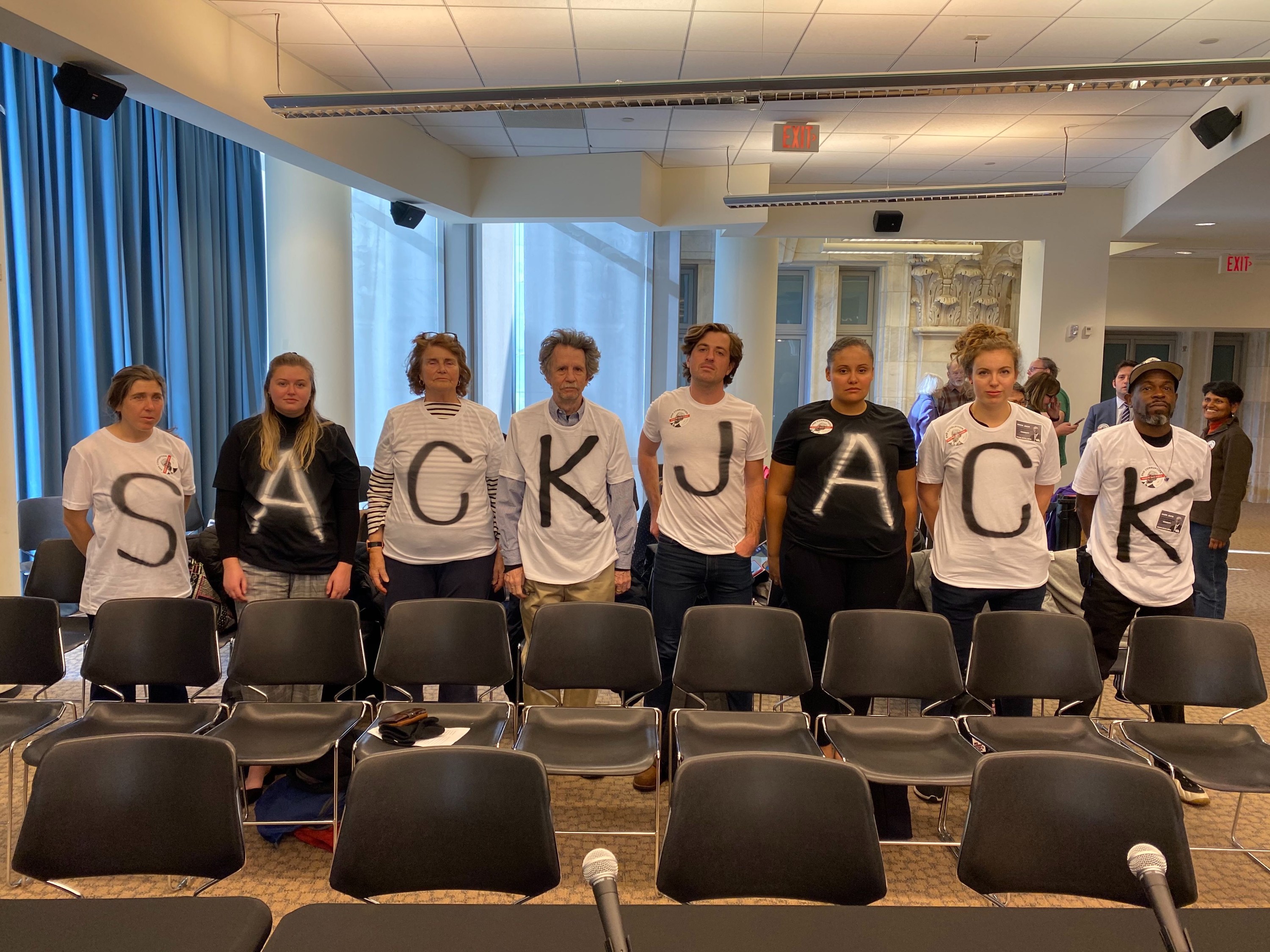
All 12 of Ward 2 Councilmember Jack Evans’ colleagues voted Tuesday to recommend that he be removed from office, the first time the city’s legislature has ever moved to expel one of its own. A final vote to actually expel Evans from office is still required, though, and is expected in mid-January.
The sudden and somewhat unexpected move caps off what has been months of turmoil roiling the Wilson Building, where Evans has served for almost three decades. But the growing body of evidence that he took official actions on behalf of developers and businesses that were paying clients of his consulting firm wore on his colleagues. They spoke angrily and dejectedly on Tuesday afternoon about the scandal engulfing Evans, who was not in attendance at the hearing.
“This is not just about Jack. We all became unwitting co-conspirators to this scheme. We all voted for bills without knowing he was getting paid by clients who would benefit,” said At-large Councilmember Elissa Silverman. “They hired him to be their D.C. government fixer, and he delivered. And he enrolled us too.”
“I was not prepared to vote today,” said Ward 5 Councilmember Kenyan McDuffie. “But ultimately, I think what Mr. Evans has done epitomizes a level of privilege that cannot go unpunished. We’ve already taken some steps to punish him. I see why we’ve gotten to a place where expulsion has to be on the table. I think it’s justifiable by the facts.”
Evans’ office has not replied to a request for comment, and his office was locked and dark after the committee vote.
The Council’s vote represents a low point for Evans in what has been a career in public office that started in the early 1990s, when the city was known as the “murder capital” and would soon enter financial insolvency. Evans styled himself a business-friendly reformer who worked with then-mayor Anthony Williams to right D.C.’s finances, later running unsuccessfully on two occasions for the city’s top office on the message that he had turned D.C. around.
But his decision to keep outside employment with a law firm that included clients with interests in D.C., followed later by a move to create his own consulting firm, led him into a thicket of ethical conflicts that started becoming public over the last 18 months. He took steps to help a digital sign company that had offered to pay him for his services and offer him stock, and was found to have used his public office to pitch law firms on the services he could offer their clients.
An investigation by Metro’s board of directors—where he was serving as chairman—surfaced some of those conflicts, leading to his resignation from the board. And a law firm hired by the council produced a 100-page report last month uncovering even more questionable actions, including moves to support the merger between power companies Pepco and Exelon while he was working for a law firm that represented them both.
Evans insisted that he never intended to break the council’s code of conduct, and that any of the votes he took were not swayed by his paying clients, but rather followed his business-friendly political philosophy. And in a recent letter to the council, Evans’ lawyers insisted that while he may have broken some rules, the fact that he did not intend to meant he should have been spared from being expelled from office.
But that failed to sway any of his colleagues, who expressed frustration that Evans had turned down an opportunity to come speak to them and answer their questions. And they said Tuesday they didn’t believe any other punishment options available to them would serve as adequate punishment for the pattern of ethical misconduct Evans engaged in, which included at least 11 instances over the last five years when he took actions on behalf of his paying clients—clients that were not fully disclosed to the public, according to the D.C. Council investigation.
Evans was reprimanded by the council earlier this year, and stripped of his chairmanship of the council’s powerful finance committee. He was also fined $20,000 by the D.C. Board of Ethics and Government Accountability. But his colleagues said he deserved worse than another reprimand, a censure, or being stripped of all committee assignments. Expulsion would require a vote from 11 members—12 voted during Monday’s committee meeting to recommend it.
“I don’t believe censuring or removing him from committees will be sufficient,” said At-large Councilmember Robert White. “I don’t know how any of us can trust any vote or piece of legislation Mr. Evans will bring before us.”
“I think we have passed the reprimand. Yes we can remove him from all committees, but what does that really say to the public?” said At-large Councilmember Anita Bonds, siding for the first time with the move to expel Evans.
It was in part Bonds’ public support for expulsion that seemed to turn the tide during Monday’s hearing, giving a sense that what little goodwill Evans may have had left among his colleagues had all but disappeared. Bonds has been more reticent than most of her colleagues to publicly criticize Evans.
And that sense fully evaporated once Chairman Phil Mendelson said he would vote to recommend that Evans be expelled. That was followed by another longtime colleague of Evans’.
“In the course of this I saw a number of opportunities given to Mr. Evans to speak and represent why the record wasn’t correct, and I haven’t heard a case being made rising to level that the public trust has not been violated,” said Ward 7 Councilmember Vincent Gray. “I don’t know how if we don’t take this action we can go out and explain what we’ve done. I don’t any more positive action, more definitive action that could be taken.”
After the vote, Mayor Muriel Bowser said she supported the Council’s decision, adding that she thought Evans “made serious mistakes.”
“Throughout this investigation, I have called on the Council to be fair and urgent in their considerations, but to act quickly to regain the public’s trust in the Council as an institution. As a former member of the Council and now Mayor, I stand by them as they make these very difficult decisions,” she said.
In a statement, Mendelson said that he expects the final vote on Evans’ expulsion to come in mid-January.
“It is a sad day when legislators must vote to expel one of their colleagues. And it is very sad for Mr. Evans and his family who never wished this. But when it comes to the reputation of the Council, I have to put principle above friendship and partisanship,” he said. “I expect that the full Council will receive the Ad Hoc Committee’s report on December 17th, will set a hearing for the first week in January, and will vote on expulsion two weeks later.”
Cheh, who chairs the committee, said she thinks the conclusion is clear: Evans will be expelled from the Council.
“The handwriting is on the wall,” she said. “This committee has voted unanimously for expulsion. It seems pretty clear to me that we’re on a course of conduct that will lead to expulsion.”
But even if he does survive expulsion, Evans still faces other political onslaughts he’ll have to fend off. The D.C. Board of Elections is scheduled to decide on Thursday whether an effort to recall him from office can move forward, and Evans is already facing a half-dozen challengers ahead of next June’s Democratic primary—when he has to stand for re-election. He has yet to file his paperwork.
This story has been updated throughout with additional information.