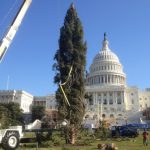
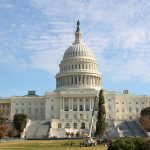
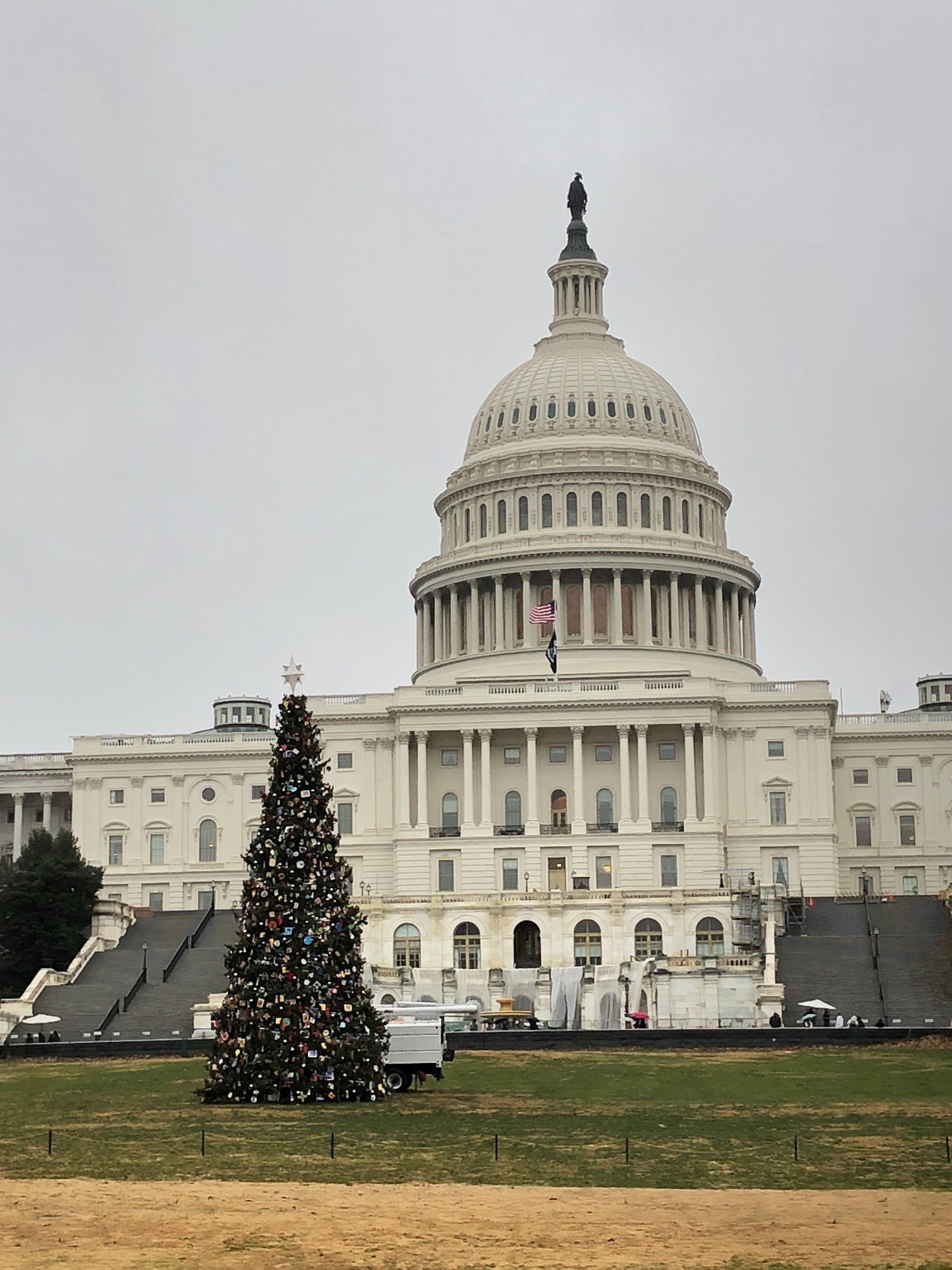
Picking the right Christmas tree is hard. There are many factors to consider: size, shape, durability, color, feel, tree species. Jim Kaufmann, director of the Capitol Grounds and Arboretum, considered all these factors and more when he chose a 60-foot-tall blue spruce (Picea pungens) from New Mexico to furnish the West Lawn of the U.S. Capitol this year.
This year’s holiday season feels like a showcase for the blue spruce species, represented by both the U.S. Capitol Christmas Tree and the National Christmas Tree in the Ellipse south of the White House. These trees, and others on display along the National Mall, require special care in their selection, transportation, and implementation.
The U.S. Capitol Christmas Tree in particular underwent a long journey to get here. Each year, a national forest is chosen, and a team from the U.S. Forest Service determines 12 trees as candidates. Kaufmann then visits to select one of the trees. Last year took him to Willamette National Forest in Oregon; this year he visited Carson National Forest outside Taos, N.M. (Next year the tree will be selected from Colorado).
“I had never been to New Mexico,” says Kaufmann. “When I heard the Christmas tree was being selected there, I thought it was going to be a cactus. I didn’t have a good appreciation for their forests. It was a new and wonderful experience for me.”
Kaufmann says this year’s Capitol tree was chosen over its competitors—mostly spruce and fir—because of its shape, proximity to the road (making it easier to extract from the forest), and its fullness. “It has a 100 percent live crown ratio,” Kaufmann says, meaning it looks full and leafy from all angles, which is important because “the tree is going to be viewed from 360 degrees.”
“You wouldn’t expect to find a tree like this in a forest,” says Vidalia Vigil, public information officer with Carson National Forest.
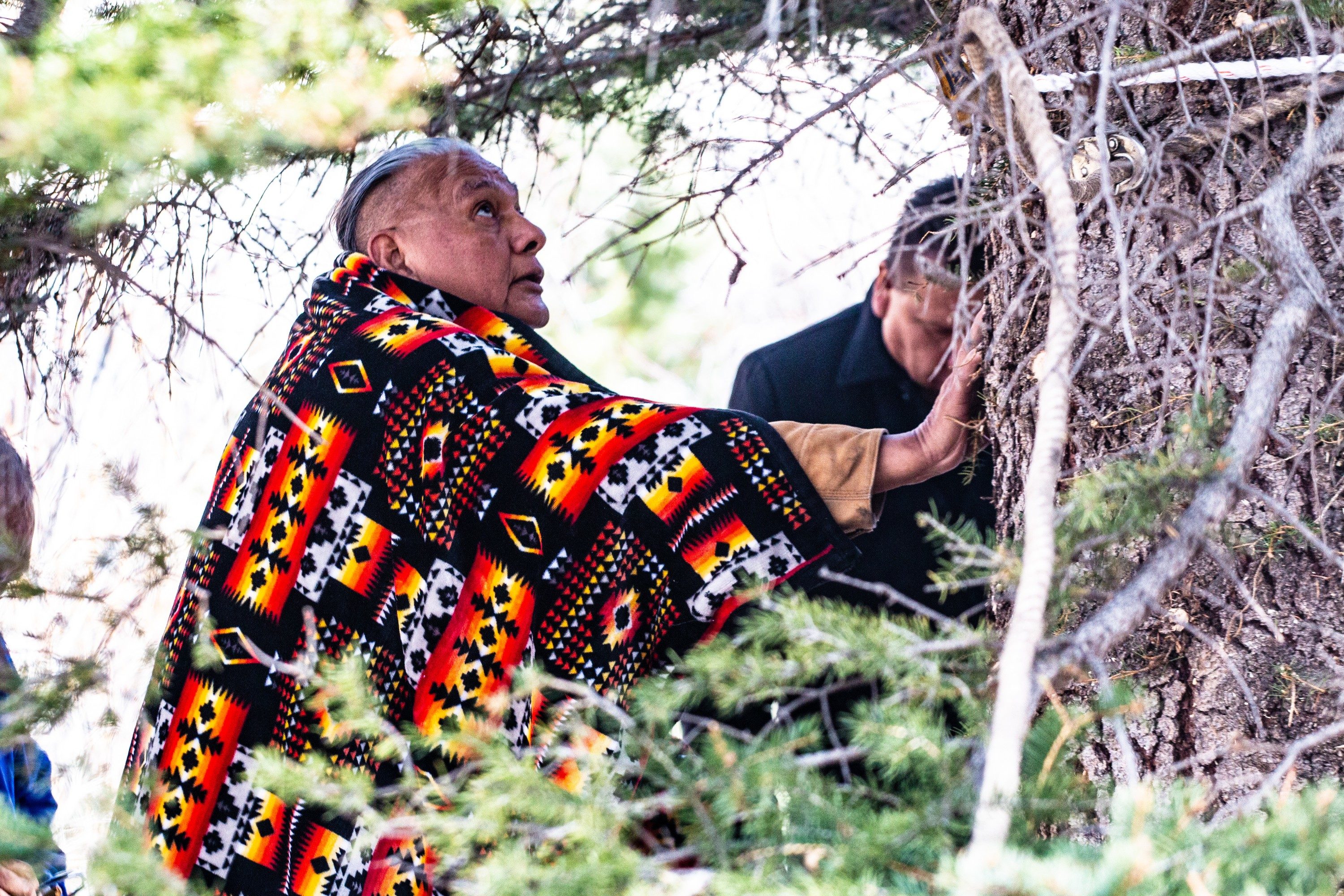
The USFS conducted a special ceremony for the tree’s harvesting on November 6, including a blessing by Picuris Pueblo officials who share nearby land with USFS.
“The U.S. Government, the U.S. Forest Service, and Native Americans haven’t always had the best relationships,” says Vigil, who is Native American herself. “We work together to strengthen those relationships.” Picuris Pueblo elders were invited to bless and thank the tree, according to Vigil. “It’s a sacred, living tree,” Vigil says. “We wanted to do this in a manner that any sacred, living organism deserves.”

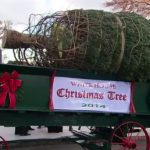
After the tree was harvested, it was carefully wrapped and placed on a custom-built trailer and driven across the country as part of an annual touring tradition. This year it made 28 stops on its way to D.C., and viewing windows were built into the trailer, according to Kaufmann. Visitors on the tour said “they could smell the tree from miles away,” Vigil says.
“It’s not very often that people can see the Capitol Christmas Tree come to town on its way across the country,” Kaufmann says. “It was a chance for New Mexico and its forests to shine, to show where it comes from.”
The tree arrived on November 24 and was set on the lawn using cranes. The blue spruce will be lit by Speaker of the House Nancy Pelosi on Wednesday at 5 p.m.
Kaufmann likes the blue spruce tree for its color, fragrance, and branches. He says its branching pattern allows easy hanging for many ornaments. “The blue spruce also makes a really nice outdoor tree, a good tree to plant live outside,” he says. “It has a light tinge of blue that’s ornamental in the landscape.”
The U.S. Capitol Christmas Tree is a cut tree and will be removed and composted in January, according to Kaufmann. The last time the Architect of the Capitol planted a live tree in the ground was 1991, and coincidentally it was also a blue spruce from Carson National Forest. But Kaufmann says there are challenges to planting a live Christmas tree on the Capitol lawn.
“[The West Lawn] is a permanent First Amendment space,” says Kaufmann, meaning it is important to keep it open and unobstructed for most of the year for events and assemblies. “Also, we’re an arboretum, and we follow cultural landscape plans that are kept in mind when we plant a permanent tree.”
When it comes to the National Christmas Tree on the White House lawn, the National Park Service doesn’t have the same challenges: NPS maintains a permanent live tree there year-round. The National Christmas Tree is only removed and replaced when it becomes sick or significantly damaged.
For example, the longest-running Christmas tree was also a blue spruce that lived in President’s Park from 1978 until October 2011, when wind toppled it. Its replacement in 2011 suffered from transplant shock and was replaced just the next year, according to Katie Liming, a spokesperson for NPS. That tree stood tall until a wind storm knocked off its top in 2014, and then a rogue climber damaged its limbs in 2018, leading NPS to replace it, according to Liming. This year’s blue spruce, planted on October 26, is now the sixth National Christmas Tree since NPS resumed using live trees in 1973, says Liming. It’s a healthy, 30-feet tall tree from Palmyra, Pa., and will be closely monitored for health and longevity.
“We hope this tree is our national Christmas tree for many years to come,” Liming says.
In addition to the live blue spruce, NPS is displaying 56 cut Fraser firs (Abies fraseri), donated by a tree farm in North Carolina, to represent all of the states, districts, and territories of the United States. Each tree will be decorated with ornaments from a school selected to represent its respective state. D.C.’s representative tree will be adorned by Ballou High School students.
It’s not just outdoors: All across the National Mall, Christmas trees are going up in museums and buildings. After two years without a large showcase tree due to building renovations, the U.S. Botanic Garden is displaying a 26-feet tall white fir (Abies concolor) from Garrett County, Md, according to Jim Adams, director of horticulture for the Botanic Garden
Adams says he likes the white fir for the holidays because of its fragrance and color. “It has a bluish-gray instead of the typical olive-green of other Christmas trees,” he says. “And it holds up exceptionally well when it’s cut and keeps its needles.”
In addition to the large white fir, the U.S. Botanic Garden will also display several cut trees on its terrace, including Fraser firs and Douglas firs (Pseudotsuga menziesii). Both Adams and Kaufmann say the Douglas fir makes a great Christmas tree because of its texture and softer needles, even if it isn’t a true fir.
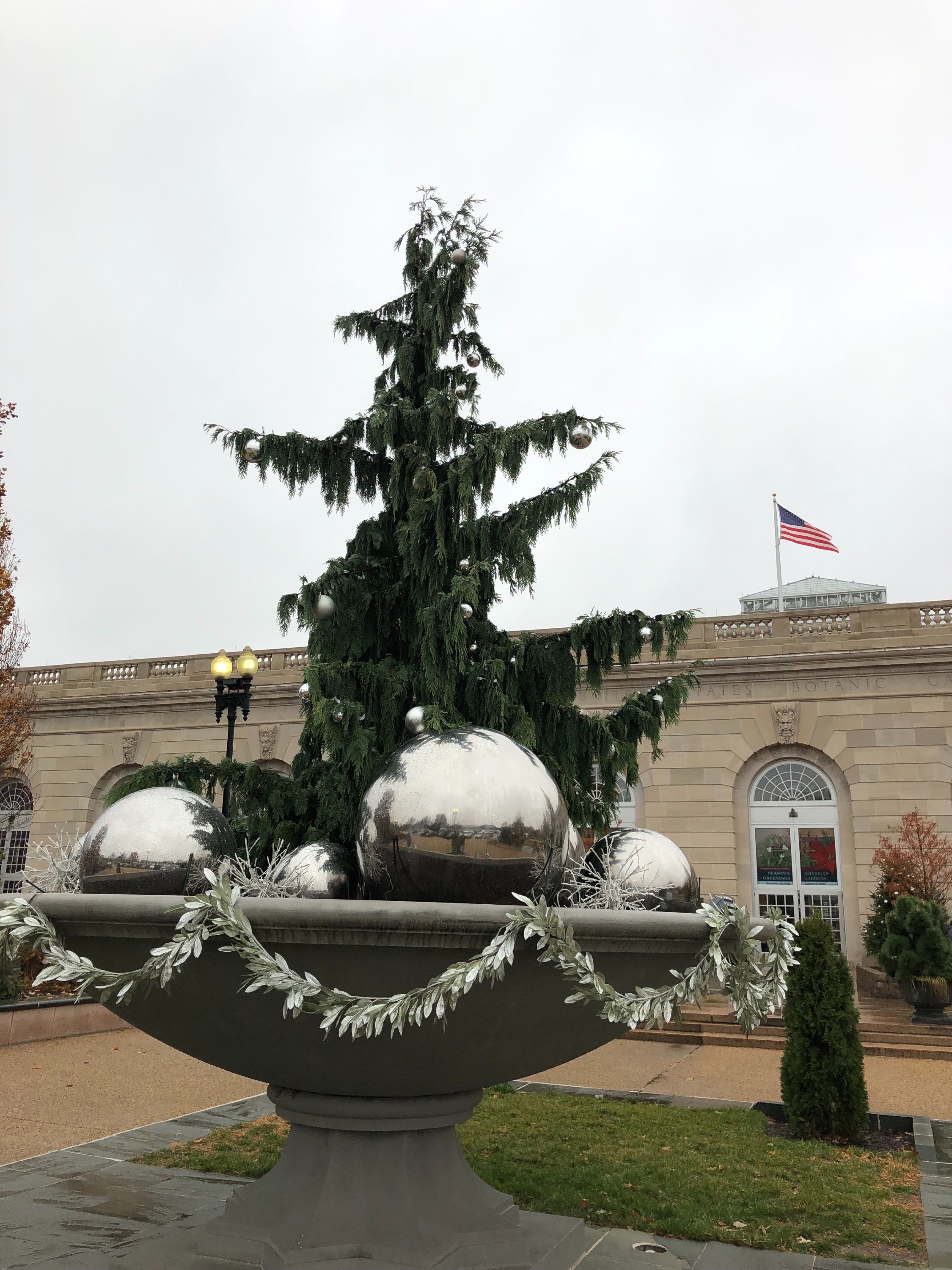
And then there’s a more unlikely holiday tree. In the middle of the terrace is a weeping Alaskan yellow-cedar (Cupressus nootkatensis “Pendula”), hung with silver orbs and ornaments around the corner from the U.S. Capitol Christmas Tree. It is shorter, drooping, and less full than other holiday trees near the National Mall, but it’s remarkable anyway, dressed lightly for the season. Together, this year’s trees remind us that the real stars of the show are not the ornaments but the trees upholding the show.
The U.S. Capitol Tree will be lit December 4 at 5 p.m. It will be lit each evening until 11 p.m. through January 1.
The National Christmas Tree will be lit by the first family on December 5 in a ticketed event. The Ellipse will reopen December 9 for all visitors through January 1.
The U.S Botanic Garden will be open during regular hours and also select evenings for their holiday concert series.
This post has been updated to clarify that USBG has been without a large showcase tree for two years.
There’s No Paywall Here
DCist is supported by a community of members … readers just like you. So if you love the local news and stories you find here, don’t let it disappear!