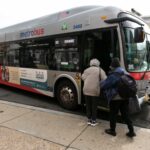
There might be some temporary relief on the horizon for the District’s most vulnerable residents who take public transportation, as the Metro board mulls over a proposal to cut fares or provide free transit.
In a report called “D.C. Low-Income Fare Pilot” released Monday, Metro’s Finance and Capital Committee argues that lowering the cost of transit for riders who receive existing government benefits will increase their mobility and quality of life. If approved, the pilot program for up to 2,500 residents will last six to nine months. Participants will be split into three groups:
- Some will get a SmarTrip card providing free and unlimited transit
- Some will receive a card providing discounted use
- Some, as part of a control group, won’t get any benefits because their card will have no value
“Low-income households are the most likely to be burdened by the costs of using public transit, the most likely to forego using transit due to cost, and the least likely to have alternative travel options,” the document explains.
Metro does offer some discounts. Seniors and people with disabilities pay $1 for regular Metrobus routes instead of the standard $2. And students going to school get free rides on Metrobus, DC Circulator, and Metrorail within the District.
New York offers discounted train and bus rides to low-income riders. Kansas City recently eliminated fares on its public transportation. And Chicago is considering its own reduced-fare proposal. But despite Washington’s high cost of living, there’s no program here focused on helping low-income residents pay transit fares.
“We are going to have the conversation at Metro. Let’s just put it that way. It is going to be something that’s on the agenda. I get to say so with confidence,” Christian Dorsey, a Metro board member and chair of the Arlington County board told WAMU last month. At the time, such a plan was not being discussed publicly.
“A reduced fare product for low-income District residents would make transit more accessible and complement Metro’s existing discounts for students, seniors, and people with disabilities,” Paul Wiedefeld, Metro general manager and CEO, said in a statement. “From the earliest stages, Metro has supported The Lab @ DC’s grant application to get this program off the ground and, pending Board approval, we stand ready to help expand access to more members of our community.”
Addressing The Need For Lower Fares
According to the Metro report, ridership and survey data shows that over 65 percent of the highest-income Metrorail customers receive an additional transit subsidy through employer-sponsored programs. Meanwhile, only 10 percent of Metro’s lowest-income rail customers receive similar subsidies through work. Low-income riders often limit transit use due to cost and spend more than twice as much of their after-tax income on transit as riders who are not low-income.
Each year in the District, low-income residents take approximately 31 million Metrobus trips and 11 million Metrorail trips. With much of the D.C. region accessible via Metrorail, this disproportionate use of bus is likely due to the higher cost of rail.
Already, it can be confusing to figure out how much a trip will cost and to budget accordingly. While Metrobus fares are steady—$2 for regular routes and $4.25 for express—Metrorail fares vary by time of day and the distance between stations.
Wiedefeld is proposing a budget for the coming fiscal year that would increase peak fares, offer a flat weekend fare of $2, and expand late-night service for the first time since 2016. The plan would also make transfers between bus and rail free, instead of the current $1.50.
How Would The Pilot Work?
To evaluate the potential benefits and effectiveness of subsidizing transit fares for low-income residents, the D.C. government would use a “randomized control trial” to test the three fare options.
The pilot program enrollment will be administered through an existing social services program administered by the District. Additional support for the program, including research and analysis, will be provided by The Lab @ DC. For this low-income fare pilot, the District would enter a fare buydown agreement with Metro to fund the fare revenue losses associated with the pilot program.
According to the Metro report, the program would be easy for participants to understand, with the benefits and eligibility criteria consistent across the region and use of the SmarTrip card quite simple.
The proposal will be presented to the board on Thursday.
If the pilot program happens, D.C. and Metro will evaluate the mobility and welfare benefits gained by the two groups receiving free or discounted transit trips. They will measure how more affordable transit options improve participants’ economic and social well-being. Other potential benefits to Metro, such as increased ridership and reduced fare evasion, will also be studied.
“Additionally, analysis of this pilot could also inform any low-income fare initiatives that other funding jurisdictions may choose to explore,” the report states.
This story originally appeared on WAMU.