Matt Blitz
The hard, ping-pong-sized blue ball smacks off the wall with a thwack and rockets back towards Leslie Connolly. With a swift wrist fling, racket meets ball as it zips towards the wall again. In a blink of an eye, the speeding blue dot is back and Connolly is there for another swing.
We are in Vienna, Virginia for some Saturday morning squash. The indoor racket sport is rising in popularity, both in the United States and the D.C-area. Squash participation in the country has grown by nearly a third over the last three years, according to one metric. Today, Connolly estimates that there are about 40 squash courts across the region.
As evidence of this growth, for the first time in the sport’s history, a world championship tournament is being played on U.S. soil. Appropriately, it’s being held in the nation’s capital at two-and-a-half-year-old Squash on Fire on M Street Northwest from December 15th through the 21st.
Connolly is the president of National Capital Squash, which is one of the tournament’s sponsors. When we talk, she is running through drills at Vienna’s Play Squash Academy, intermittently perfecting her swing and explaining the sport’s nuances. It’s different than racquetball, she explains in between whacks, in that the squash is more about precision and movement than swinging hard. It’s unlike tennis because there’s little wasted time chasing a ball after each point.
“I was a tennis player,” says Connolly. “But after playing squash for the first time, I said ‘I’ll never play tennis again.’”

The rules of squash are simple. The sport is played on a rectangular indoor box court that has smaller dimensions than both tennis and racquetball, with a hard rubber ball (which becomes bouncy only when warmed) and a racket more elongated than one used for tennis. Games are played to 11 points, and players alternate hitting the ball back against the wall. A point is scored when either the ball bounces twice on the floor before being returned or is called out, meaning it hits the wall below the “tin” or above the “out” lines.
“It’s a really easy game to learn,” says Christopher Gordon, a veteran professional squash player who will be competing for the United States at this month’s Men’s World Squash Team Championship. “You are hitting a ball against a wall, so the actual concept isn’t that difficult.”
But it’s a fast, unrelenting, claustrophobic, and exhausting sport that requires great hand-eye coordination, good lateral quickness, and solid conditioning. It’s so demanding that even professionals are often huffing and puffing after 20-second-long rallies.
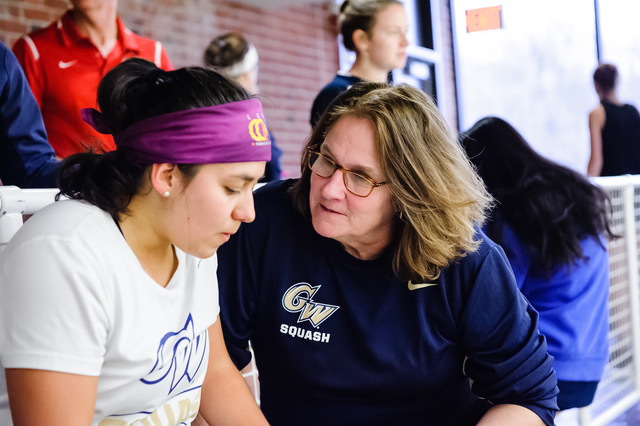
“There’s an expression my college coach used to use,” says Wendy Lawrence, the now-retired long-time coach of both the women’s and men’s squash teams at George Washington University. “You get in shape to play squash. You don’t play squash to get in shape.”
Squash was probably first invented in a notorious London debtor’s prison as a game one could play alone with a ball made of wound cloth and a stretched tennis racket. By the mid-19th century, it had spread to the schoolyards and became popular with England’s youth. It sailed across the Atlantic in the early 20th century, particularly into northern cities where harsh winters called for indoor sports. Squash also moved with the British empire, becoming a pastime for those countries under colonial rule in the 19th and early 20th centuries like India, Pakistan, South Africa, and Egypt.
For many years here in the U.S., squash was mostly sequestered in northern elite schools. America’s first courts were at an exclusive all-boys school in New Hampshire, and it was in the country clubs of Philadelphia where the game became popular in the United States. For decades, teams from Harvard, Yale, and Princeton dominated the collegiate ranks.
The shift, according to Lawrence, happened in the 1970s when more and more New England-area boarding schools went co-ed. “That opened up the game to a lot of women,” she says. “I think that’s been a large part of [squash’s] growth.”
According to U.S. Squash, in the last decade, women’s participation in the sport has doubled. This also appears to be true internationally. “The best women in the world, they come from Malaysia, Egypt, India … places that are not typically powerhouses for women athletics,” says Connelly. In a year where pay equity in sports has been top of mind, the women’s world squash champion will win more money than her male counterpart in 2019.
Some kids are getting involved because of the notion that squash can open doors during the college admissions process. The sport “is seen by a lot of parents as an entrée into … the more elite colleges in the country,” says Lawrence, who saw this while recruiting during her tenure as GW’s coach. “If you look at the top 25 ranked colleges, eight of them are Ivy League … arguably, the most selective colleges in the country.”
Philippe Lanier says it was his sister, Camille, who inspired him and their father, prominent D.C. developer Anthony Lanier, to open Squash on Fire in May 2017.
“My little sister was a champion and, at one point, she was number two or three in the U.S. as a junior,” says the younger Lanier. “She would have been an Olympic contender if it were an Olympic sport.”
He says traveling with his sister around the world for squash tournaments made his family realize how much the U.S. was lacking in squash infrastructure and how courts were not particularly accessible. The key, says Lanier, is creating courts and clubs that do not require a membership. Hence, the pay-as-you-go structure of Squash on Fire (named as such due to its location above the West End Fire Station).
The 19,700 square foot facility and the buildout didn’t come cheaply—it cost $20 million, about four times the initial budget. “We overspent on this building and went over the top,” Lanier says.
But, according to Lanier, Squash on Fire has so far achieved what they had hoped. He says they have around 1,500 players who come to the facility at least once a month and, on average, are getting 180 to 200 new players each month. And the club is profitable, Lanier says, while using a business model intended to make squash more accessible: “Taking away the concept of membership and elitism from it and making it everyone’s favorite sport is a key goal of Squash on Fire,” he says.

About a month after Squash on Fire opened, the facility was approached by the World Squash Federation to host the 2019 Men’s World Squash Team Championship. It was a combination of the governing body wanting to host the tournament in the U.S. and the new state-of-the-art squash facility opening in the nation’s capital that made Squash on Fire the choice, according to Lanier.
“It’s a financial commitment, but we said we will take the risk … and do the work to bring in sponsors, the audience, and make this a real hit,” Lanier says. He expects about 4,000 people to attend over the seven-day tournament. The favorite to win the tournament is Egypt, a traditional powerhouse team that features the top four players in the world.
It’s getting closer to mid-day on Saturday in Vienna and, besides Connelly, there are people of varying ages, genders, and abilities playing on the courts.
Connelly says this is one of her favorite things about squash: that it’s for everyone. “Women and men play on the same court with the same rules and equipment,” says Connelly.
Wendy Lawrence agrees. She may be retired from coaching, but still plays squash twice a week.
“It’s a lifelong sport,” says Lawrence. “Squash isn’t about brute strength. It’s a lot of finesse and conditioning. I’m 66 now, but I don’t think about stopping.”
There’s No Paywall Here
DCist is supported by a community of members … readers just like you. So if you love the local news and stories you find here, don’t let it disappear!