Rachel Kurzius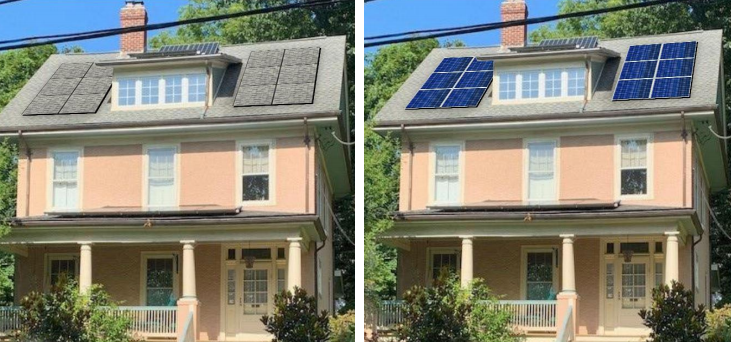
It seems that the third time’s a charm for Steve Preister, the Takoma resident who has now come before the D.C. Historic Preservation Review Board on three separate occasions to seek approvals for the solar panels he wants to install on the front of his home in a historic district.
His application has come to represent the push and pull between conserving the environment and preserving historic buildings.
“I kind of feel like I know you now and you guys know me,” Preister told the five members of the nine-person board in attendance at Thursday’s monthly meeting. Because Preister lives in one of D.C.’s 37 historic districts, he had to go through an additional bureaucratic process before doing any new construction or alteration to his home to ensure that his changes are “compatible with the historic character” of the neighborhood.
Over the past decade, the board has evolved from opposing all visible solar panels in historic neighborhoods to allowing for the possibility that some could be compatible. This new perspective was made official on Thursday, when the board approved a set of new sustainability guidelines to help property owners figure out how best to ensure their historic buildings are energy efficient.
At the same meeting, the board unanimously approved Preister’s modified application, which will allow for a dozen solar panels on his main front-facing roof. (He already has board-approved panels elsewhere on his home, but says that the best, brightest sun hits his front roof.) Preister described his mood after the decision as “elated.”
The biggest difference between this version of Preister’s application and previous ones is the addition of what’s often called a solar “sleeve” or “skin”—a product applied on top of the panel that changes its color to help it blend in better on a roof.
But these don’t come cheap. Suhaib Hassan of Sol Energi, who worked with Preister on his solar panels, said that the sleeve modifications cost about 10 percent more and have a reduced efficiency, so he’ll get fewer solar renewable energy credits.
Still, Preister has made clear throughout this years-long process that he’s not motivated by the money. He’s concerned about climate change, and wants to do his part to help. “Species are dying,” he says.
Much of the criticism over the board’s decision to reject Preister’s application in October was centered around concerns over the impact of climate change, and the existential question of whether anything else matters in the face of rising tides and temperatures. “Disappointing,” Tommy Wells, the director of the District Department of Energy and the Environment, wrote on Twitter. “Waiting for the next generation of appointees…”
Wells’ agency has been partnering with the Historic Preservation Office on the sustainability guidelines, which were initially inspired by the question of front-facing solar panels at a home in the Cleveland Park historic district. They’ve been going through a series of edits and updates for about a decade, and were further revised amid the D.C. Council’s passage of climate legislation that requires the city to transition to 100 percent renewable energy by 2032, with 10 percent from local solar sources.
Solar panels are a small part of the 70-page guidelines, which HPO deputy preservation officer Steve Callcott says are intended to be a “useful guide … It’s not to have people think, ‘I put solar on my roof and I’m done,’ but to think about their buildings” in a more holistic way. But the question of visible solar panels is by far the one that’s caused the biggest stir.
Loretta Neuman, a resident of Takoma, said in her testimony that she cared “passionately about historic preservation, because once you destroy or lose a place, it’s gone forever.” She was perplexed at how her neighborhood became “the poster child” for the solar issue, “as if we’re somehow going to save the city, save the planet, because we could have more solar houses.”
Two distinct perspectives emerged about the guidelines: one, from groups like the D.C. Preservation League and the Committee of 100 on the Federal City, centered around concern that the document was trying to do too much and needed more work before passage; meanwhile, environmental groups and solar advocates worried that the guidelines didn’t go far enough.
“Unfortunately, the Historic Preservation Review Board has not been an ally in the fight against climate change,” said Mark Rodeffer, the chair of the Sierra Club D.C. Chapter, in testimony before the board on Thursday. “You have repeatedly denied applications for solar panels in historic districts, in one case with an HPRB member stating that the ‘desire to save the planet’ is laudable but less important than members of this panel being ‘upset’ at seeing solar panels on row houses.”
According to numbers provided to DCist by Callcott, the Historic Preservation Office has approved more than 1,400 solar applications from 2009-2019. The board itself only hears the controversial cases, like visible solar, and their rulings help guide staffers for future cases. But Preister and others going through the process say that all of the layers of bureaucracy scare away people who would otherwise be interested in solar panels.
Georgetown resident Carole Lewis Anderson spent three years trying to get solar panels on her home (she was also dealing with a homeowners association and other roadblocks). She said that she walks through historic districts and sees HVAC systems, cable wires, and satellite dishes, “yet I have to fight for three years to get solar panels. We have a climate crisis and yet we still make it very difficult to receive free, clean energy of the sun … We need a new look at preservation—shouldn’t it first apply to the planet?”
Erin Palmer and Geoff Bromaghim, two Advisory Neighborhood Commissioners for Preister’s neighborhood, helped pass a resolution at their ANC which called on the board to consider solar panels like it does gas meters or other modern amenities.
“Historic districts aren’t parks—we don’t live in Jamestown,” said Bromaghim, who wants the board to provide guidance to help people in historic districts learn how they can successfully apply for solar panels. “Saying that panels should not be prominently visible sort of implies that the panels are unattractive—that’s a notion we reject.”
Rodeffer agrees. “To me, the biggest philosophical problem is that [the board is] treating solar panels like they’re bad: ‘If you have them, they need to be hidden, no one can see them,'” he tells DCist after the vote. “We think we need to be expanding solar, and when people put up solar panels and their neighbors see it and they see it, and they see that they’re generating electricity and the electricity is free, then they say, ‘hey, I want some solar panels, too.'”
But board member Chris Landis, who says that he is an advocate of solar with his own solar installation, said that the question about visible solar panels has led to confusion about the role of the Historic Preservation Review Board. “We are the guardians of the historic character and fabric of the neighborhood,” he said. “If solar trumps everything, do we take out the heritage trees?”
As board member Andrew Aurbach, the only member of the board who voted in favor of Preister’s October application, noted, the board and HPO staffers are compelled to comply with the city’s overarching preservation law. The idea moving forward is that the board will continue to decide on cases involving visible solar for now, until the staff can get an “understanding of where the board is,” said Aurbach.
Board chair Marnique Heath emphasized that historic preservation and sustainability need not be in conflict. In the end, all five members present voted in favor of the sustainability guidelines.
Then, it was time to preview Preister’s latest application. Callcott explained that the staff was in favor of his modifications. During testimony, Neumann and another Takoma neighbor, Sara Green, came forward, as did Palmer.
It was clear that Palmer would be in favor of Preister’s application—she helped him submit it. But both Neumann and Green had spoken out against Preister’s application in October. This time, though, they weren’t going to oppose it.
Neumann, who had sold Preister the home 35 years ago, said that she believes his home will be a good test of the solar skins. “If it doesn’t work, we’ll just live with it,” she said. “But I’m hoping it works.”
Preister says that “when I walked into the meeting room today and I saw them, I thought, ‘Oh, I’m gonna get it again.” But instead, Neumann told him that she wouldn’t oppose the solar panels. “It was just a wonderful feeling,” he says.
But he’s still pushing for the board and the Historic Preservation Office to provide technical assistance to homeowners looking for guidance on solar.
The process has taken so long for Preister that he missed a deadline for tax credits. “I don’t think it has to take this long,” he says. “I had to be one of the first through the gate and I think it will go much quicker now. I hope so, because we don’t have that much time.”
Previously:
After Hullabaloo, New Proposal Would Allow Some Visible Solar Panels In D.C.’s Historic Districts
Should Historic Homes Be Allowed To Add Visible Solar Panels? A Rare Solar Panel Denial Hinged On The Question
There’s No Paywall Here
DCist is supported by a community of members … readers just like you. So if you love the local news and stories you find here, don’t let it disappear!