Matt Blitz
It’s a tiny brownish speck inside of an ornate, gold statue, so small that it can barely be seen. The only identification is a small tag with neatly typed Latin words “s. Nicolai Ep.”
While seemingly inconsequential, this tiny dot is apparently from a 1700-year-old saint that has since become the inspiration for a certain jolly, bearded big guy in a red suit. “It’s a bone fragment of St. Nicholas, authenticated by the Church office in Rome that authenticates relics,” says Father Deacon Elmer Pekarik of Annandale, Va.’s Epiphany of Our Lord Byzantine Catholic Church. “We are the stewards of this relic.”
Yes, Virginia, Santa Claus’ bone is in Annandale.
It’s sort of a mystery of how St Nicholas’s bone fragment, a first-class relic, ended up in this Byzantine Catholic Church in a Northern Virginia suburb. According to the St. Nicholas Center, there are 11 other churches in the United States that have pieces of the saint.
The Epiphany of Our Lord says that they don’t know the exact details of how they acquired it, beyond that it was donated sometime between 1973 and 2011. The parish also has a vial of “manna,” a sweet-smelling, mysterious liquid that is thought to have exuded from the tomb of St. Nicholas. That relic is only brought out occasionally for a liturgical service and was kept behind closed doors on the evening DCist visited.
What is clear is that it’s a pretty big deal that a piece of St. Nicholas, who is the Byzantine Church’s patron saint and believed to be the inspiration for Santa Claus, is right here in the D.C. area. “Not all Byzantine Churches have relics of St. Nicholas. We were fortunate to get it,” says Pekarik. “It’s a very good thing.” The Annandale parish is only one of two Byzantine Catholic Churches in the U.S. (there are 207 total) to have relics of St. Nicholas.
It’s thought that the man who would become known as Saint Nicholas was born in the city of Myra on the southwest coast of modern-day Turkey around the year 280. His parents died of malaria when he was young, but they left him a sizable inheritance. Rather than squander it, he used it to help others. There’s a story of him providing dowries for three poor sisters whose father was about to sell them into prostitution. There’s another rather morbid tale of St. Nicholas bringing three boys back to life whom an evil innkeeper had murdered, dismembered, and threw into a pickling barrel.
“He was a widely popular saint during the Middle Ages … known for some really wonderful characteristics,” says Rev. Michael Witczak, associate professor of liturgical studies at Catholic University, “Generosity was one of them, but he was also known as a miracle worker.”
When he died on December 6, 343, Nicholas of Myra was recognized as a saint and eventually laid to rest in a church named after him in his hometown. Though it was thought that 11th century sailors raided the church in Turkey and stole the bones, that theory was debunked in 2017, when Turkish archaeologists discovered the bones in their original burial place in the ancient city of Myra.
Witczak says that during the Middle Ages, tombs of popular saints like St. Nicholas were sort of ancient tourist attractions. “People would make pilgrimages to where [saints] were buried … to ask for help, give thanks, and hope to [see] a miracle be performed.”
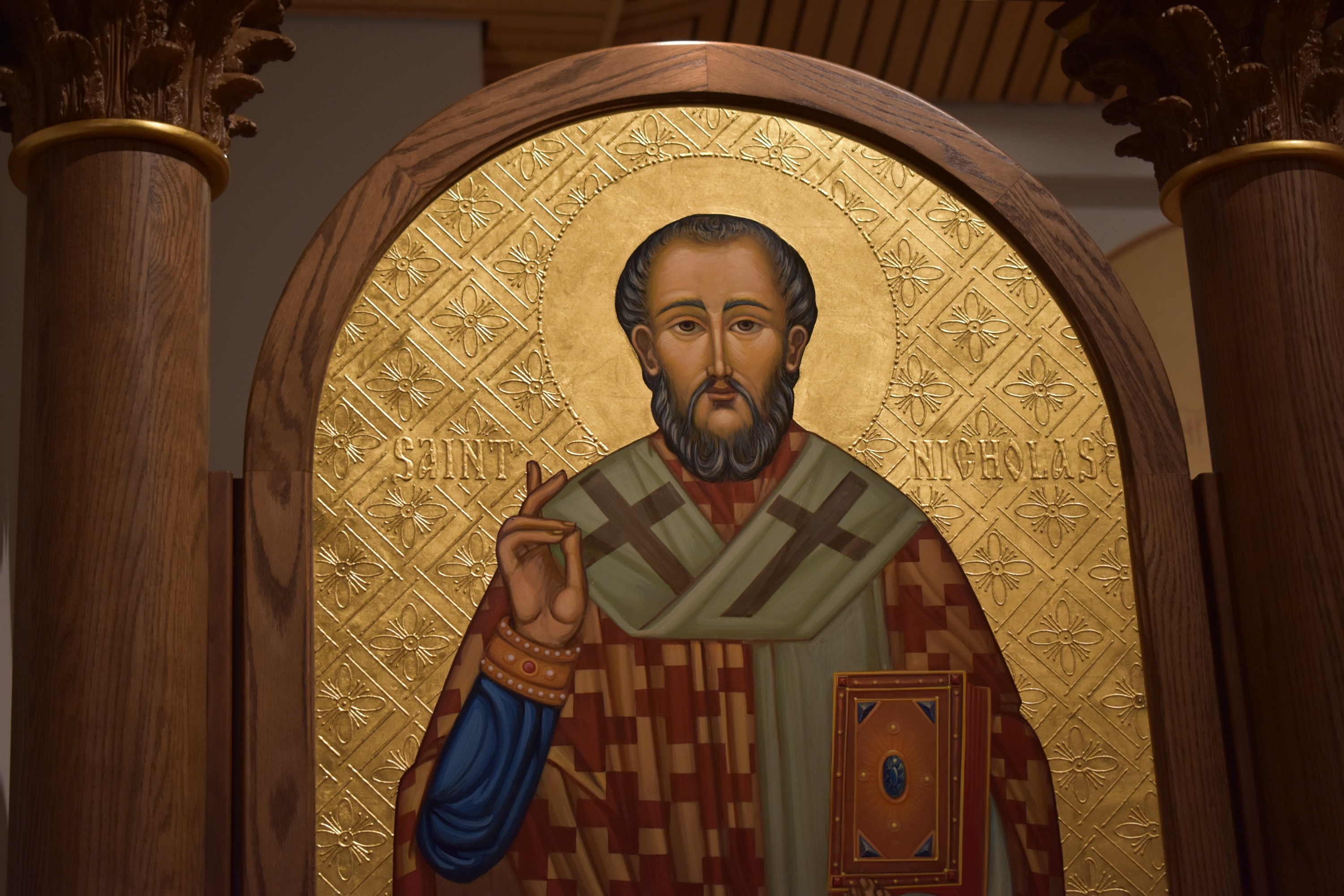
As the years went on, though, and the Catholic Church began to extend its reach, people got tired of traveling far distances to see their saints. So they began taking saints’ bones, or relics, back home with them.
“As you can imagine, the Church wasn’t too happy about this,” says Witczak. “There are stories of people breaking into a church at night … and taking a part of the saint.” It wasn’t until the 16th century that the Catholic Church began to formalize the concept of relics. There are now three classes of relics, ranging from pieces of the corpse itself (first class) to an item that the corpse touched (third class).
In 2017, the Vatican updated its authentication practices and rules to stop the fraudulent sale of relics, a longtime issue for the Church. Relics obtained in the years before the Vatican beefed up its rules are harder to authenticate.
“The problem with [relics of an] ancient saints like St. Nicholas is that there’s no chain of custody,” says Witczak.
Relics of saints are an important part of Catholicism, found in nearly every Catholic Church worldwide. Some relics are used to sanctify altars. “To sanctify means not just to bless it, but set it apart for its intended use,” says Pekarik. “We can’t have the liturgy served on the altar today, and tomorrow, use it as a table for cutting bread.”
At other parishes, including Epiphany of Our Lord, relics are available for veneration. “Saints are models on how to live our own lives,” says Pekarik. “So anything that was a part of them [like a bone fragment] is worth venerating.”
In this particular case, since St. Nicholas is the Byzantine Church’s patron saint, his relic is kept in a special container called a reliquary so it can be carried around to the congregation. “The priest holds [the reliquary] up and people come kiss it” says Pekarik. “And, for cleanliness, he’ll have a cloth with alcohol on it to wipe it down.”
Epiphany of Our Lord also celebrates the feast of St. Nicholas on December 6, which includes liturgy, Holy Communion, and veneration of the relic. Afterward, for the children, St. Nicholas makes an appearance. “It’s an honor to be St. Nicholas,” says Pekarik. ”Whoever that person is, the kids don’t recognize him. He may be their dad, but he’s dressed as St. Nicholas.”
The Saint Nicholas that appears at Epiphany of Our Lord is dressed in the garb he might have worn during his lifetime—not at all like the Americanized version who visits on December 25. His reputation as a jolly bringer of gifts traces back to the Middle Ages when St. Nicholas—the patron saint of children—was beloved for bringing gifts to youngsters who said their prayers. The Dutch were particular celebrators of the saint, whom they called “Sinterklaas.” In the 17th century, mass Dutch immigration to the continent across the Atlantic brought Sinterklaas to America. “[Sinterklass] gets transmogrified into Santa Claus by English speakers,” says Witczak. “It’s a corruption of the Dutch nickname for St. Nicholas.”
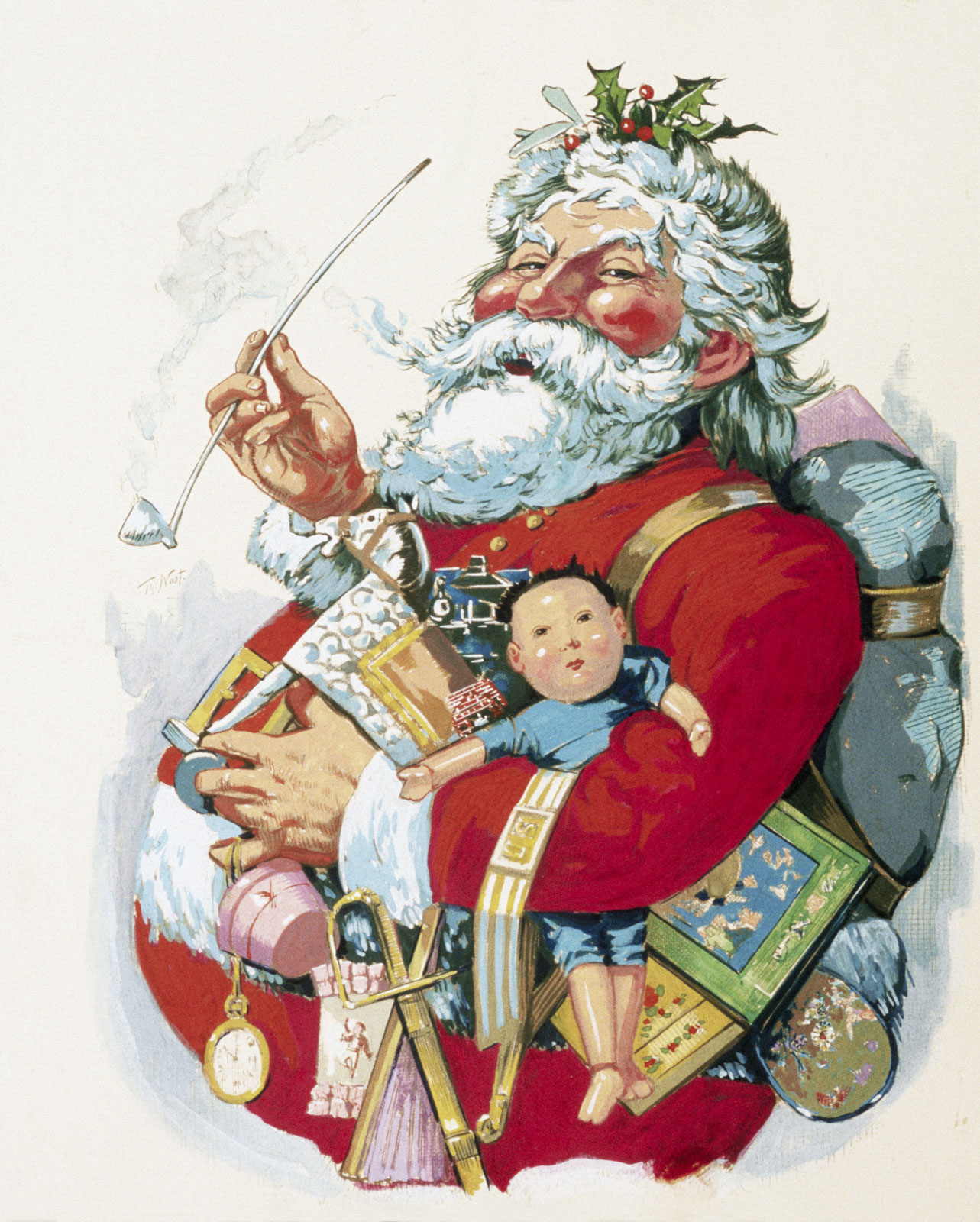
It was Washington Irving’s 1809 book Knickerbocker’s History of New York that first portrayed him as a pipe-smoking, flying magical man delivering gifts to little girls and boys. In 1822, Clement Clarke Moore’s “A Visit from St. Nicholas” (which is better known as a “‘Twas the night before Christmas”) added a sleigh and eight reindeer. Santa Claus’s jolly, grandfatherly figure was largely constructed by the famed late 19th-century political cartoonist Thomas Nast. “There was this slow establishment of an image of who Santa Claus is and what he does. It took on a life of its own,” says Witczak. “By the time you get to Santa Claus sipping a Coca-Cola, the connections to the historic St. Nicholas had become pretty tenuous.”
Pekarik agrees that the religious connection between St. Nicholas and today’s image of Santa Claus has been lost. “The country now overemphasizes Santa, the gifts, and Rudolph red-nosed reindeer,” he says. “I think we need to get back to more of the spiritual aspects.”
Despite there being very few actual relics of St. Nicholas in the United States, Pekarik says it’s rare that anyone contacts him to make a pilgrimage to see their relic. He adds, though, that people are welcome to arrange visits.
While the bone of Santa Claus may only have been in Annandale for a few decades at the most, the plan is to keep it in this Northern Virginia Byzantine Catholic Church for generations to come. Says Pekarik, “The relic … will always be here. It’s safe here.”
There’s No Paywall Here
DCist is supported by a community of members … readers just like you. So if you love the local news and stories you find here, don’t let it disappear!