Natalie Delgadillo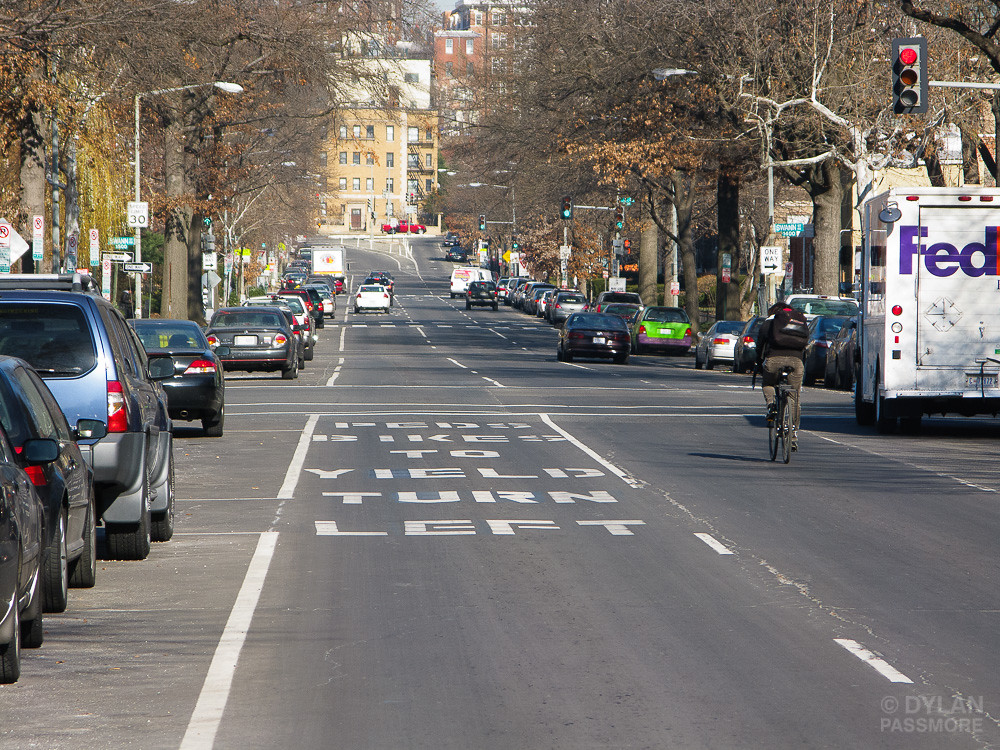
A mobile application launching next month will allow users in D.C. to report traffic safety violations, including bike lane blockers and illegal parking jobs, directly to the city government.
OurStreets, a new-and-improved version of the app How’s My Driving—which similarly allows users to report traffic violations they witness—will connect straight to the complaint system at the Department of For-Hire Vehicles, which regulates taxi and ride-hailing companies in D.C.
The application is also in talks to share data with other city agencies, including the Department of Public Works and the Department of Transportation, says Mark Sussman, the chief executive of OurStreets.
The Washington Post was the first to report on the app.
Here’s a basic run-down of how it will work, per Sussman: On a screen, users can tap what kind of violation they want to report—a car where it’s not supposed to be, dangerous driving behavior, and other issues. From there, they can snap a photo of the violation if possible, confirm their location, and submit the violation. Then the violation information goes “directly into the back end of DFHV, right into their complaint system,” says Sussman. The city can then use the data to discuss strategic enforcement measures or infrastructure improvements, he says.
“We think that this will ultimately be a deterrent for dangerous driving behavior,” Sussman says. “The ultimate goal is to give people an outlet for their angst, for their frustration, for the way they feel unsafe, to actually contribute toward collective action on our streets.”
Users can report everything from bike-lanes being blocked to near crashes to illegal parking to speeding to aggressive or distracted driving, a mockup on the app’s website shows.
DFHV, for its part, said in a statement to the Post that it will notify Uber, Lyft, or other ride-hailing companies of the notices of violation it receives via the app. The cab or ride-hailing company is then supposed to conduct its own investigation, and tell city officials what their “proposed resolution” for the violation is. DFHV then notifies the person who made the complaint about the outcome, per the Post.
The OurStreets app “is an example of technology that can be developed to support the Department of For-Hire Vehicles’ efforts to ensure safety on the District’s streets,” said DFHV Director David Do in a statement to DCist.
D.C. is currently the only city where OurStreets connects directly to a city agency’s complaint system, but users can still log violations they see in any other city and form a kind of data bank of violation patterns, according to Sussman.
“We’re trying to put together a snapshot of what’s happening on our streets because we can’t manage what’s not measured,” Sussman says. “Without the data, we can’t possibly understand how to solve the problem of street safety.”
Sussman and his partner Daniel Schep hope to funnel information directly to other city agencies in the future. They are in talks with DDOT to record scooter violations in particular, Sussman says. Scooter companies could also use the data to move scooters or record violations on their own.
OurStreets first started as a Twitter bot that gained popularity last year by pulling up unpaid citation information for license plate numbers submitted by users who said they’d witnessed a violation. From there, How’s My Driving took shape. The platform was used by advocates this year in two day-long experiments to track violations at the H and I street bus lanes and bike lanes across the city. OurStreets is an improved iteration of the, according to Sussman. It is slated to launch in January.
“Crash data and citation data are not enough to go on,” he says. “There’s this giant gap in violation data, and that’s where we think we can help with enforcement.”
There’s No Paywall Here
DCist is supported by a community of members … readers just like you. So if you love the local news and stories you find here, don’t let it disappear!