Natalie Delgadillo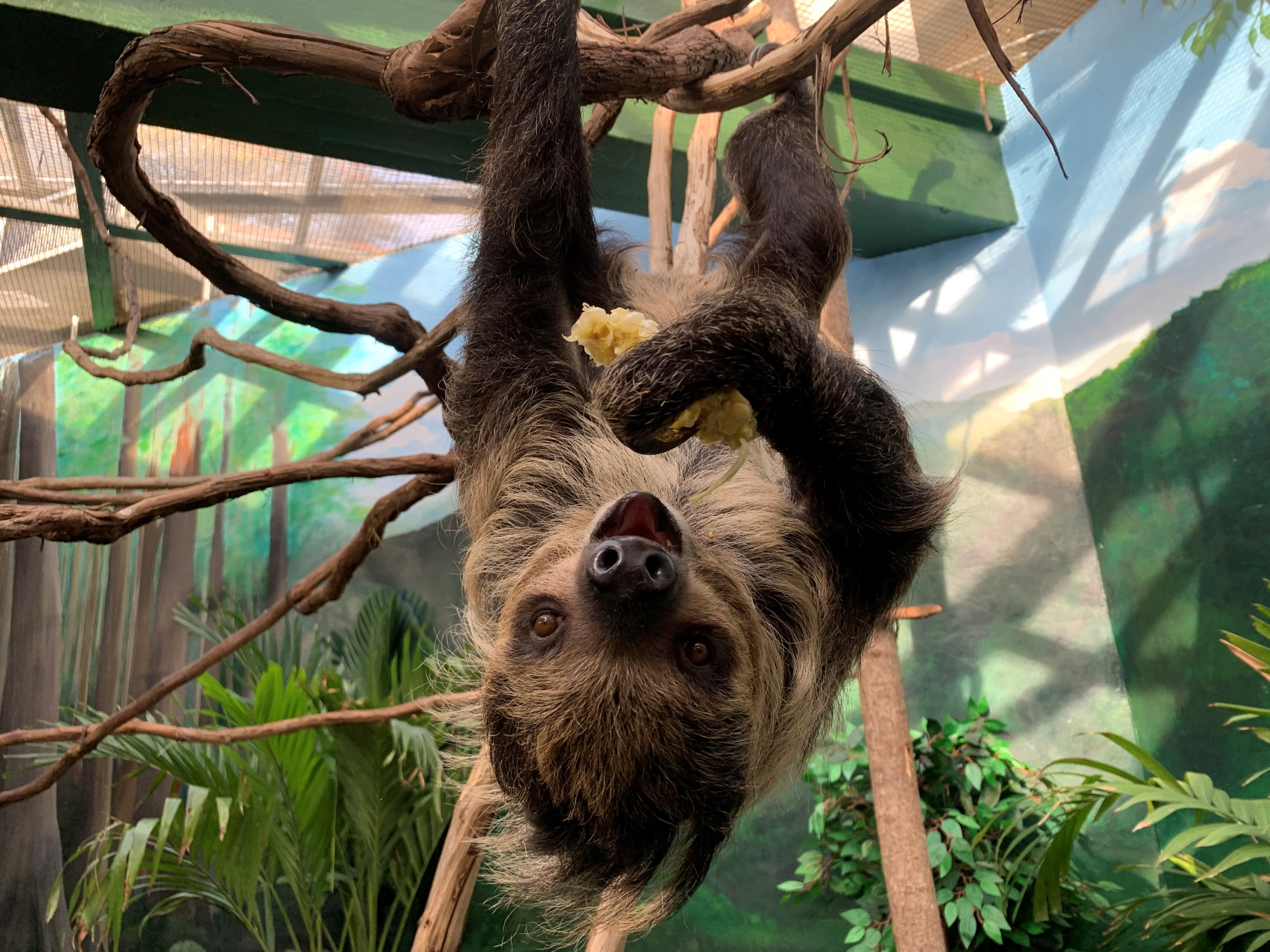
Nearly two years after the death of geriatric sloth Ms. Chips, the National Zoo has a sprightly new addition to the Small Mammal House in the form of 1 1/2-year-old sloth Athena.
Athena was shipped to D.C. from the Ellen Trout Zoo in Texas to breed with Vlad, a 34-year-old sloth who lived with Ms. Chip in the Small Mammal House for many years. Vlad and Ms. Chip appeared to have a mostly platonic relationship, though keepers can’t say for certain—if they ever mated, it likely happened under cover of darkness and away from the prying eyes of zoo staff, says Kara Ingraham, an animal keeper who cares for the sloths.
“It’s very possible there was mating, but it happened at dusk or dawn when sloths tend to be most active,” Ingraham says. “We never witnessed any breeding, and they never had any reproductive success.”
The point is, Vlad has no living heirs. The two-toed sloth species survival plan recommends that he produce some with Athena, who is slated to reach sexual maturity at 3 years old. When that happens, keepers will just have to wait and see whether it’s a romantic match between the two tree-dwellers, Ingraham says.
For now, Athena has been placed in an exhibit with Vlad in the Small Mammal House. Before her debut on December 22, the baby sloth was quarantined for a month and slowly prepared for her introduction to her potential future-partner-in-parenthood. Keepers regularly switched Vlad and Athena’s blankets to get each sloth used to the other’s smell, Ingraham says.
On her first day in the enclosure, staff moved Vlad to give Athena time to acclimate to her new surroundings, Ingraham says. There’s quite a lot to get used to: Athena and Vlad live in a mixed-species enclosure with two golden lion tamarin monkeys and a green aracari, which is a tropical bird.
So far, Athena seems curious about her surroundings and relatively fine with her neighbors of a different species, Ingraham says. She grew up at her previous zoo in an enclosure with a different species of tamarin monkey, so “she knows the deal with little mammals zooming and jumping around her,” Ingraham says.
It remains to be seen if the monkeys will be quite so close with Athena as they are with Vlad: They are often seen cuddling and napping with the male sloth, per Ingraham, or else using him as a substitute tree branch as they leap around the enclosure. “They kind of hang onto him and ride him around,” says Ingraham. “They’re waiting to see how tolerant [Athena will] be of them right now, so we’ll see.”
On Athena’s second day out of quarantine, keepers introduced Vlad into the enclosure and allowed the two to meet for the first time. So far, they appear to be indifferent to one another—Ingraham says they haven’t interacted much, except for sleeping near each other up in the trees. It’s possible there won’t be much interaction between them until Athena reaches full maturity and breeding age, Ingraham says.
Because she is a sloth, there are certain limits on Athena’s speed and energy levels. But within those limits, Athena is a sprightly and curious creature, Ingraham says. She eats willingly out of keepers’ hands, has tried (unsuccessfully) to break into the tamarin monkeys’ food enclosure, and took a marked interest in the scales Ingraham uses to weigh the monkeys, sniffing them and pulling on the cords. “She still doesn’t move very fast, but she’s not moving in slow motion either,” Ingraham says.
Keepers are beginning Athena’s training, which includes getting her used to a feeding routine and, eventually, training her to submit to ultrasounds.
If Athena and Vlad produce offspring, it will be the first two-toed sloth born at the zoo since 1984.