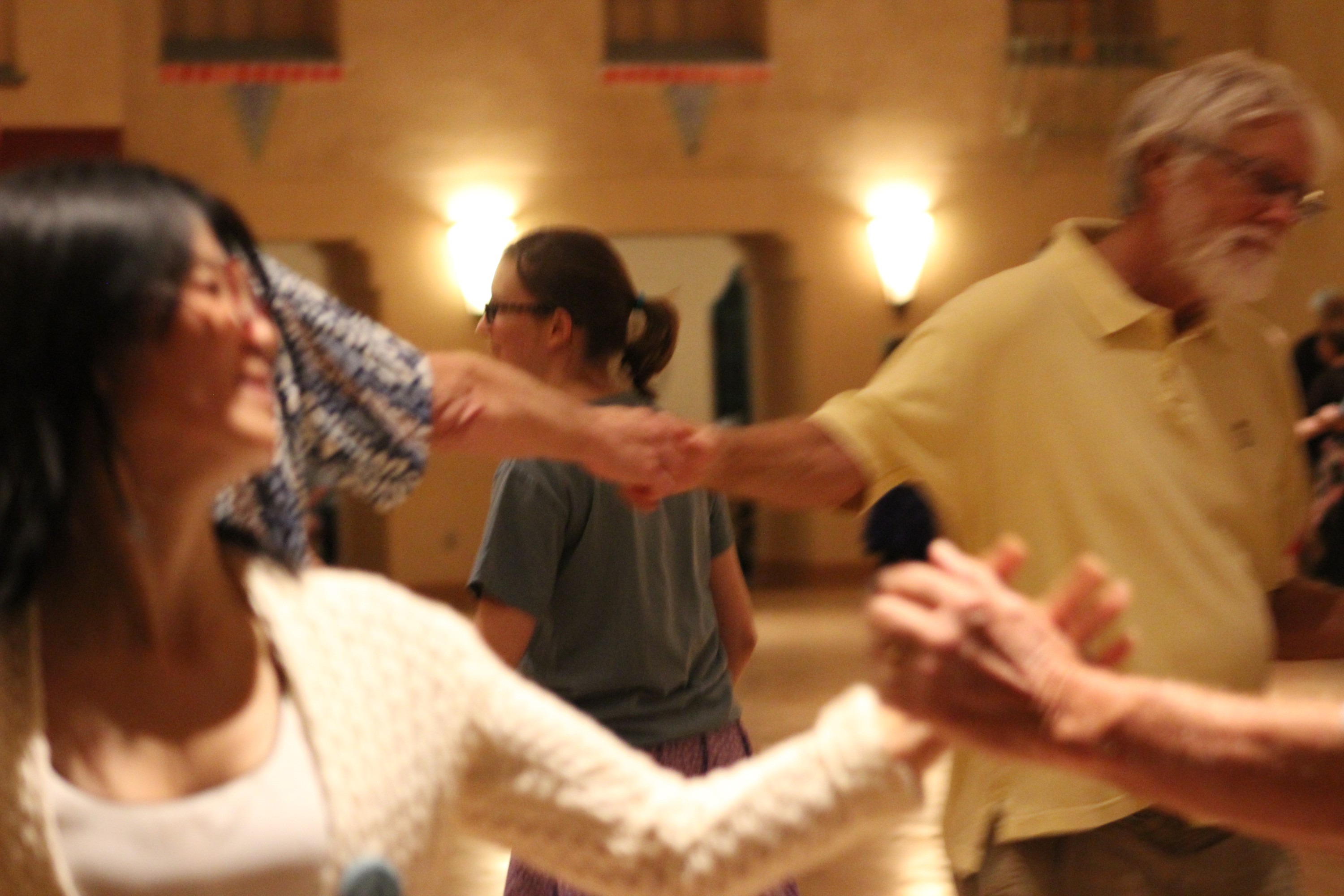
With periwinkle “new dancer” buttons pinned on their shirts, a little over a dozen people trickle into the grand Spanish ballroom at Glen Echo Park on a recent evening. In an hour, they’ll be swinging and do-si-do-ing up and down the contra lines, but for now, they stand still and wait for their lesson.
“Everyone pair off with somebody. Two men, two women, doesn’t matter,” Greg Frock, tonight’s instructor for Friday Night Dancers, tells the group as they prepare for tonight’s contra dance, a folk dance of two lines made up of couples that follow the caller’s instructions. Even though tonight’s caller will say things like, “Ladies chain!” and “New gents in the middle!” Frock tells the newcomers that “ladies” and “gents” are just titles, and they should negotiate with their partner what role they want to dance.
Partners stand opposite from each other, creating one line of “ladies” and one of “gents.” Most choose the title associated with their gender. Later, several women join and take both sides.
Frock starts to demonstrate a balance and a swing with Kappy Laning, tonight’s caller. He dances as the lady, Laning as the gent. “Just again to reinforce the no-gender thing,” he tells the crowd.
While the folk music and dance moves are similar to that of the original contra dancers, the “no-gender thing,” is relatively new in contra dancing’s 400-year history. In the 80’s, queer contra groups started forming accross the country to provide a safe space for gays and lesbians and eventually other members of the LGBTQ community like bi and trans people. Many used “ladies and gents” and ignored the gender association, or they called without gender reference at all.
In recent years, more groups have made efforts to promenade gender-free contra dancing into the mainstream. Dancers’ responses have varied on a spectrum from wanting to keep tradition to wanting to modernize. At FND, the community grapples with the multitude of nuanced positions.
“In the conversation now is how to be welcoming to whatever identification, and people can feel free to dance whatever role they want to dance,” Laning says.
While some contra dancing groups are resistant to incorporating new terms, saying changing the language is confusing for longtime dancers, others across the country are experimenting with different words. Still, there’s no definite agreement on what to use. Terms vary depending on the region and culture of the community.
Laning, who uses “ladies and gents,” finds that those traditional titles make sense to most people. It recognizes the tradition of men and women dancing together, he says, and it’s familiar to many long-time contra dancers. Unlike explicit gender terms like “men and women” used in some dances, “ladies and gents” are roles people can choose, Laning says.
But the general pushback to “ladies and gents” from those who want to modernize has been that those terms hold inherent gender associations that can’t be removed.
FND always explains that dancers’ gender identity does not have to match their role when “ladies and gents” is being called, but Caroline Barnes, FND President, has noticed that dancers loosen up a little more when callers’ use terms other than “ladies and gents.”
“It makes everyone feel very welcome and not afraid to be who they are and to express who they are,” says Abigail Klima, a member of the LGBTQ community. She started dancing four years ago in high school in North Carolina. Her two best friends, who are trans, did not want to go with her at first because they thought “men” and “women” would be used. But the dance used gender neutral calling, and one of her friends still attends—now with his husband.
“First and foremost my preference is for gender-free role terms,” says Robin Banerji, a queer dancer and caller at FND and several other communities. “It is long past time for the dance floor to be de-gendered because it’s just not accurate.”
Across the country, contra dancing groups have tried different ways to eliminate gender in the roles. Some groups have used “jets and rubies”; others have given dancers arm bands and used “bands and bares” or “reds and blues,” depending on the color of the arm bands.
But not everyone agrees on all these terms. While a 2018 survey shows that there’s a growing consensus to use “larks and ravens” for gender-free contra dancing, partially because the L and R make it easy for dancers to remember left and right, there’s discussion even within that. Some want to replace “ravens” with “robins,” which they argue is more gender neutral than the traditionally masculine raven. Others want it changed because ravens have cultural significance to many Native American tribes.
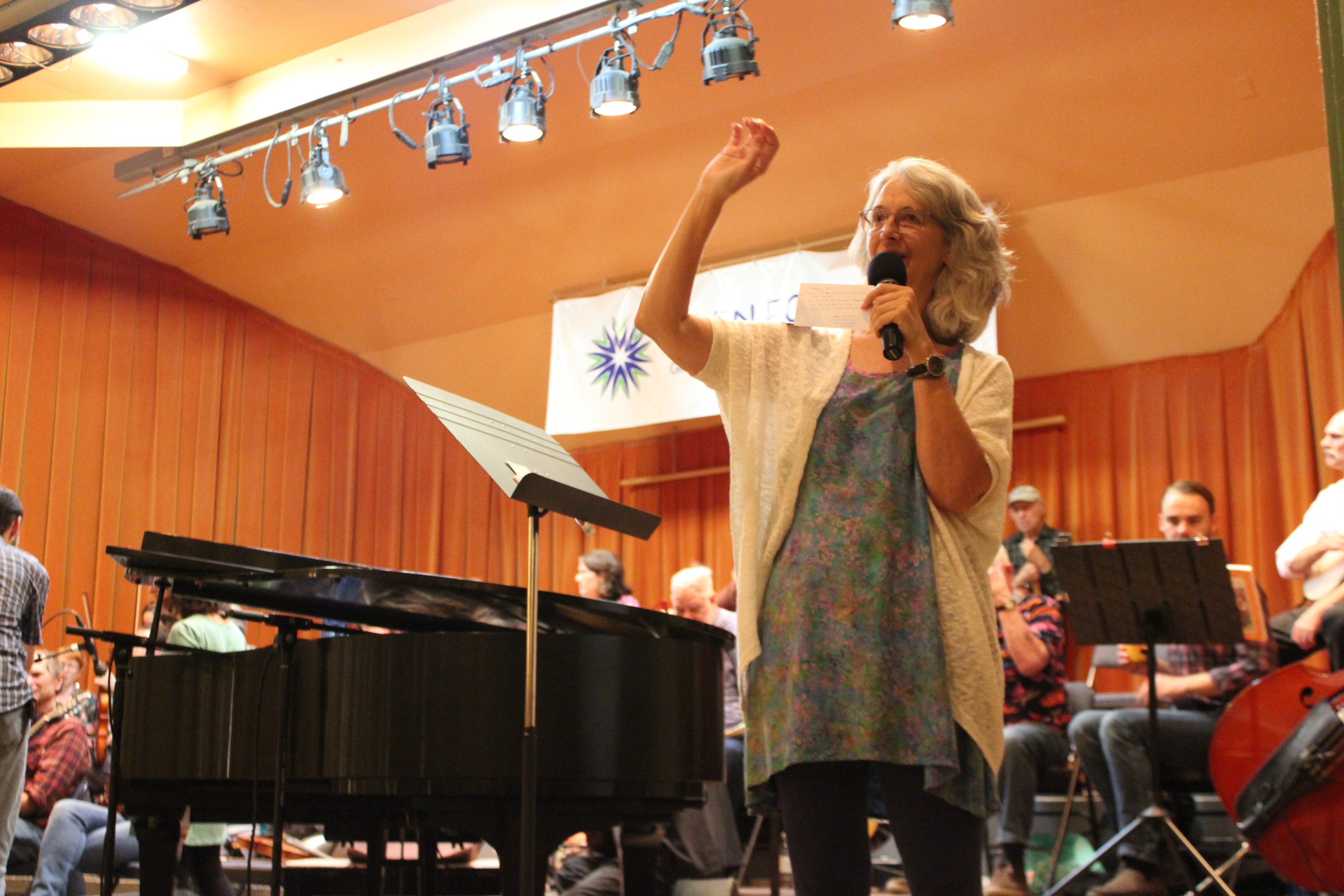
Some callers at FND use terms like “lead and follow” in an attempt to eliminate gender.
Banerji says “Lead and follow” is the most accurate way to describe the two positions because they directly connect to contra dancing. They’re also a shorthand for how dancers expect their partners to communicate with them during the dance.
Other people don’t think there is a clear “lead” and “follow” in contra dancing. Andrea Nettleton, a dancer and caller at FND and other local communities says “lead and follow” creates a hierarchy of power and control in contra dancing, which is fundamentally a “team sport.”
“The newest thing is: why do we have to use gender terms at all?” Frock asks. “In the long run, I think positional calling is the way to go.”
With positional calling, the caller describes positions and moves throughout the dance. For example, a “ladies chain” becomes a “right-hand chain” or, with more detail, “the pair with right hands free, pull by for a right hand chain.” Instead of giving the jargon, positional calling explains the move and its details, according to Nettleton.
“I want something that is robust through every level of dance,” Nettleton, who uses they/them pronouns, says. Positional calling allows every dancer—from newcomers to regulars who switch roles throughout the night—to understand where they should be and what they should be doing at all times, they say.
It also takes away a dancer’s ability to impose gender on a non-gendered term, they say. Some may be tempted to trace a term like “lead” back to “gent” and divide by gender.
When a positional caller came to FND over the summer, it was “completely seamless,” says Amy O’Brien, who has been contra dancing for 25 years.
“If you’re going to call gender-free, that is the way to do it,” O’Brien says. “It was brilliant.”
But positional calling can be complicated for callers and doesn’t come naturally, says Banerji, who prefers “lead and follow.” Nettleton acknowledges that it takes a little getting used to, for callers and for dancers.
“There is some front loading of work for callers and communities who decide to adopt it, but it’s a worthwhile work because [it] will eventually become habitual,” Nettleton says. “If we as callers explore this together, we will be able to come up with language for every situation.”
At FND, the board lets the caller for each dance decide what terms will be used.
“We’re just trying to let it happen as people in the community want it to happen,” says Leonard Lu, who books the callers and the bands at FND. “We’re not trying to push it one way or the other.”
FND has only had a handful of gender-neutral dances since beginning the practice in March. When callers use something other than “ladies and gents,” FND gets a few responses in their weekly survey from people saying they didn’t like it, or they decided to skip the dance altogether. But those numbers are small compared to their 200 weekly attendees, Lu says.
“It seems like there are small numbers on both sides that are very intensely committed on the issue, but nearly all the people I’ve talked to just want people to get along and have fun,” Lu says.
Calling terminology is just one part of that, Banerji says.
“In making non-binary and queer folks welcome in dances, role terms are great and having non-gender role terms is a huge step, but that’s only true if the community is such that everyone really is welcome,” he says.
Tonight in the ballroom, partners of all sorts of gender pairings follow Laning’s “ladies and gents” calls to the music. New dancers with their periwinkle buttons are given tips by the more experienced dancers. A man and his wife’s skirts move to the same beat.
Klima’s rainbow pride pin stands out on the front of her denim vest. When looking up FND before the dance, she saw their non-discriminatory notice on the homepage and their promise to provide an “inclusive and welcoming environment.” She decided to wear her pin.
“It’s a place where I feel safe and, like, welcome, which I don’t always feel that way,” Klima says. “So it’s really nice that I feel that here.”
There’s No Paywall Here
DCist is supported by a community of members … readers just like you. So if you love the local news and stories you find here, don’t let it disappear!