Crochet needles seem to be an extension of Dwayne Lawson-Brown’s hands.
Any spare moment Lawson-Brown has is consumed by a new scarf, like the long aquamarine and cornflower blue one that flows from his fingers like a woven river. On a chilly December night, Lawson-Brown is creating that scarf while sitting on a low-pile shag rug in a cozy, basement room in Southeast Washington. When he finally pauses his work, it’s to express his other passion: poetry.
“As timeless as each second spent in your presence, as infinite as the space between,” Lawson-Brown reads in soft tones from his own book of poems. “For every coat of dew fallen on a night forgotten, there is a cherished morning cleaning cobwebs, evaporating what moisture remains.”
He puts the book down and his five-person audience hums in agreement.
“Peace y’all! How y’all doing?” Lawson-Brown says, as he welcomes everyone to another Thursday edition of Spit Dat, the D.C. open mic that has welcomed poets, singers, comedians, and artists of all kinds since 2002. Founded by Lawson-Brown’s close friend and fellow poet Drew Anderson, Spit Dat has consistently held an open mic each Thursday for almost two decades but has moved locations across the District several times.
Lawson-Brown and Anderson now host two different Spit Dat sessions, the intimate “speakeasy” held each Thursday at a secret location in Southeast and the larger, monthly residency that will run at Woolly Mammoth Theatre Company through March. Though the speakeasy location is not advertised publicly, anyone can request the address by messaging Spit Dat’s Instagram account. According to Lawson-Brown, the secrecy helps keep the event feeling intimate—the speakeasy is “akin to a spoken word support group,” he says.
“The goal with the [Woolly Mammoth] residency is just to expose more people to the same Spit Dat energy that we have here,” Lawson-Brown says before starting a recent Thursday open mic. “The idea behind being at Woolly Mammoth is creating that same kind of warm, supportive environment in a larger space where people who may not be likely to come to Southeast D.C. or may not be privy or hip to different spaces can have access to the art.”
The basement where Lawson-Brown has held the speakeasy since February isn’t a large space—about 6-12 people tend to show up each week—but it’s all his. And after hopping from cafes to capoeira studios and community centers over the last several years, that ownership means more than atmosphere. The snug spot also hearkens back to Spit Dat’s roots, when Anderson started the open mic with about four people at the Java Head Cafe in Brookland. Lawson-Brown became one of Anderson’s first regulars, before the open mic ballooned to almost 100 people.
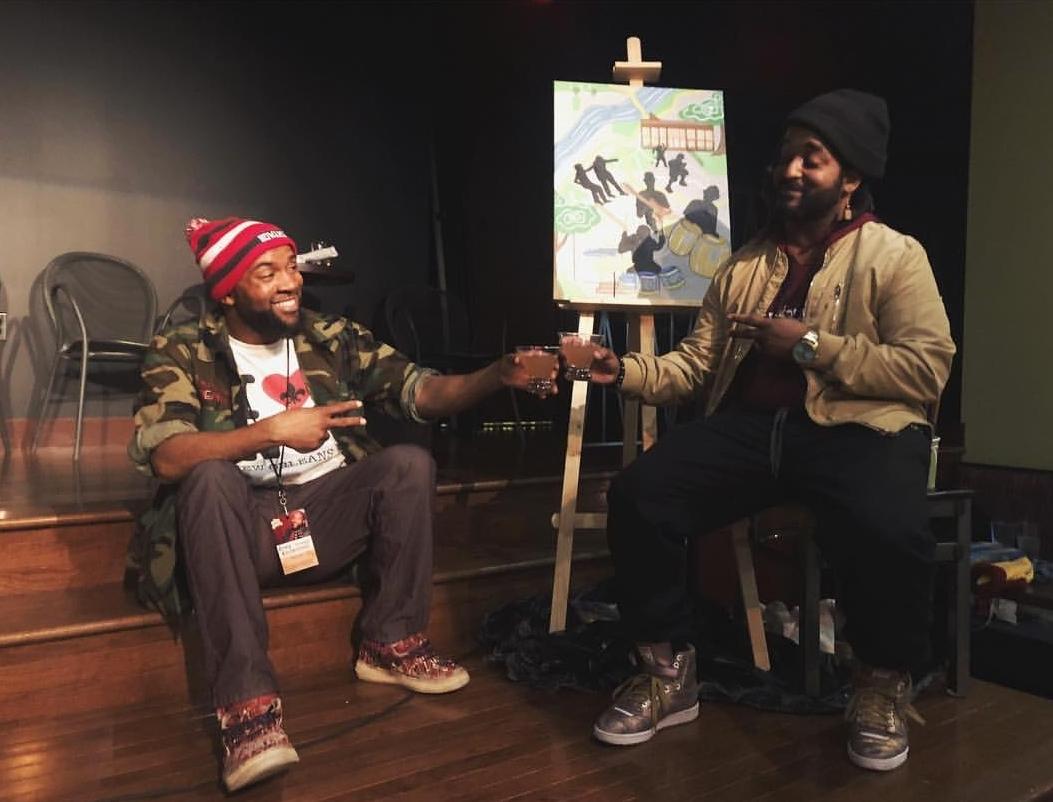
Anderson, a Howard University graduate and New Orleans native, named the open mic “Spit Dat” to honor another poet, Komplex, who once hosted an open mic at the Java Head in College Park.
“[Komplex] lived in Baltimore, Brooklyn and Jamaica, when he really liked what you said he would say ‘Spit that, spit that,’” Anderson says. “I’m from New Orleans, we do a lot of replacing the ‘th’ with ‘d.’ So it was a shoutout to where I’m from and where Java Head was from.”
When Java Head shut down around 2005, its owner suggested another venue on U Street, Mocha Hut. Nestled between 13th and 14th streets NW and operated by Howard alumnus Vernal Crooms, the space appealed to Anderson immediately.
“That’s when we gained a lot of notoriety. We had performers from American Idol just pop in and they were just happy that no one knew them in the space,” Lawson-Brown says. “That’s when a lot of the rituals at Spit Dat became as popular as they are.”
Lawson-Brown is referring to the many call and response rituals he leads at both the speakeasy and residency sessions. At the speakeasy, the half dozen people gathered in the small basement burst into a robust chorus when Lawson-Brown calls their attention.
“Lions, tigers and bears!” Lawson-Brown commands.
“Oh my!” his audience responds.
Spit Dat’s rituals range from the pragmatic—an expletive-laced plea to silence your cellphones—to the bizarre—announcing the “mystical presence” of an imaginary guest known as Fat Boy Shawn. There’s another mystical being by the name of “sexual innuendo.”
“Whenever somebody says something that could be taken the wrong way,” Lawson-Brown says.
“Taken the wrong way!” his audience says, elongating the phrase with mischievous winks.
“Feel free to point it out and enjoy yourself,” Lawson-Brown says. “One could say that open mic-ers who only come to hear themselves are lyrically masturbatory.”
Spit Dat thrived at Mocha Hut until it closed in 2009. Anderson soon found a new home at the Universal Angola Capoeira Center on U Street, but the open mic lasted at its new location for less than a year after residents at nearby apartments complained about noise coming from poets freestyling in the alley.
Universal Angola Capoeira Center’s instructor Dale Marcelin connected Anderson with Sylvia Robinson, who ran the Emergence Community Arts Collective, a community center that hosted cultural events inside a sprawling 19th-century house at the top of Euclid Street. In 2010, Spit Dat moved into ECAC, where Lawson-Brown and Anderson hosted the Thursday open mic for the next nine years. It wasn’t until Robinson’s death following a long battle with breast cancer in 2017 that Anderson says Spit Dat’s and other community organizations’ relationship with ECAC soured.
“That is exactly when things went awry,” Anderson says. “After that, it’s like there was no command and control … with her passing there was sort of a void in leadership and accountability.”
Meanwhile, Lawson-Brown was fostering a partnership with Kristen Jackson, connectivity director at Woolly. Jackson first met Lawson-Brown through a poetry event at the theater in 2014 as part of her work producing special events and partnerships with educators, activists, and community leaders. When she learned Spit Dat was looking for a new home in February, she thought it would dovetail well with the theater’s mission.
“Having them in residency is something that’s a new step for us and speaks to our trust and regard for Dwayne and Drew,” Jackson says. “We really are so beyond thrilled with the partnership and how we continue to grow together because we don’t just see this as a space thing.”
For Anderson, gaining stable real estate at Woolly remains his greatest coup.
“It became a lesson about ownership of the space,” he says. “You don’t own the space or at least have a really good relationship with people who do, like we have a really good relationship with Woolly, then anything can happen. We found a space that we have more control over. A space built out of the love and organic energy that Spit Dat started with.”
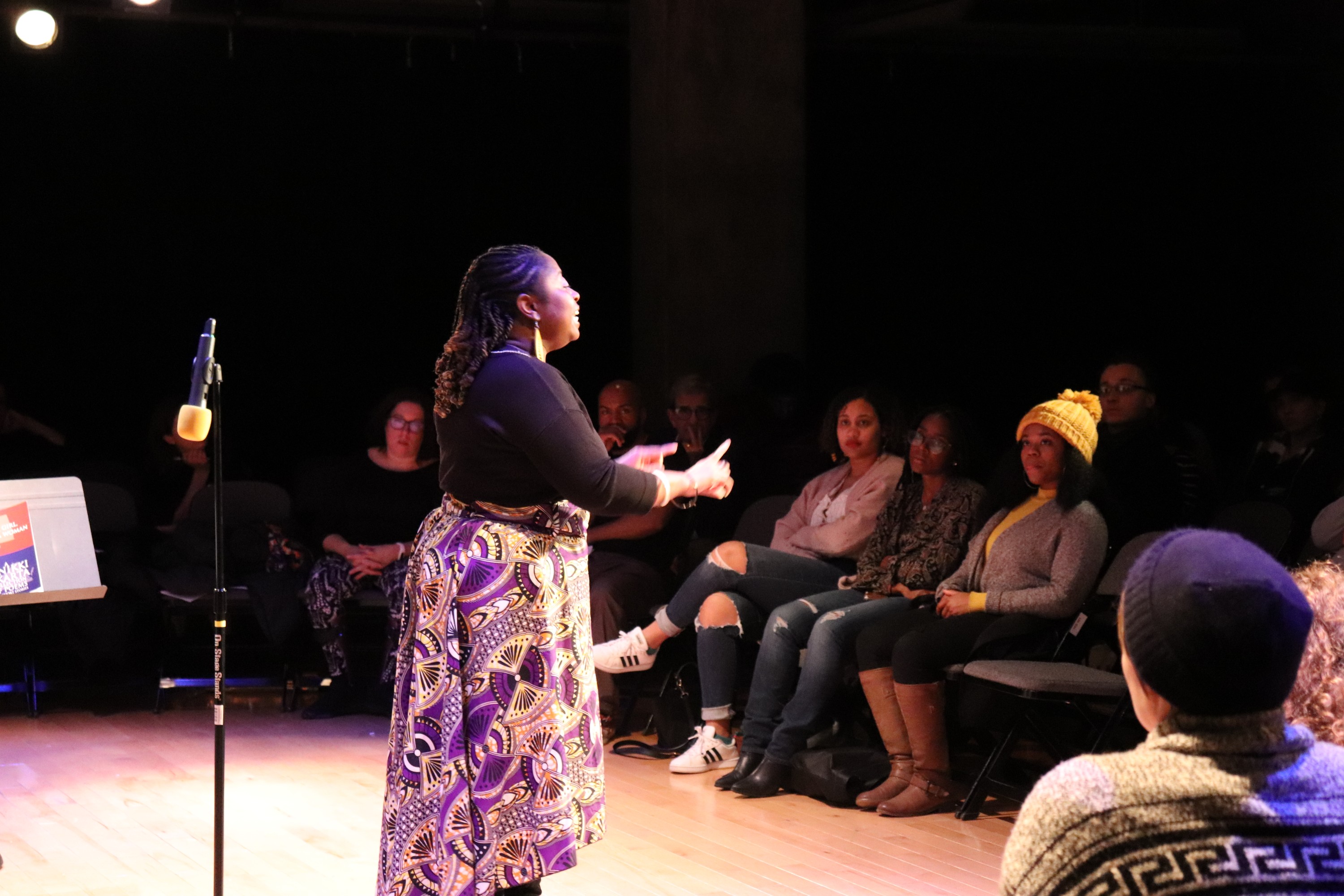
Since it began in October, the Spit Dat residency holds onto the rituals that regulars know and love, but audiences will find a more professional roster at Woolly than at the speakeasy, which can morph from a freewheeling open mic to an impromptu therapy session.
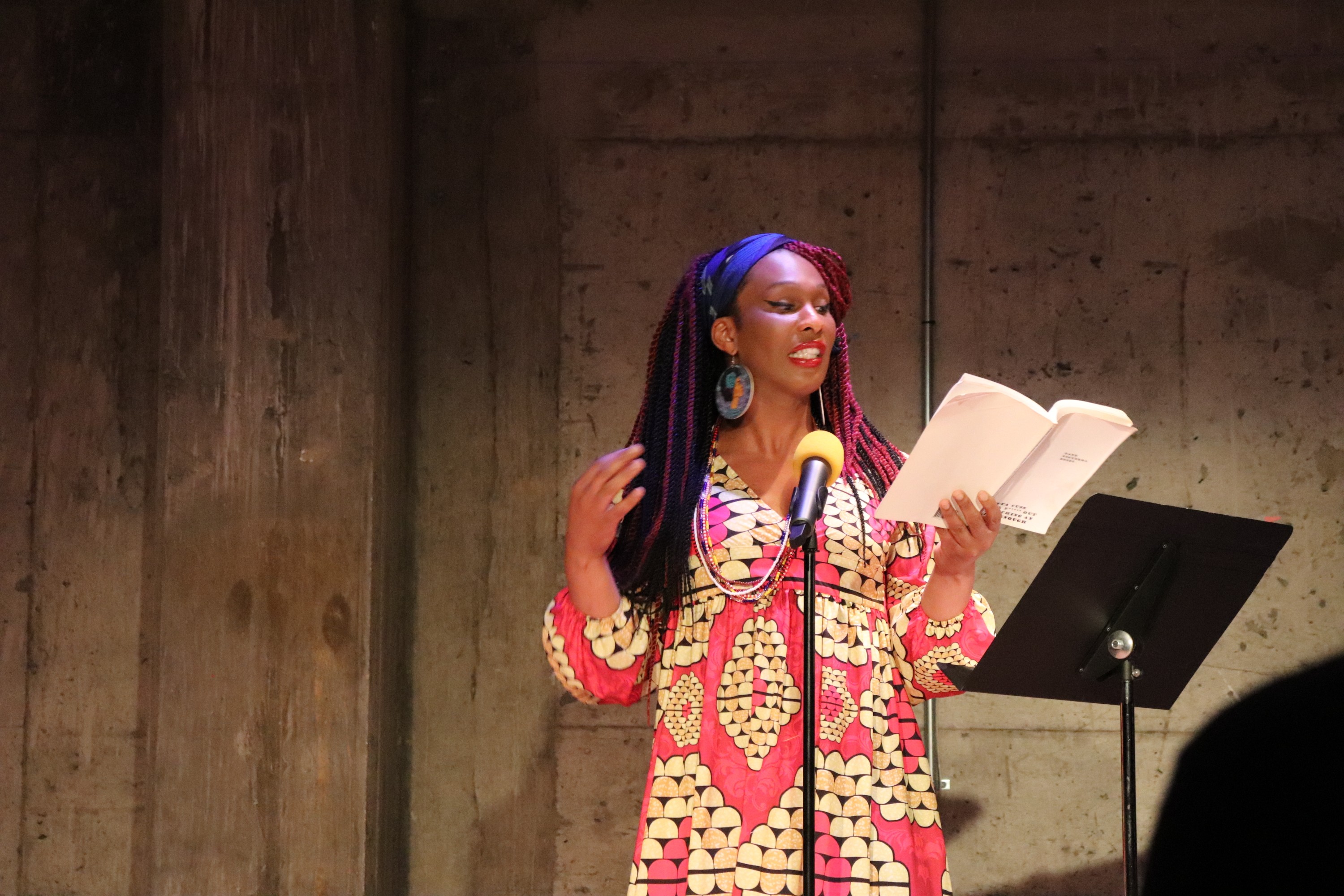
Each Spit Dat at Woolly follows a loose theme. December’s session echoed the theater’s showing of She the People with “Femme Forward,” a show featuring six femme-identifying performers.
Gowri K, a queer Tamil American poet, belied her talents before whipping out her work.
“I don’t have poems, it’s just varying tones of rage,” she says.
Her found poetry, which pulled language from the Bruce Museum in Connecticut, replaced the words “sedimentary rocks” with “global majority,” a phrase she uses in lieu of “minorities.”
“People of the global majority are extremely varied, differing widely in color, texture and composition,” Gowri K says in a cheery, professorial tone that elicits laughs and later approving snaps. “In total, these people cover about three-quarters of the earth’s surface. Nearly all are made of materials that have been moved from a place of origin to a new place of deposition. The distance may be a few feet or thousands of miles.”
Natalie E. Illum, a poet, disability activist, and 2013 Beltway Grand Slam Champion, pulled her inspiration from the #MeToo movement. Her poem, “Predatory Logic,” exchanged her fear of male predators with sharks.
“Once, one bit a woman in half in Hawaii, but it was her fault for swimming at dawn,” Illum says. “When they circle back, like men, to decide if you are food or junk, they just take too much, leave with your flesh in their mouths.”
With the impressive list of poets at Woolly who have competed across the country and spoken around the world, it’s easy to be intimidated by this new version of Spit Dat. But Lawson-Brown and Anderson don’t intend for the open mic to turn into a scored poetry slam.
“Woolly is a way to introduce the theater component. So we want that showtime element but we also want to keep the intimacy that Spit Dat started with,” Anderson says. “We have the best of both worlds now. We’ve got showtime and we’ve got grow-time.”
Spit Dat’s next residency performance is at Woolly Mammoth Theatre Company’s Smith/Melton Rehearsal Hall on Jan. 6 at 8 p.m. FREE
There’s No Paywall Here
DCist is supported by a community of members … readers just like you. So if you love the local news and stories you find here, don’t let it disappear!