Elliot C. Williams
Updated 4:01 p.m.: After four homicides in D.C. were reported over the weekend, Metropolitan Police Commander William Fitzgerald confirmed the fifth murder of the year in a press conference on Monday afternoon.
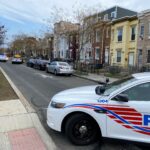
Officers responded to a report of gunshots in the 2400 block of Franklin Street NE around 1:35 p.m. An adult male was discovered laying on the curb with gunshot wounds. He was taken to a local hospital, where he was pronounced dead.
Two other adult males were wounded by gunshots and were taken to the hospital with non-life threatening injuries.
Fitzgerald says that people who congregated outside a convenience store near the location of the shooting “were targeted,” though he didn’t know whether the victims themselves were bystanders or the intended targets.
Original:
Just six days into the new decade, D.C. has already recorded four homicides, all of which occurred over the past weekend, according to D.C. police.
The spate of killings comes on the heels of the city’s highest murder rate in a decade last year, with 166 killings. Metropolitan Police Chief Peter Newsham points to repeat offenders and access to illegal guns as the root cause of the persistent uptick in homicides.
“One of the things that I’ve learned from traveling the city and talking to communities is that when it comes to violent crime, nobody is happy about that,” Newsham says. “Nobody is satisfied about that. Sometimes these folks can really intimidate a community, and I think we’re going to get a lot of backing in trying to get those folks out of the community so we all can be a bit safer.”
The first homicide of the New Year was reported just after 3:30 a.m. on Saturday, when 60-year-old Charles Robinson was found fatally shot in Anacostia, according to police.
Then, just before midnight on Sunday, a man identified as 39 year-old Anthony Ward was found suffering from multiple gunshot wounds inside a residence on the first block of K Street NW. Less than three hours later, early Sunday morning, police responded to a stabbing on the 1200 block of U Street NW. The victim, 22-year-old Dy’Mani Priestley, later died in the hospital.
And around 5:30 a.m. on Sunday, 26 year-old Xavier Tate was discovered fatally shot in a residence in the 1400 block of 3rd Street SW.
No arrests in any of the cases have been made so far, according to an MPD spokesperson.
Last January, when the year began with 18 homicides and a triple murder, city officials grappled with ways to curb the violence and pointed to a number of public health initiatives as potential solutions. The proposals included providing people with criminal records easier access to jobs, tackling trauma caused by violence, and preventing killings with the help of Violence Interrupters.
Newsham also touts the city’s Pathways Program, a work-readiness program for District residents aged 18 to 24.
“I like the way that the city is working on all those angles. The city has been bending over backwards to find jobs for folks,” Newsham says. “They’re taking some really high-risk individuals in our city and trying to get them to a place where they won’t re-offend.”
Ward 6 Councilmember Charles Allen, who called into the Kojo Nnamdi Show Monday for a discussion on gun violence with the chief, also noted the Pathways Program, calling it “strikingly successful.” Per City Paper, the program’s first three cohorts have had a 51 percent full-time employment rate, and a recidivism rate of less than 7 percent.
The city has also aimed to increase its police force to 4,000 officers. Newsham says the department currently hovers around 3,800 officers. And D.C. will fund hundreds of new closed circuit security cameras in an effort to deter crime.
In the coming year, Newsham says his department will focus on repeat offenders: “At the end of the day, there are going to be some really bad people with bad intentions that are going to do really bad things,” he says. “And in those cases, I think that’s where you have to bring in law enforcement. You have to remove those folks from the community.”
Newsham says MPD will also focus on preventing guns from being brought into the city from Virginia, where people legally purchase firearms to illegally resell in the city. Ghost guns, pieced together from spare parts and virtually untraceable, are also a persistent problem, Newsham says.
Despite the record homicide rate, Newsham says D.C. is a safer city than it was a decade ago, as the number of violent crimes has decreased by around 3,000.
But with homicide rates going in the wrong direction, advocates and lawmakers are looking to other efforts to stop gun violence.
In November, the U.S. Justice Department launched Project Guardian, a federally run effort across the District, Maryland, and Virginia to curtail access to illegal firearms by better enforcing laws that already exist.
Still, to those most directly affected by gun violence, the city’s efforts are not enough. One corner store in Congress Heights—where a majority of the homicides are concentrated—saw two teenagers murdered on its doorstep in seven months, according to the Washington Post.
Mike Austin, a Ward 8 commissioner representing Congress Heights, told the Post, “The community, they’re livid right now. While we’re preaching this narrative—‘crime is down, crime is down’—they don’t feel it. I don’t feel it. People don’t feel safe to go to stores, gas stations, whatever.”
There’s No Paywall Here
DCist is supported by a community of members … readers just like you. So if you love the local news and stories you find here, don’t let it disappear!