Martin Austermuhle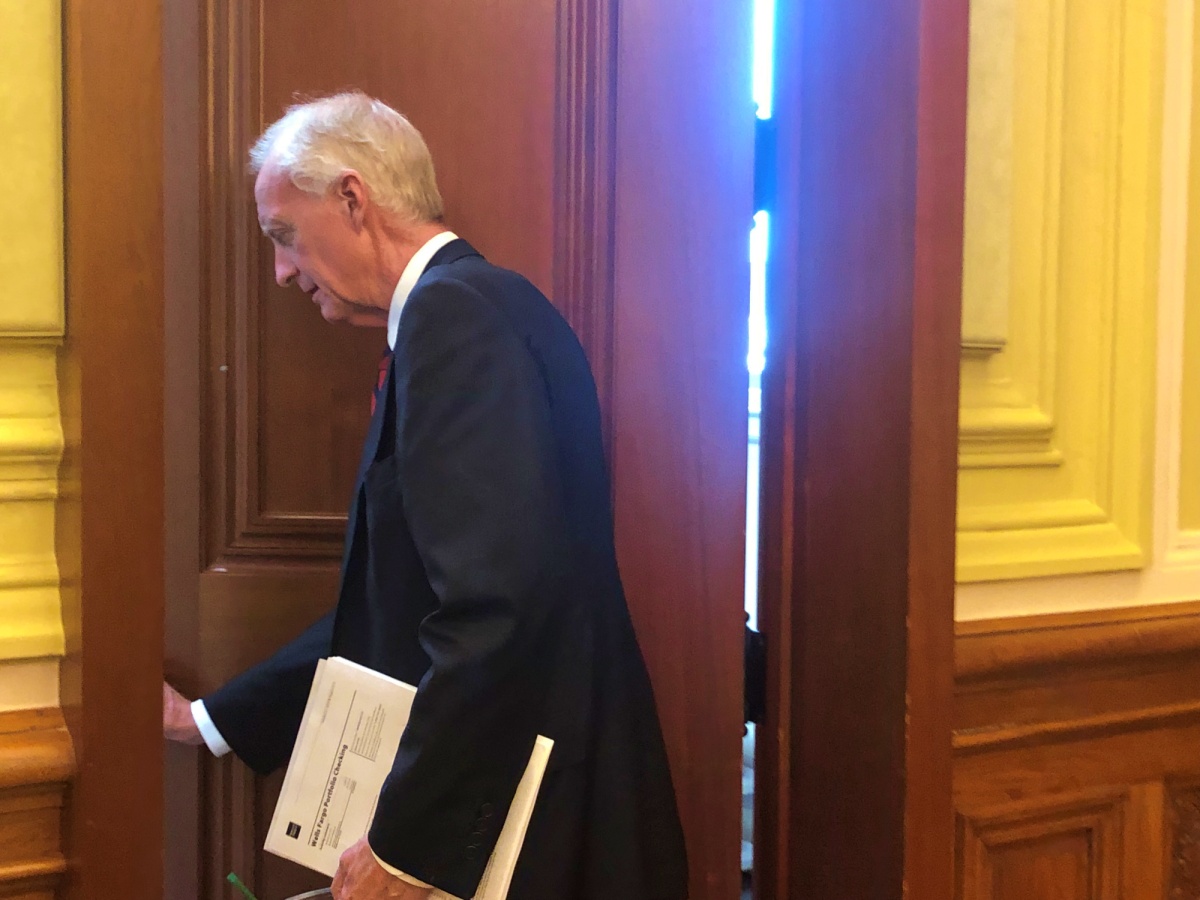
Jack Evans, the D.C. Council’s longest-serving member, resigned from office on Tuesday, preempting a likely vote by his colleagues later this month to expel him over revelations that he repeatedly violated conflict of interest rules by taking official actions to help developers and businesses that paid his private consulting firm.
Evans announced his resignation shortly before a hearing where he would have been allowed to speak about the Council’s expected vote to expel him, which was scheduled for Jan. 21. Had the vote happened, Evans would have been the first lawmaker in the legislature’s history to have been removed by his colleagues.
“After nearly 30 years of public service to the District of Columbia, I have advised the Board of Elections that I resign my position as Ward 2 Council member on the Council… as of the close of business on Friday, January 17, 2020,” he wrote in a letter to Chairman Phil Mendelson. “I believe Washington, D.C. to be the pride of the nation and I am proud of the contributions I have made in helping create a vibrant city.”
Speaking after the announcement, Mendelson, who has worked with Evans for more than two decades, called the decision “sad” but said it was what Evans needed to do.
“I think this is the right decision for Mr. Evans to have made. It saves the Council from going through more of this time and distraction from the business we ought to be doing. It’s also important in a step in restoring integrity of the institution and the trust of the public,” he said. “It’s very sad that we’ve come to this point.”
The sudden, albeit expected resignation brings to an end a career in elected office that spanned almost three decades, including two unsuccessful runs for mayor, two terms as the chair of Metro’s board, seven trips as a D.C. delegate to Democratic National Conventions, and hundreds of groundbreakings and ribbon-cuttings of everything from renovated schools to a brand new baseball stadium — many of which were memorialized in framed pictures lining the walls of his office in the Wilson Building.
Evans was first elected to the Council during a special election in 1991, pledging to clean up the city’s government. He cultivated a reputation as a business-friendly reformer, working to attract residents and businesses back to a city in financial free fall that was quickly losing both. But he was also known as an aggressive advocate for Ward 2, which over the years has stretched from the tony neighborhoods of Georgetown to struggling areas in Shaw.
“Jack came to every meeting in the community pretty much we ever asked him to attend,” says Alex Padro, a 20-year ANC commissioner in Shaw who worked with Evans for more than a decade until redistricting in 2013 moved his neighborhoods into Ward 6. “Out of the Council members I have dealt with, he was the most approachable and the most aggressive in terms of trying to fight for his constituents’ needs and wellbeing. Jack had sharp elbows and he wasn’t afraid to use them.”
But it was Evans’ outside job as a lawyer that would prove to be his eventual downfall. He worked for years at Patton Boggs, a powerhouse law firm, before moving to Manatt Phelps, a smaller firm that has represented a number of developers and businesses with interests in the city. After leaving that job in late 2017, he started looking for other ways to leverage his long service in government — and that’s where his troubles started.
Last year, The Washington Post reported that Evans had used his public email account to seek job opportunities with other law firms with local clients. Around the same time, District Dig, a local news outlet, reported on the close relationship between Evans and a company seeking to place digital signs on buildings in downtown D.C. The revelations spurred an ongoing federal investigation and scrutiny from Evans’ colleagues into his private consulting firm, whose clients he had long refused to disclose.
Investigations by both the Metro board, which Evans chaired, and a law firm hired by the Council laid bare some of the conflicts of interest lines Evans had overstepped: working to steer a Metro parking contract to one his clients, supporting a merger of Pepco and Exelon while working for a law firm that represented them both, and taking a number of other official actions on behalf of developers and businesses that were paying him as a consultant.
Evans was reprimanded by his colleagues, agreed to pay a $20,000 fine, resigned his seat on the Metro board, and ultimately was stripped of his chairmanship of the Council’s powerful finance committee. And that wasn’t it: late last year, all 12 of his colleagues voted to recommend that he face the most serious punishment available, expulsion from the Council. The power to vote someone off the Council was written into law after another spate of ethics scandals in 2010 and 2011.
Once Evans formally leaves office, the Board of Elections will declare a vacancy and start the process of scheduling a special election to fill the seat. Given the timing of an already scheduled June primary, there is a chance that Ward 2 voters will be asked to elect someone to finish out Evans’ term—which runs until January 2021—and the party candidates for November’s general election. There are a half-dozen Democrats already vying for the seat.
Previously:
A Handy Guide To All Of The Investigations Into Jack Evans
D.C. Council Unanimously Recommends Expelling Jack Evans From Office