Martin Austermuhle
Update, 9/22/20: The D.C. Council passed a bill on first vote that designates the little brown bat as the official mammal of the District. It still needs a final vote, but it’s expected to pass. Then, the bill will go to Mayor Muriel Bowser and, after that, it will be subjected to a 30-day congressional review under the Home Rule Act.
Original:
In popular culture, they’re thought of as flying creatures of the night: airborne, beady-eyed, and disease-ridden animals that will dive bomb onto an innocent person’s head in search of a meal of human blood.
“You hear the fluttering of leathery wings. Bats! With glowing red eyes and glistening fangs,” recounted Calvin, the elementary-aged comic book star of Calvin & Hobbes, to his classmates during a presentation.
But for a group of Girl Scouts in D.C., bats are more than that—they’re simply misunderstood, and worthy of official recognition.
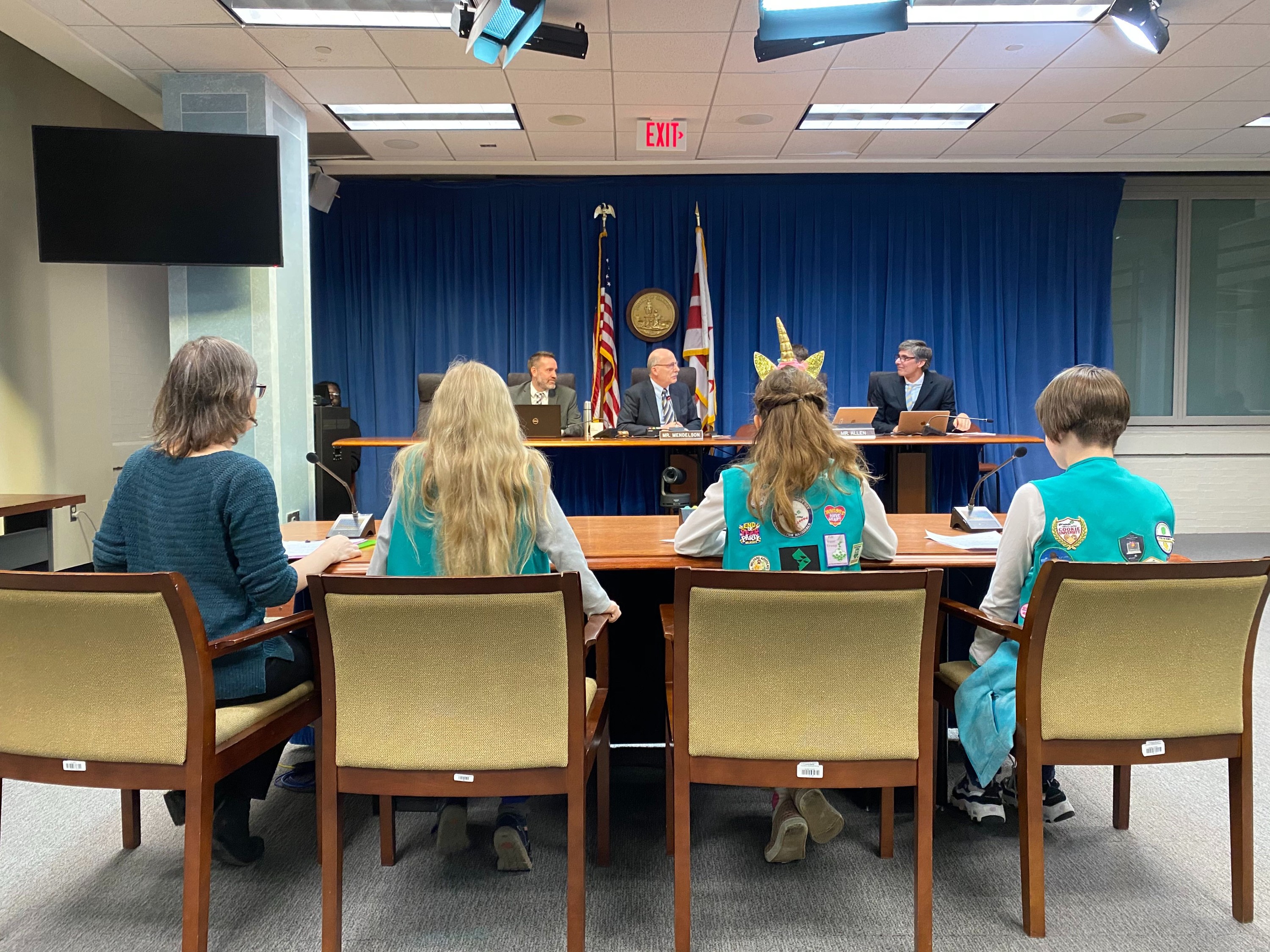
“I’m here to tell you that bats are cool,” said Lydia Adcock, a 10-year-old Junior Girl Scout from Troop 44051 on Capitol Hill. Wearing her green, patch-clad vest, Adcock was joined by at least a dozen other Girl Scouts who testified before a D.C. Council committee on Monday in support of a bill that would make the endangered Little Brown Bat D.C.’s official state mammal.
Yes, the official state mammal. D.C. already has an official state bird (the wood thrush), tree (scarlet oak), fruit (cherry), stone (Potomac bluestone) and even dinosaur (Capitalsaurus). But a 2018 team-building research project by three Girl Scout troops made the young participants realize bats needed both the attention and protection an official D.C. designation might bring.
“The Girl Scouts discovered how important bats are to our ecosystem and also learned that white-nosed syndrome is decimating many of the bat populations here in D.C. and across North America,” explained Alison Kaufman, a troop leader, referencing a widespread fungus that affects hibernating bats—including colonies in D.C. “Once our Girl Scouts learned about bats, then they of course wanted to know how they could help them.”
They pitched Ward 6 Councilmember Charles Allen on the idea of designating a bat as the D.C. state mammal last year. But on Monday, they faced an important challenge: convincing lawmakers who could have just batted the idea away simply because, well, bats can seem scary.
“I once had a bat in my apartment, and I was petrified,” admitted Council Chairman Phil Mendelson.
“Bats have gotten a bad rap, which makes it harder to spread the word about how important they are,” said 10-year-old Kajsa Guhl. “There are tons of false myths about bats. For example, bats are not flying mice. Bats will not suck your blood. While there are three vampire bats species in Latin America that feed on blood, only one targets mammals and it is usually cattle. Bats are definitely deeply misunderstood.”
“Bats enjoy eating moths, mosquitoes, root worms, beetles, and flies,” added Mary O’Brien, 11. “And they can eat up to 1,200 insects an hour. Imagine how much worse D.C. summers would be if we didn’t have bats to eat our mosquitoes.”
According to the D.C. Department of Energy and Environment, there are roughly eight bat species in the city, and the agency periodically runs bat walks on Kingman Island. (The scouts have done one of the walks.) It also provides guidance for residents who want to build their own bat boxes in their backyards, which the agency touts as “organic pest control.”
Bats help pollinate plants. They can’t see, so they use sound—echolocation—to find food. (Some of the scouts said they wished they had echolocation.) Bats have been around for a long time (52 million years), they’re the only mammal that can fly, and they can have wingspans exceeding five-and-a-half feet. (“That’s taller than my mom,” offered Adcock.) And when asked by a bat-skeptic local reporter about whether bats scared them, the full contingent of scouts made their position clear: “No!”
I may have started by asking these kids to convince me that bats aren’t gross and scary. They were convincing. https://t.co/5MOoLpVS4P
— Martin Austermuhle (@maustermuhle) January 27, 2020
But they’re at risk, so much so that the Virginia-based Save Lucy Campaign was launched a decade ago to better educate people about bats and how to help save them—a goal the scouts said they share.
“They’re endangered and we need to raise awareness about them,” said Guhr about their collective push to designate the brown bat D.C.’s official state mammal.
But in researching and lobbying on behalf of the Little Brown Bat, the scouts also learned a difficult lesson—it may no longer exist in the city. According to a DOEE official, the last known sighting of one was in 2004. So as the hearing on Monday proceeded, the scouts decided to shift their efforts to a bat that still remains.
“The Little Brown Bat was once one of the most commonly found bats in our region,” said Lydia Tiersky, 10. “However, we have since learned from the DOEE that because of the white-nose syndrome, scientists have not seen the little brown bat in our area in several years. We’ve recently learned that the Big Brown bat has developed resistance to the fungus and its populations are persisting.”
“Is everyone comfortable with the Big Brown Bat?” asked Mendelson.
“It would be better if the Big Brown Bat was the state mammal because it wouldn’t make sense to have a state mammal that wasn’t in the state,” said Tiersky, referring to the now-extinct Little Brown Bat.
The bill still has to proceed through the rest of the legislative process, but if history serves as any guide, kids can be effective advocates for their causes—the Potomac bluestone, cherry and Capitalsaurus gained their official status after lobbying from school-aged kids, after all.
This story originally appeared on WAMU.