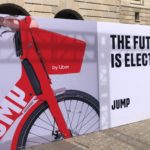
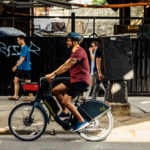
City streets will see thousands of rentable electric bikes this year with the expansion of Uber-owned Jump’s local fleet and the introduction of Helbiz, a New York City-based micromobility company founded in 2015.
Helbiz’s e-bikes hit D.C. Thursday, with a year-long permit issued by the District Department of Transportation. According to Helbiz, more than 500 of the company’s e-bikes are on the streets in the District. D.C. is the first U.S. city where Helbiz is providing e-bikes, per a release about the deployment. Helbiz anticipates it will have 2,000 e-bikes in the District over the coming year.
“We consider Washington one of the most important cities, not solely for the American culture, but also for the micromobility space. The DDOT is really open and interested to test new operators,” CEO Salvatore Palella told DCist.
Helbiz’s e-bikes cost $1 to unlock and 15 cents per minute to ride.
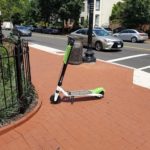
Under the city’s program for so-called dockless vehicles, which includes electric bikes and scooters, companies may expand their fleets throughout the year, provided they meet certain requirements. Jump was allowed to operate around 1,000 e-bikes in D.C. last year, and in 2020 is permitted to expand its fleet to 1,500. More than 5,200 e-scooters from eight companies are currently permitted today.
When DDOT recently moved to restrict the program to just four companies—cutting the current number in half and removing several that have been in the District from the beginning of the program—the agency was criticized for the opaqueness of the process (it has temporarily halted the decision to give excluded scooter companies time to appeal). Many wondered why Helbiz, a brand new operator to the city, had made the cut.
Palella suggests that it was because of the company’s emphasis on ensuring equitable access—residents who receive public assistance through the SNAP, TANF, and Housing Choice Voucher programs are eligible for unlimited free 30-minute rides through its Helbiz Access program—and on hiring local residents as full-time employees, rather than contractors.
“The only people who are allowed to touch the bike or recharge the bike are people who work full time for Helbiz,” Palella says. “Compared to our competitors, people aren’t working for us randomly or just for charging the bike … That was a main point of our application, and it was a main point for DDOT, for being on the same page with them.”
https://twitter.com/akent/status/1222917345091424257?s=20
The city’s dockless vehicles program launched in September 2017, attracting a handful of bike companies to District streets. Many of the initial companies have since left (remember Mobike and Ofo?), with some saying that DDOT’s regulations for dockless bikes were too restrictive (at first, companies were allowed to operate only as many as 400 vehicles each, whether scooters or bikes or both, and there still remains a 20 mph speed limit for e-bikes.)
But with program changes, up to 20,000 vehicles—split between 10,000 e-scooters and 10,000 e-bikes—could eventually operate in D.C. this year. The city is requiring providers to deploy their vehicles in all eight wards of the city.
Helbiz, which is is active in more than 20 cities worldwide, now has a warehouse and an office in the District. Palella says that they are focused on e-bikes for now, but eventually also hope to bring the company’s scooters and mopeds to D.C.’s streets.
Meanwhile, Capital Bikeshare is set to reintroduce its own e-bikes this year, WTOP reports, after the service’s initial e-bike fleet was pulled from D.C. streets in 2019 because of possible braking problems. In terms of parking, DDOT announced last week that it will soon install 100 corrals for dockless bikes and scooters across the city.
Margaret Barthel contributed reporting. This post has been updated to clarify the number of Helbiz bikes on D.C. streets.
There’s No Paywall Here
DCist is supported by a community of members … readers just like you. So if you love the local news and stories you find here, don’t let it disappear!