 Will Schick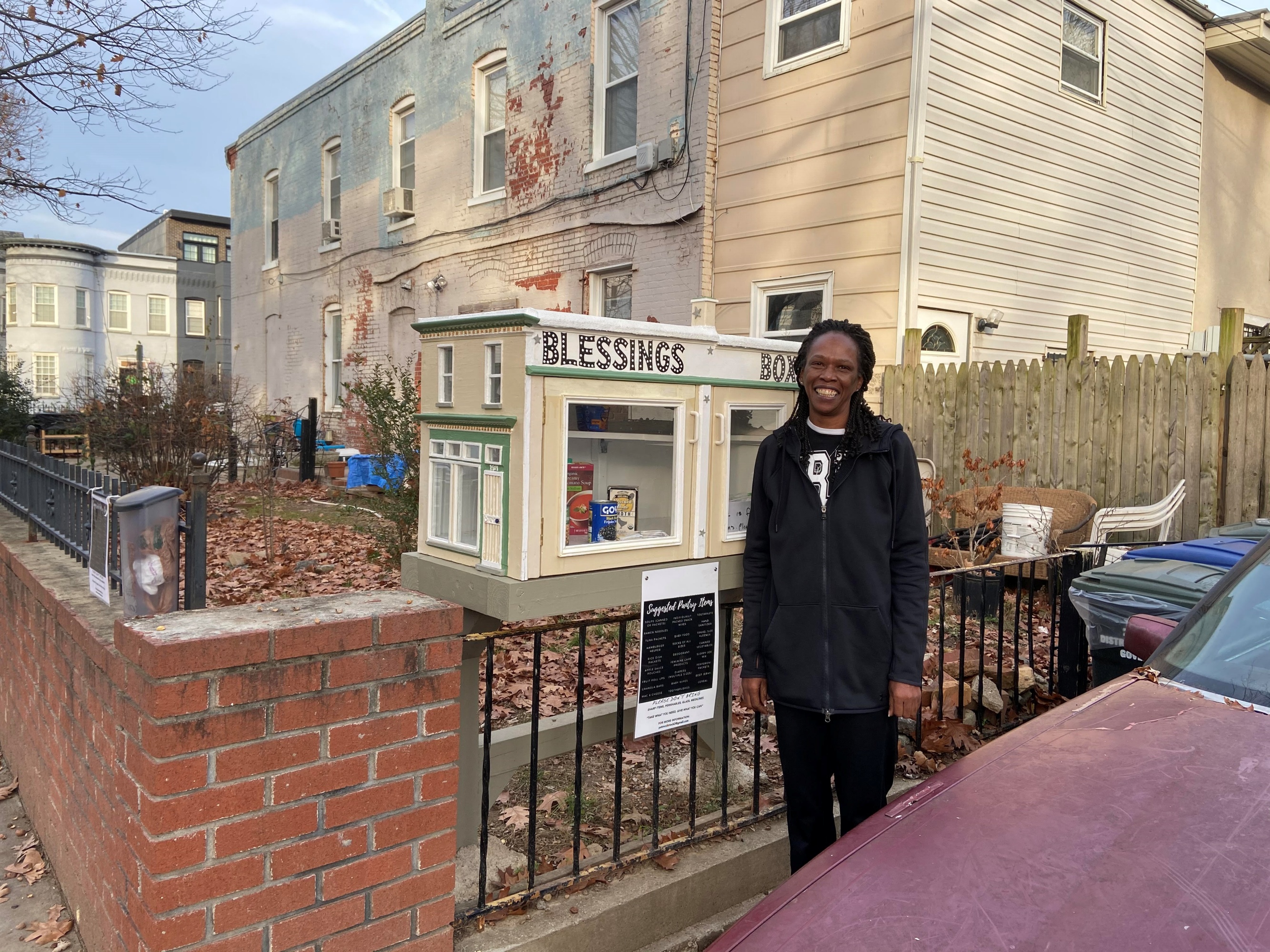
There’s a small mailbox pantry on the corner of 14th and E Street SE. The mailbox is a miniature replica of the home it stands in front of, and it’s stuffed full of canned goods and sundries. A sign out front explains how the pantry works: In short, take what you need, give what you can.
The mailbox pantry in Hill East comes courtesy of Wendy Hammond, a longtime resident of D.C., who set it up in November 2019. One neighbor designed and built what’s labeled as a “blessings box,” and others helped fill it with food. There are hundreds of similar mini pantries across the country, part of the little free pantry movement, which started in 2016 in Fayetteville, Arkansas as a community-driven effort to provide food to needy neighbors.
Ever since the box has gone up in her neighborhood, Hammond says it has become “a conversation piece,” jumpstarting community discussions about local history and frank talks about food insecurity and poverty.
Much like other parts of the city, Hill East is rapidly changing, with luxury apartments and condos getting built where older buildings once stood. The low-income population in some of the neighborhood’s census tracts has decreased by more than 30 percent from 2000 to 2016, according to a recent study from the Institute on Metropolitan Opportunity.
Across the street from Hammond’s house, a Safeway grocery store was recently demolished to make way for a new grocery store that will feature luxury apartments on top. Another well-appointed, deluxe apartment building, located just a block over from Hammond’s home, opened its doors in 2019. It offers leases for 1-bedroom apartments that start at $2,500 dollars a month. Next to that, there are signs announcing the forthcoming arrival of new 2-4-bedroom townhomes, and advertisements promoting the availability of newly constructed condominiums on the site of the former Buchanan school. The school was built in 1895 and closed its doors in 1992—the building was left unused until it was developers started work in 2017.
While Hammond’s little mailbox pantry is also, technically, a new addition to the neighborhood, it has a foundation that stretches back over 30 years. At that time, her grandmother, Velma Hammond, ran a local corner store and beauty salon at the very site of Hammond’s home. Back then, this area was a predominantly African-American neighborhood, and according to Hammond, it was a place where “everyone knew everyone.”
During this time, Hammond says her grandmother regularly set up tables outside the store where she placed free “bags of vegetables, greens, sweet potatoes, onions,” and other items for neighbors to take when they needed them. The goods would often come from the gardens of other neighbors, and from a local resident who worked with the Capital Area Food Bank, Hammond says.
Velma Hammond also encouraged her neighbors and relatives to leave other items like used clothes on the tables she arranged outside her store, and told people to take them, no questions asked.
The store eventually closed its doors, and Velma Hammond passed away in 2017. Wendy Hammond moved into the property a year ago. Shortly after, she said, she was approached by her neighbor Patrick McClintock, a longtime Capitol Hill resident who had known Velma Hammond and knew of the store’s history, and was asked if she would be interested in setting up a pantry.
Hammond remembers how she and her mother responded to McClintock’s idea: “We looked at each other, and I was like ‘Yes, that’s something we can start.’”
McClintock, a local massage therapist and community organizer, said he had read about the little free pantry movement and thought Hammond’s home was the perfect location for one: Being so close to the Potomac Avenue Metro Station, it sees quite a bit of foot traffic. McClintock says he felt like the community needed something like this now more than ever. “The mood in the cities and in the country is hopelessness,” he says, pointing to what he views as increasingly polarized and vicious politics.
Rosemary Wisniewski is another neighbor who helps McClintock keep the pantry stocked. A retired lawyer and Hill East resident, she worries that recent proposed changes to the requirements for programs like SNAP will likely exacerbate problems with food insecurity. From 2016 to 2018, 10.4 percent of District residents were “food insecure,” which is defined as not having “access at all times to enough food for an active, healthy life, ” according to a report published by the USDA Economic Research Service.
While the pantry is unlikely to be an end-all solution to those in need of food, Wisniewski and McClintock say they hope it lets people in the community know that others care about them.
A few weeks after the mailbox pantry went up in November, Hammond and other neighbors gathered to hold a ceremony. They christened it as a “blessings box” and called for those who give and take from it to be blessed.
Hammond says that the box “has really sparked something.” She says she has started to get to know more of her neighbors, many of whom are contributing, and her interactions with people in her community are starting to resemble those she had many years ago, when everyone knew each other’s name.
“It’s not my box—it’s a community box, and it belongs to the community,” she says. “And I know my grandmother is looking down and she’s smiling, knowing that her legacy is still moving on.”