Colleen Grablick
A new study out of University of California Berkeley found that a majority of self-identifying Native Americans take offense to the Washington NFL team’s name, contradicting previous research.
The study, which surveyed more than 1,000 individuals who self-identified as Native Americans, revealed that more than half of the participants found the Washington football team’s name offensive, as well as Native mascots more generally. The results found that 57 percent of participants who strongly identified with being Native American and 67 percent of participants who frequently engaged in tribal cultural practices reported feeling deeply offended by “caricatures of Native Americans,” according to a press release from U.C. Berkeley. The study, conducted by Arianne Eason, a UC Berkeley assistant professor of psychology, and Stephanie Fryberg, a psychologist at the University of Michigan, marks the largest scale investigation of its kind into attitudes towards Native mascots.
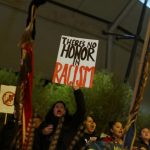
While Washington’s football team isn’t the only athletic organization with a Native American mascot, it often draws special attention because its name is considered a slur. For years, advocates and some politicians have called on the team to change its name, something owner Dan Snyder has refused to do.
The new UC Berkeley study reached a very different conclusion than polls conducted in previous years by the Annenberg Public Policy Center, the Washington Post and marketing research firm Wolvereye. In 2004, an Annenberg Public Policy Center study concluded that only 9 percent of Native Americans found the Washington team’s name offensive. The Post conducted its own study in 2016, and reached similar findings, with one in 10 Native Americans across every state and D.C. finding the name offensive. Most recently, a web-based poll through Wolvereye last August found 68 percent of Native Americans were not offended by the name. (DCist does not use the name, because it is a dictionary-defined slur.)
Eason told UC Berkeley that the study was motivated by an observed disconnect between what public opinion polls were showing and the frequent protesting and vocal objection to problematic team names by Native people.
Using some questions from the 2016 Post poll, the study prompted participants to disagree or agree on a scale of one to seven with statements like “I find it offensive when sports fans wear chief headdresses at sporting events” and “When sports fans chant the tomahawk chop, it bothers me.” The study also collected demographic information about the participants’ affiliation and involvement with a tribe or Native American culture.
“Ultimately, our study demonstrates that people who identify most with being Native American are the ones most likely to feel harmed by the continued use of stereotypical Native American team names and mascots,” Eason said in a press release from UC Berkeley. “This suggests that the debate over the continued use of Native mascots should be more closely attuned to Native American voices, particularly the voices of those who are most highly identified.”
The study, first flagged by Patch, is going to be published in the Social Psychological and Personality Science journal later this month, only weeks after another NFL team with a Native-themed name—the Kansas City Chiefs—won Super Bowl LIV. Fans faced criticism for “war chants” and “tomahawk chops,” and wearing face paint and headdresses, but the Chiefs defended the team’s traditions, saying in a statement that it uses its “platform to create an awareness and understanding of Native cultures.”
The Washington NFL team has faced continued pressure to change its name, especially in the early 2010s. In 2014, the U.S. Patent and Trademark Office canceled the team’s trademark, calling it “disparaging to Native Americans.” However, in a 2017 ruling that impacted the team, the Supreme Court ruled that the law that allowed the patent office to revoke trademarks violated the First Amendment. Since then, area schools like Green Acres and Sidwell Friends have banned apparel displaying the team’s logo.
There’s No Paywall Here
DCist is supported by a community of members … readers just like you. So if you love the local news and stories you find here, don’t let it disappear!