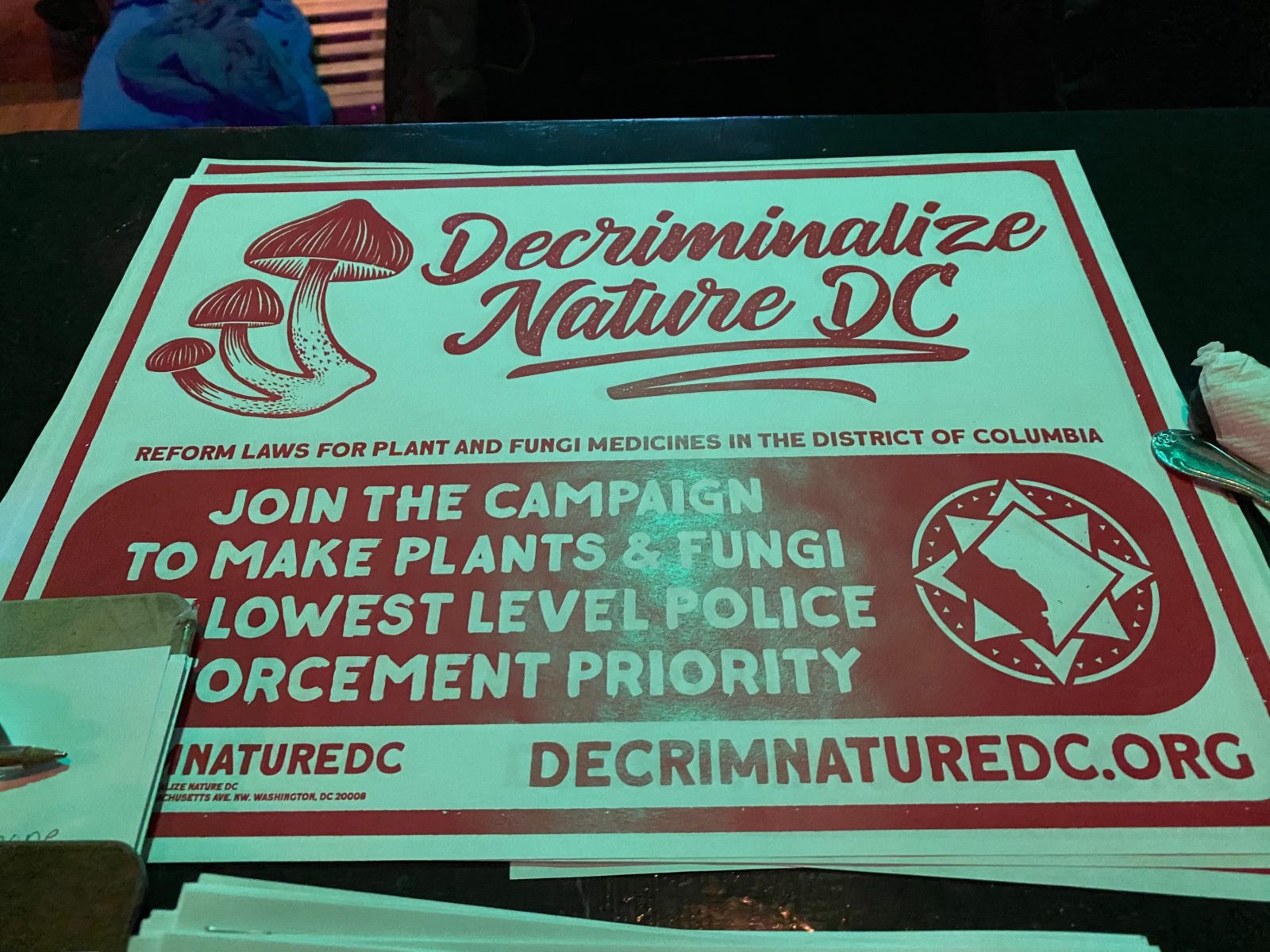
An effort to reduce police enforcement of laws against magic mushrooms and psychedelic plants in D.C. cleared a procedural hurdle on Wednesday, when the D.C. Board of Elections said the issue can legally be voted on by residents later this year.
That means that proponents of the initiative—formally known as the Entheogenic Plant and Fungus Policy Act of 2020—will soon have to start the arduous task of collecting more than 25,000 signatures from D.C. voters to put the measure on the November ballot.
If approved by voters, the initiative wouldn’t formally legalize or decriminalize the possession and use of magic mushrooms and psychedelic plants, but rather make enforcing those laws the “lowest priority” for police in the city. Both are currently listed as Schedule I drugs, which can bring heftier penalties.
Proponents specifically worded the initiative like that to avoid violating an existing congressional prohibition on D.C. taking any steps to lower penalties on marijuana or other illegal drugs.
“The proposed initiative would not in any way legalize, or reduce any penalty for possession, use or distribution, of entheogenic plants,” said Joseph Sandler, an attorney for Decriminalize Nature D.C., the group leading the effort. “It would simply enact new language establishing a new policy to be implemented by MPD.”
That was the same approach used in Denver, where voters approved a measure last year to make enforcement of drug laws against mushrooms a low priority. The Oakland City Council followed suit last June, and there are now efforts in dozens of cities across the country to ease penalties on psychedelic mushrooms and plants.
Speaking to the board on Wednesday morning, proponents and supporters of the ballot initiative hailed the medicinal benefits of psychedelic mushrooms and plants.
“Entheogenic plants saved my life,” said Jesse Gould, a veteran and founder of the Heroic Hearts Project, which connects veterans to Ayahuasca treatment, a vine native to South America that can be used as a tea. (An entheogen is a psychoactive substance that can induce a “spiritual experience.”)
“Recent clinical trials demonstrate the powerful therapeutic uses of various psychedelic substances, particularly psilocybin, in relieving … anxiety and depression in terminally ill patients,” wrote Mikhail Kogan, the medical director of the George Washington Center for Integrative Medicine, using the formal name for magic mushrooms.
With approval from the board in hand, proponents will have to quickly build up a campaign that will need to collect signatures from at least 5 percent of registered voters across the city, including from 5 percent in at least five of the city’s eight wards, by July.
Melissa Lavasani, a D.C. government employee who is leading the campaign, says educating the public on the use of mushrooms and psychedelic plants will be one of the biggest challenges. She used psilocybin to address depression and anxiety that developed after she gave birth to her two kids.
“People are suffering. And if you’re not suffering, you know someone that’s suffering. This issue really touches a lot of people in this country. Our message is we want to educate you on safe use, we’re not advocating for partying with it. This is very serious work for us,” she said.
This won’t be the first time that drug policy has come up at the ballot box. In 1998, D.C. voters signed off on medical marijuana, and in 2014 further legalized the possession, personal use and home cultivation of small amounts of marijuana. But in both those cases Congress initially stepped in to overrule D.C. voters; the city’s medical marijuana program was in limbo for a decade because of Republican opposition.
Lavasani says she’s focusing on one thing at a time. “This was a big hurdle. It’s so exciting that it got approved,” she said. “Now we can focus on educating people and gathering signatures that we need to get on the ballot.”
This story originally appeared on WAMU.