Most people know soccer star Kelley O’Hara as a tenacious member of the 2019 U.S. Women’s World Cup championship team. Before she competed in two World Cups and two Olympics, the Stanford University graduate also excelled in another field: academics.
A lifelong love of math and science led O’Hara to college classes in product design, coding and classic science, technology, engineering and mathematics (STEM) topics. She ultimately majored in science, technology and society, with a focus in environmental engineering.
If not for her athletic success, O’Hara may have followed a few of her Stanford classmates into the renewable energy industry. And someday, when she retires from soccer, she may want to work with sports teams and stadiums looking to make their operations more sustainable.
In the meantime, O’Hara regularly integrates STEM concepts into her work as a professional athlete and public speaker.
“Athletes track everything. We have apps, we have devices, we have programs that help us improve,” she said. “Even though I’m not working in a STEM field, I’m always working with technology.”
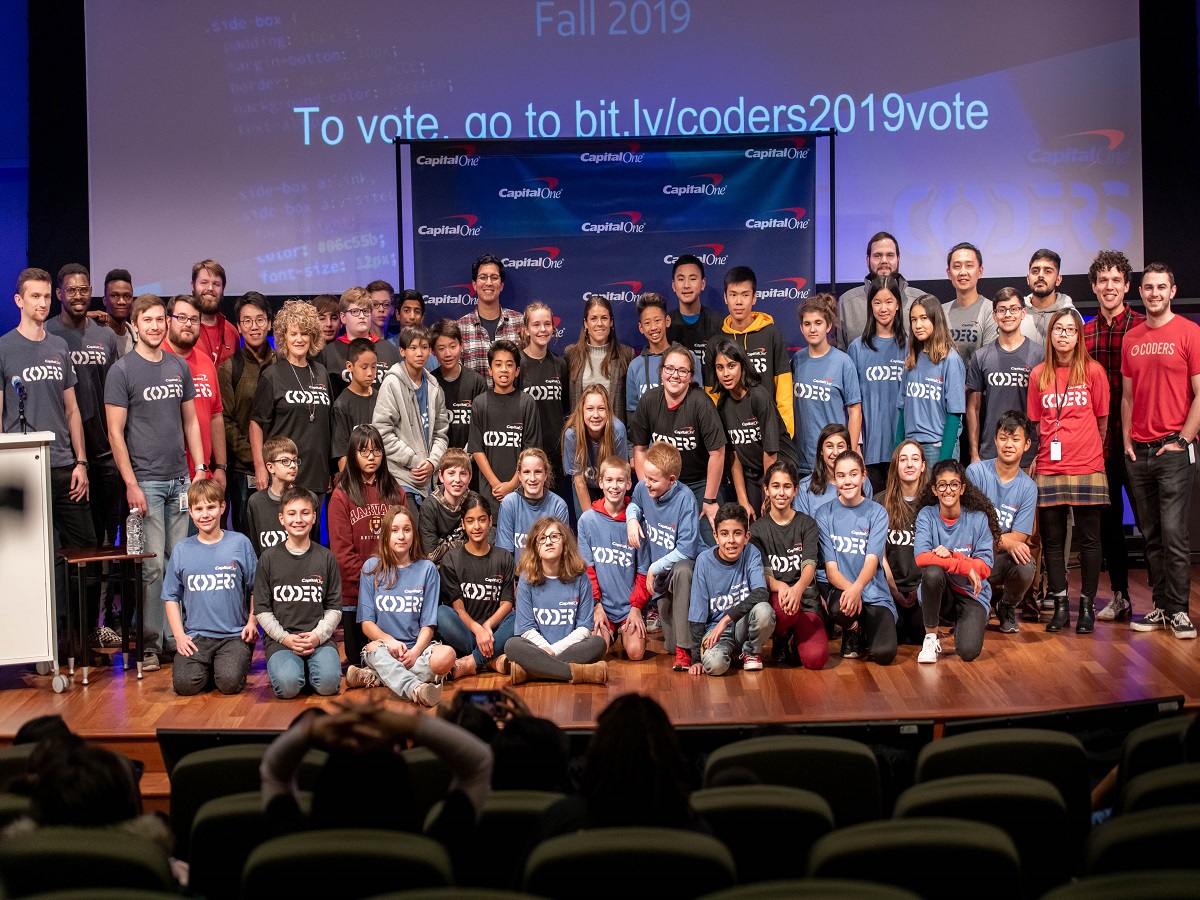
O’Hara shared a similar message with Washington, D.C.-area students in December, when she was the keynote speaker at a Capital One Coders celebration. The volunteer-run program brings Capital One employees into local classrooms, where they mentor and teach coding and application-design skills to middle school students.
During weekly Coders classes and “Ignite” workshops, students learn the basics of algorithms, loops and conditional statements before building their own mobile applications with the open-source MIT App Inventor tool. At the end of each program, the students demonstrate and show off their apps for friends and family at a special celebration event. Some enterprising students even win awards for creativity and technical implementation.
Since Capital One Coders was established in April 2014, the program has served over 15,000 students through partnerships with some 120 schools and nonprofit organizations across 11 cities. Capital One volunteers have dedicated more than 90,000 hours to Coders activities, the company reports.
O’Hara said she jumped at the opportunity to partner with Capital One and its employees on the innovative initiative. She views participating volunteers as positive role models who introduce potential new career paths to young students. According to the National Science Foundation, children who learn technological skills during their formative years also are better positioned to succeed in the digital age. STEM classes give future leaders the skills they need to respond to evolving workplace dynamics, generate new ideas and solve complex challenges, says the U.S. Department of Education, and a STEM education can mean higher future earnings. A recent Pew Research Center analysis links college-level STEM training to higher earnings, whether or not an individual works in a STEM occupation.
Students gain important perspectives from Capital One Coders activities, O’Hara added, even if they don’t naturally gravitate toward STEM classes.
“Life is about trying new things and learning new skills, even when you don’t feel comfortable or confident about something,” O’Hara said. “I encourage kids to explore all kinds of activities, because that’s how we learn, grow, evolve and find out what we are passionate about.”
Programs such as Capital One Coders can be especially beneficial for young girls, since women are underrepresented in several STEM careers. In 2019, the National Center for Education Statistics reported that women received 58 percent of bachelor’s degrees overall, but only 36 percent of the degrees awarded in STEM fields. The Pew Research Center found that the share of women working in computer science, software development and related fields has decreased by seven percent since 1990.
“As a female athlete, I’ve come to realize the importance of visibility. When little girls watch our games on television, they understand that maybe they can do this one day,” O’Hara said. “The same thing happens when I speak about STEM and what it means to me. Young girls and boys alike learn that there are so many professional opportunities for women in this field.”
Jay Sanne, one of the executives leading the Capital One Coders program, speaks personally about the long-term impact of STEM opportunities. Sanne studied English in college, but followed an unexpected career path after completing tech internships and a software engineering boot camp.
Today, as a managing vice president at Capital One, he and his team write the code that fuels digital banking experiences for the company’s customers.
“That boot camp introduced a whole world that I had never imagined. I learned firsthand how you can use technology to benefit individuals and organizations,” he said.
He sees a similar spark when he visits Capital One Coders classrooms. Students buzz with excitement as they design games, write code and troubleshoot their own apps. As they navigate challenges related to software and hardware, they also strengthen communication, leadership, problem-solving and presentation skills.
“When students demonstrate their apps, I like to ask about their choices and the code behind their work. Often, they’ll launch into how they want to improve it and what they plan to do next,” Sanne said. “In those moments, Coders has really achieved its goal of inspiring kids to pursue STEM endeavors.”
In addition to inspiring students, the program lays the foundation for their futures. According to a recent analysis of 26 million job postings, nearly half of all jobs in the top-earning quartile require some level of coding skills. As technology advances and new opportunities unfold, however, educational gaps threaten to leave some students behind.
Capital One aims to bridge those gaps through Coders and related outreach funded by the company’s Future Edge initiative. The five-year, $150-million campaign prepares Americans for 21st-century career opportunities.
“Technology is part of an increasing number of jobs. We deal with a lot of data here at Capital One, as do many businesses in our digital world, and the ability to interpret that information quickly is paramount,” Sanne said. “Whether you are a technologist creating software that interprets the data, or you are a consumer using the technology, you need to understand how it works to be effective in what you do.”
In addition to the success of Capital One Coders, program leaders know how important it is to impact the entire community in a positive way.
“From a Capital One perspective, exposing people to technology, preparing them for 21st-century jobs and supporting small businesses are really important ways of showing our community impact,” Sanne said. “On a personal level, I went from [an] English major to technology patent holder in a very short period of time. It completely changed the course of my life. I like to think that we are paying that forward.”
While the inaugural Coders participants haven’t yet graduated from college, Sanne looks forward to handing a paycheck to the first one who joins the Capital One team as an employee.
“That will be a measure of the real impact that we can have,” he said.