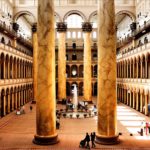
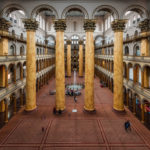
When the National Building Museum reopens in March after a major renovation to the floor of its iconic Great Hall, it will have a brand new visitors center and several months’ worth of planned exhibits. But something will be missing: about 8 percent of its staff.
Layoffs representing the biggest employee reduction at the nonprofit museum in recent memory took place in January. Seven staff members across various departments were let go, Chase Rynd, the museum’s executive director, confirmed to DCist.
The staff reduction coincided with a drop in revenue related to the ongoing renovation project, along with broader financial challenges, according to Rynd. Repairs to the ceramic floors forced the closure of paid exhibits and the Great Hall, which is often used as a space for private events, starting in December. (Both the museum’s gift shop and offices have stayed open during the renovations.)
“What that challenge did is reveal to us that, like a lot of nonprofits, we were trying to do more than we can with the revenue we have,” he said, adding that he consulted each department head about the staff cuts. Over 75 employees remain at the National Building Museum, though not all of them are full-time salaried positions.
While the museum turns 40 this year, the Renaissance Revival building it occupies—the old Pension Building—is much older, having debuted in 1885. The General Services Administration, which maintains the federally owned building in Penn Quarter, is replacing the Great Hall’s concrete floor with an updated foundation.
Rynd, who has led the museum since 2003, added that the staffing cuts were difficult but necessary for the museum’s long-term sustainability. The museum will overhaul its lineup of free and ticketed programs to readjust to the smaller staff size. “We will be doing a little less of this or that,” he explained. “It’s not like we’re throwing out all youth programs. We are adjusting our scales.”
Popularly known for its interactive and extravagant summertime installations, the National Building Museum was created by an act of Congress in 1980. Unlike Smithsonian properties located a few blocks away, however, it has charged admission fees since 2011, which Rynd said was due to the lasting impact of the recession. The price of a general admission ticket for an adult was $10 last year (access to previous special summer exhibitions cost $16 for non-member adults).
That puts the National Building Museum among the few museums in the area that charge for admission, competing for visitors with the free Smithsonian. Building Museum attendance in fiscal year 2018 was 522,000, an increase of 13 percent over the prior year, but down five percent as compared with the year before that.
Mid-last month, museum staff were pulled into an unexpected meeting with management and told to anticipate staff cuts because the museum has been struggling financially, according to a person with knowledge of the situation. Days later, the affected staffers were privately notified that their positions were being eliminated and were promised severance payments, said this person, who requested anonymity citing potential professional repercussions.
In a written follow-up statement, Rynd said the cuts were part of broader financial planning for the museum. “Rather than only address the ‘one-off’ impact of this construction project, we felt that this was an opportunity to take appropriate measures to also right size the institution to match more sustainable budgets in the future and to reorganize and to review and readjust (as needed) our programs and activities to fit those budgets,” he told DCist.
The National Building Museum’s tax filings show that the museum’s net income has fluctuated widely over the past several years: It was positive in fiscal year 2018 ($383,323) and from 2013 through 2015, but negative in fiscal years 2016 (-$740,780) and 2017 (-$163,916). Program services and donations have consistently brought in the most revenue for the museum; for example, in fiscal year 2017, they were 46 percent and 40 percent of revenue, respectively.
Rynd said the museum’s board of trustees increased and accelerated their annual monetary pledges after learning of the financial situation over the past several months, helping with the museum’s cash flow. Still, his efforts to bring in new major benefactors before the renovation were unsuccessful, he said, and staff was the only area left to cut.
The remaining staff is currently working on multiple grant proposals and drafting a strategic plan to use the museum’s resources more sustainably. “We’re on the right course, in part because we have wonderful models in the museum world,” Rynd said.
Other items slated for the reopened museum include the upcoming summer installation in the Great Hall, a Shakespearean playhouse in partnership with the Folger Shakespeare Library, and new educational programs for grade-school students.