 Victoria Chamberlin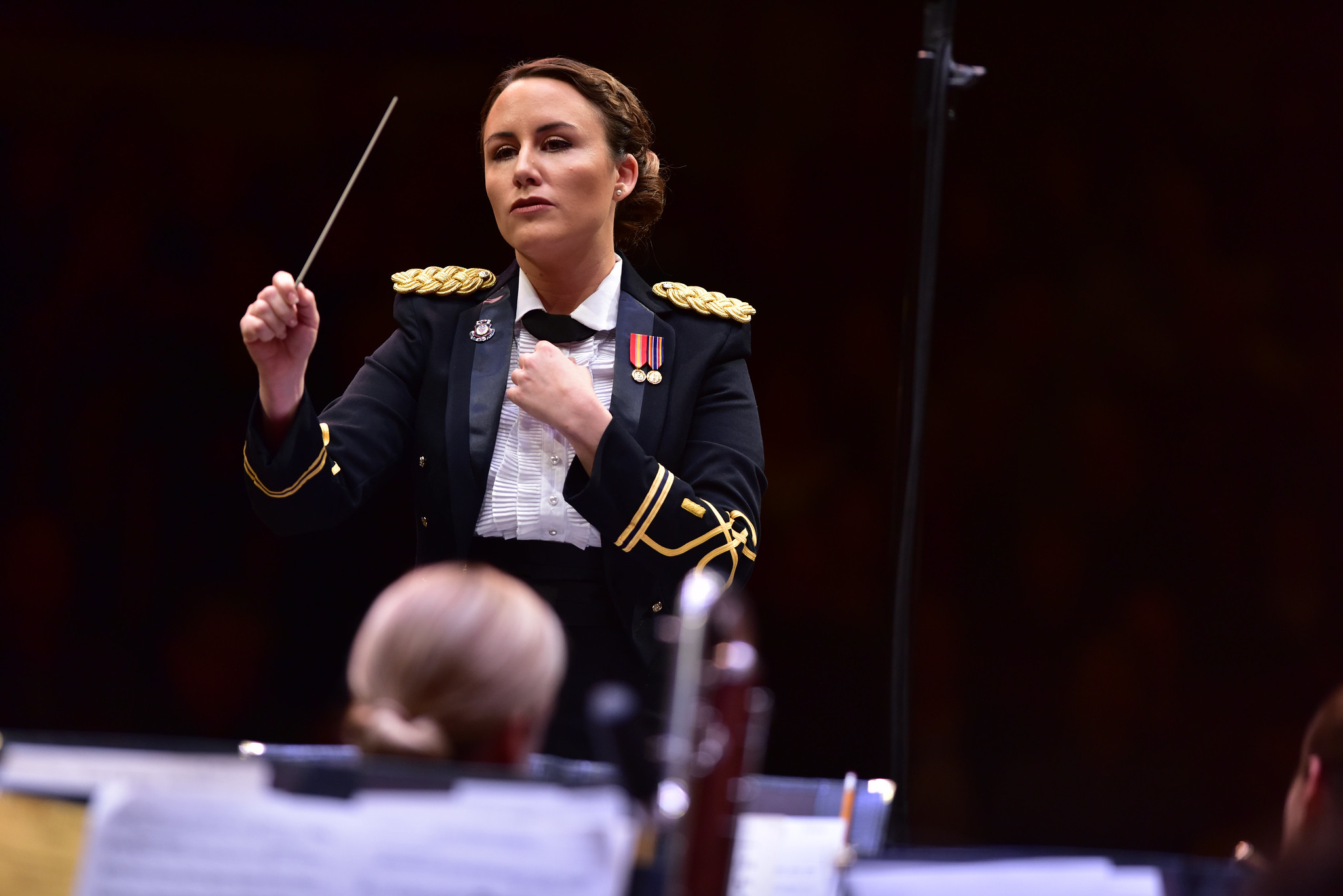
Turning to music for comfort was always a natural thing for Army 1st. Lt. Elizabeth Elliott, an officer in the Army Band. She turned to that familiar place on November 8 2018, when her daughter Madison was stillborn a day after her heart stopped beating.
While in active labor at VCU Medical Center in Richmond—knowing her pain was only beginning—Elliott searched in her mind for a way to keep her daughter’s memory alive.
“I have to bury my baby,” she remembers thinking. “What am I going to do to keep her with me?”
As she recovered from labor in the hospital, she realized she wanted to memorialize Madison through music. She lay awake trying to think of pieces of classical music written about the loss of a child and came up short.
This weekend, the U.S. Army Band “Pershing’s Own” will perform the debut of a new piece inspired by her experience, composer Brian Balmages’ Love and Light, at the Rachel M. Schlesinger Concert Hall and Arts Center in Alexandria.
The piece is scored for wind ensemble and incorporates elements of a lullaby throughout, loosely based on the chord progressions of Ben Folds’ song “The Luckiest,” which Elliott played on the piano for her daughter during her pregnancy.
Around the start of her second trimester, Elliott, who is stationed at Fort Eustis in Virginia, learned that her blood showed elevated protein levels, and that her amniotic fluid seemed low. Her doctor suggested she stay as hydrated as possible as a precaution.
“It became like my job to just drink as much water as I can,” Elliott says. “Whatever was in my control, I was gonna control it.”
But when she went for her next appointment, the fluid level was even lower. Her military doctor suggested introducing more fluid into the placenta, but the procedure to do so would be risky. Elliott asked for a second opinion from a civilian doctor.
“She was the first one to give it to me straight,” Elliott says. “She told me that from the beginning, the placenta hasn’t been giving your baby enough nutrients.”
Two days later, the Elliotts went to their final ultrasound appointment. “[My husband] Scott asked me that day ‘How do you feel?’ And I said, ‘I feel weird,’” she recalls. “It was just an intuition.”
The ultrasound tech squeezed the cold goop onto Elliott’s 21-week belly and began reciting the measurements of the baby’s legs and abdomen. Next, the circumference of her head. But no mention of the heartbeat.
A grandfatherly doctor came into the room a few minutes later and Elliott began to cry. The doctor placed his hand on her gently, and asked if she had been spoken to about her prognosis before that day.
“I’m so sorry,” he said to her.
Madison Hope Elliott was stillborn on November 8, 2018 at 8:18 in the morning.
“You deliver on the same floor as all the other women who are delivering babies that are alive,” she remembers with tears in her eyes. Elliott was in labor for 12 hours, listening to other babies being born and crying their first cries.
“You’re going through the pain of labor knowing you’ll be with your baby at the end, and for me, this pain was just the beginning,” she says.
With a long road of pain and recovery ahead, Elliott knew she wanted to be open about her experience from the beginning, and had to figure out a way to grieve while being there to lead her soldiers. A week after she returned to work, she addressed the issue head-on in formation.
“They all knew why I was gone. But they didn’t know what to say to me, and I didn’t know what to say to them,” she says.
Elliott thinks the ordeal has made her a more empathetic leader.
“I’m much more aware of the struggles my soldiers might be going through,” she says. “You can’t really be there for a person experiencing a loss fully, until you have gone though that yourself.”
Two months after giving birth to Madison, she reached out to Baltimore-based composer Balmages with the idea to commission a piece of music to honor Madison’s memory and provide the comfort Elliott felt from music to others. Something that could help someone cope with a tremendous loss.
“My first reaction was that what business do I have to even try to tackle that,” Balmages tells DCist. “But after speaking with her and hearing her story and all the emotions with it, it started to make me feel it.” Balmages set out to answer difficult questions through the piece, Love and Light.
“I wanted to know, what does it sound like when a child first sees the face of God? What does unconditional love look like?” he says.
The composer drew from his own life for inspiration, through the death of his father and difficult medical issues with his son. Balmages hopes that his piece will start a conversation about grief and help others heal. “I hope this piece will help others the way music has seen me through the hardest times in my life,” he says.
As an Army Band officer, Elliott leads her soldiers in rehearsals and performances, guiding the way musicians interpret the music they’re playing. Balmages insisted that given Elliott’s expertise and deeply personal connection to the music, that she be the one to lead the band in the world premiere of his piece.
Elliott will be at the podium, conducting the group in a maternity dress.
Her son Oliver James will be born in April.
The U.S. Army Band’s performance will take place Saturday at the Rachel M. Schlesinger Concert Hall and Arts Center. 6:45 p.m. doors, 7:30 p.m. show. FREE with registration
This story has been updated to correct Elliott’s son’s due date, and that she will be wearing civilian clothes for the performance.