Jacob Fenston
D.C. has been making progress cleaning up the Anacostia and Potomac rivers, to the point where those long-polluted waterways could soon be safe to swim in. But recently, management at D.C.’s water and sewer authority has been considering scrapping a major part of the cleanup project, potentially continuing to dump more than 600 million gallons of sewage into the Potomac each year, for years to come.
The court-mandated project is known as Clean Rivers, and it’s one of the biggest — and priciest — infrastructure projects in the city since Metro was built. It consists of 18 miles of tunnels; they’re wider than Metro tunnels, and deeper underground. The whole project has a price tag of $2.7 billion. The vast majority of that is being paid for by residents with a Clean Rivers fee — currently $21 a month (about a fifth of the average residential water bill).
Throughout the spring and summer of 2019, DC Water officials spoke publicly about wanting to modify the project, with an eye to saving ratepayers money. But as deadlines with federal regulators loomed, and after pushback from local officials, DC Water backed off the idea — for now. Still, the episode shows the high stakes of the project: At the same time environmentalists and regulators are demanding the cleanup be completed on a tight schedule, some residents are accusing the utility of driving low-income people out of the city with exorbitant water bills.
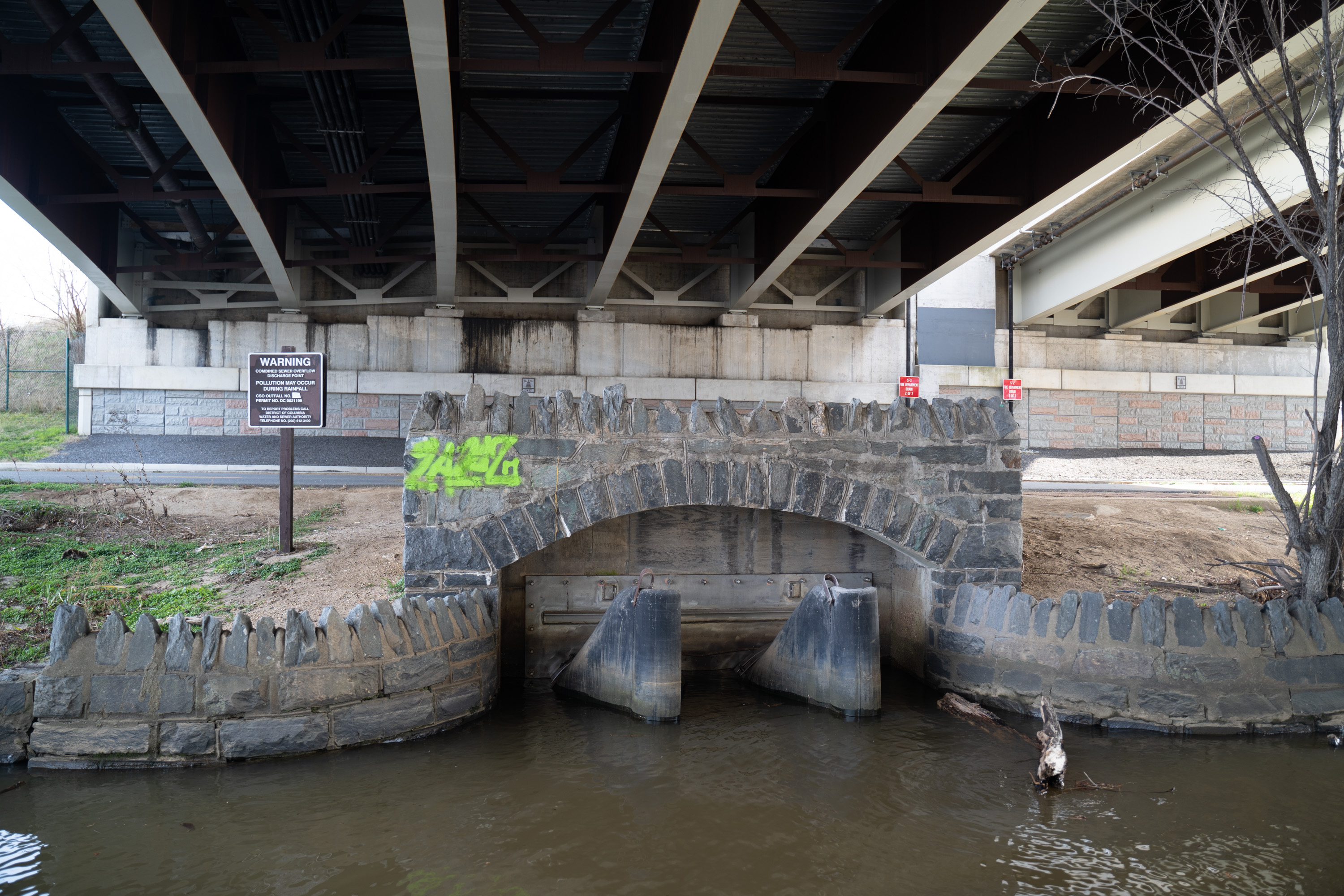
Combined sewer outfall 7, under the 11th Street Bridge, drains sewage and stormwater overflow from Historic Anacostia.
A History Of Pollution, A Pricey Fix
Ever since Washington’s first sewers were built in the 19th-century, those sewers have dumped untreated waste directly into the city’s rivers. To get a view of the problem up close, I hopped in a boat with Jim Foster, president of the Anacostia Watershed Society, and motored down the Anacostia River.
Foster maneuvered the boat around bridge pilings, up to a large opening on the shore.
“It looks like a little stone fortress,” he said, describing the opening.
The stone structure could be a scenic overlook, or other park feature, if it weren’t for the small brown warning sign reading: “POLLUTION MAY OCCUR DURING RAINFALL.” This spot marks a combined sewer outfall — there are 47 of them lining the banks of the Anacostia, Potomac and Rock Creek. Until recently, outfalls on the Anacostia would open up, spewing raw sewage into the river, more than 80 times a year.
“It’s huge,” says Foster. “In a river that has very little flow, this was a huge amount of sewage that would get into the river, and just cause these incredibly high levels of bacteria.”
Twenty years ago this month, the Anacostia Watershed Society sued DC Water over the sewage pollution. The result was a consent decree — a legally binding agreement with the Environmental Protection Agency. DC Water agreed to build the sewer tunnels. The first tunnel went online in March 2018, preventing 90 percent of sewage overflows into the Anacostia River and keeping 7 billion gallons of untreated sewage out of the river — along with 3,100 tons of trash. The second tunnel is under construction: a 650-ton boring machine named Chris is chewing its way under the city at a rate of about 50 feet a day. Chris is currently beneath New York Avenue Northeast.
But the third tunnel, which will stop pollution in the Potomac, is still a ways off from going online. In recent months, DC Water officials have been eying that final tunnel — and its half-billion-dollar budget. The idea was to go back to the EPA and renegotiate the consent decree, possibly removing the Potomac tunnel from the agreement, or asking for an extension for the tunnel’s completion date.
David Gadis, DC Water’s CEO, brought up the issue during a public town hall in Ward 7 in June. The agency’s chief operating officer, Biju George, was leading the effort, Gadis said.
“We’re now taking a look at the consent decree,” Gadis said. “I’ve asked Biju to take a look at reopening the consent decree, and see if we can bring forward some modifications to ease the burden on our customers as we move forward.”
Gadis has not said publicly that the modification he wanted was to cancel the Potomac tunnel in particular, and he declined multiple requests for an interview. But according to two people familiar with the discussions, the Potomac tunnel was on the chopping block. Diverting the Potomac tunnel’s $560 million budget could lower water bills for residents and allow the utility to pursue other priorities.
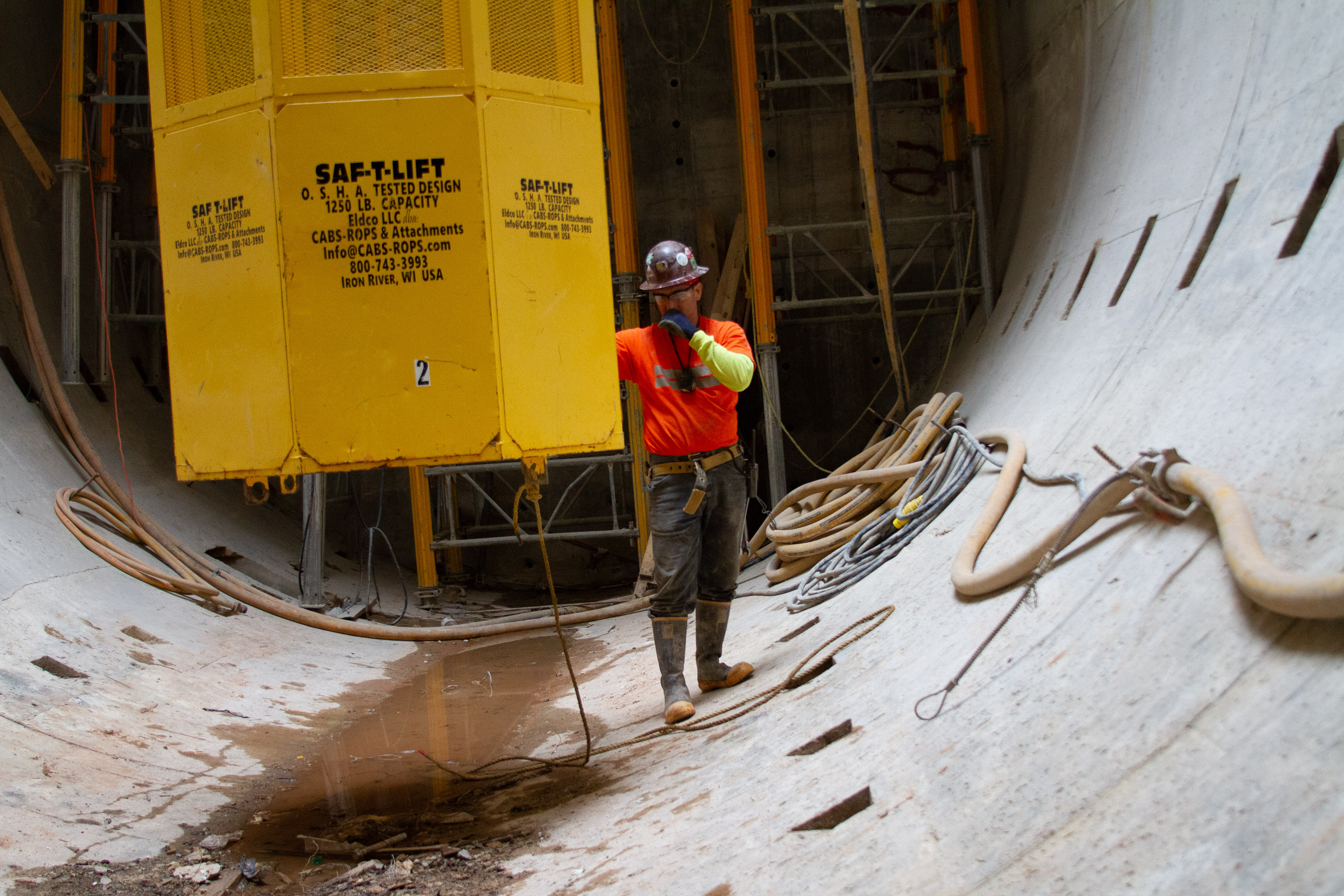
A worker inside the Anacostia Tunnel.
‘Solving A Problem That Needs To Be Solved’
Potomac Riverkeeper Dean Naujoks was outraged to hear DC Water was considering scrapping the tunnel or asking for an extension.
“Washington, D.C., should not be reaching out to EPA and asking for more delays on this project,” said Naujoks. “We want them to end sewage dumping by 2030, absolutely no later.”
The Trump administration has been going easy on polluters, said Naujoks, leaving D.C. with a choice:
“Do we commit to providing safe, clean water for future generations and restoring this river? Or are they going to take this carrot from an EPA and a Department of Justice that really doesn’t care about water quality, that has demonstrated that they’re not concerned about public health?”
D.C. is far from the only city with a sewer overflow problem. There are more than 700 cities around the country with similar antiquated systems, many of them currently under federal consent decrees, just like D.C. These old systems combine stormwater from streets with sewage from buildings. It all goes in one big pipe, which fills up and overflows any time there’s a big storm. This was state-of-the-art design in the late 1800s.
“One hundred years later, it is a significant design flaw,” said George Hawkins, former CEO of DC Water. Hawkins oversaw the Clean Rivers project for almost a decade until 2018. He acknowledges fixing this “design flaw” is a massive undertaking, but he said, “it simply must be done.”
“I personally believe that while an assessment of where money can be saved and looking at affordability is always important, at this point sticking to the plan we have now would be what I would recommend,” said Hawkins. “It is solving a problem that needs to be solved.”
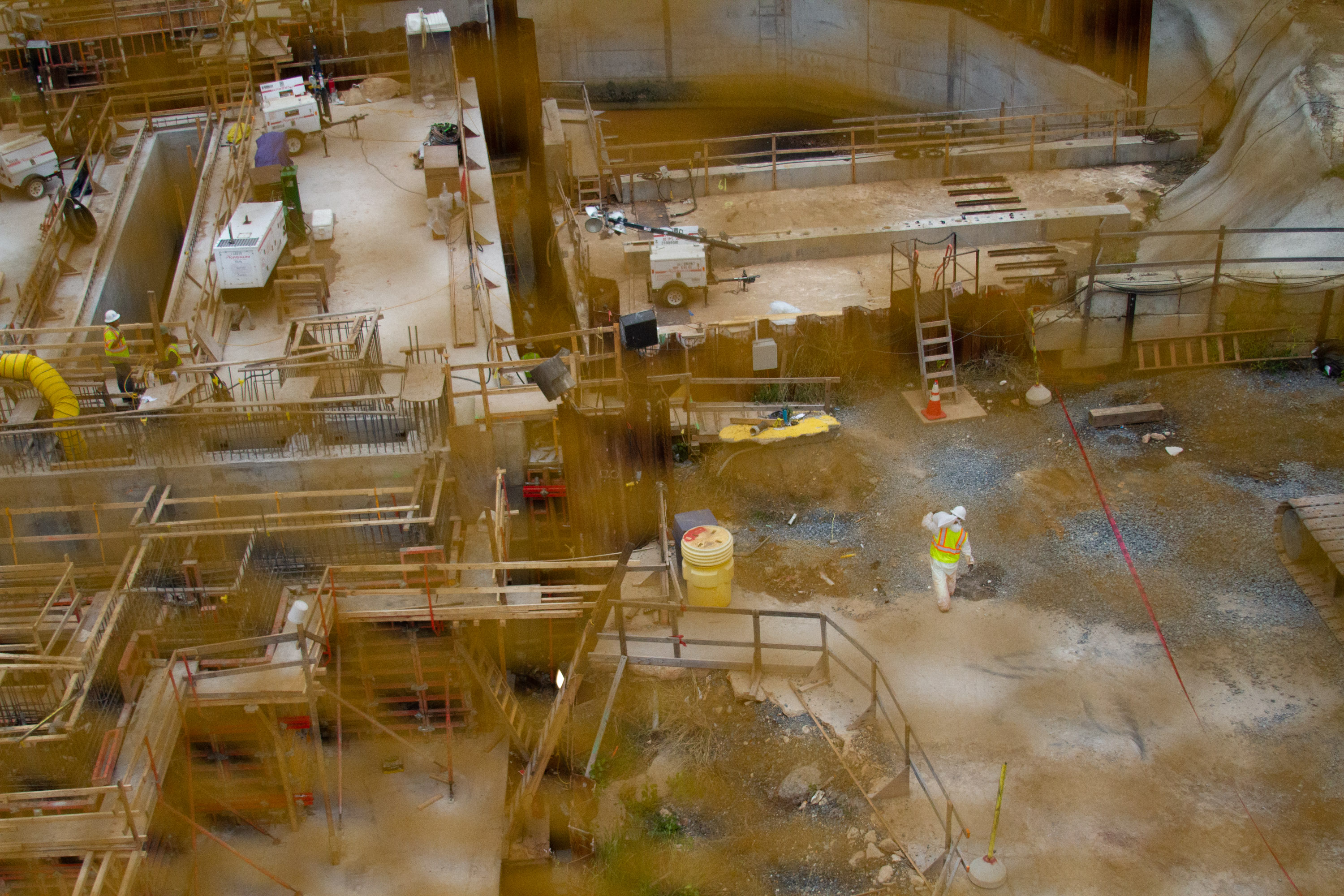
A Clean Rivers construction site near RFK Stadium, seen through a mesh cage being lowered by crane into the tunnel.
An ‘Unfunded Mandate’
The issue of affordability is a real one, and one that many cities are grappling with.
Adam Krantz, CEO of the National Association of Clean Water Agencies, said the federal government is not doing its part to fund these huge projects. Congress passed legislation in 2000, requiring cities with combined sewers to stop dumping waste. Lawmakers authorized significant funding, said Krantz, but, “none of that funding ever got appropriated.” Utilities were left on their own to figure out how to pay for the projects, mostly passing the cost onto ratepayers.
“Some people want to call that an unfunded mandate,” Krantz said.
Whatever you call it, Krantz said regulators are asking utilities to do more and more but, “there’s no money coming in to deal with those issues.”
The affordability issue blew up in D.C. during 2017 and 2018, when some churches, cemeteries and other non-profits reported water bills as high as $18,000 a month because of fees to pay for the Clean Rivers Project.
At a D.C. Council hearing in May 2018, residents said high water bills were forcing churches and residents out of the city, accelerating gentrification.
“Water is a necessity and not a privilege,” said Patricia Fears, a pastor at Fellowship Baptist Church in Ward 4. “The city must stop stripping away its culture and its history by eliminating long-term residents through oppressive water charges,” she said, to applause. “People are being driven out of the District.”
But former DC Water CEO George Hawkins said the question of unaffordable water bills is a different question than whether to move forward with the project.
“You can focus on the former, which is how to help the affordability of the project for particular categories of your customers, without sacrificing the latter, which is, this is a problem we need to solve, for everyone in the city,” said Hawkins.
After the Council hearing in 2018, the District government and DC Water established two new programs to help residents and organizations struggling to pay the Clean Rivers fees. A relief program for low-income residents now provides a discount of up to $65 off water bills, while a program for non-profits reduces Clean Rivers fees by up to 90 percent.
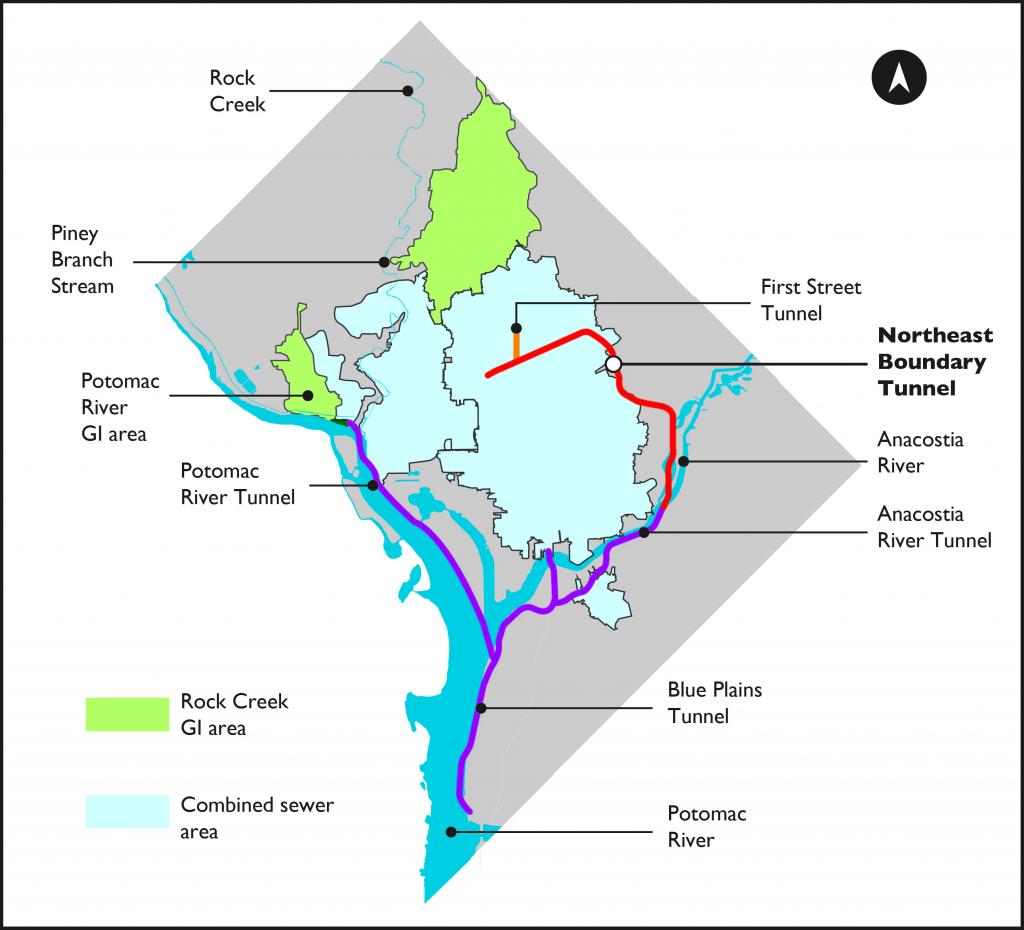
A map showing the 18 miles of tunnels planned to keep sewage out of the rivers.
DC Water Recommits To The Potomac Tunnel
Earlier this year, DC Water officials backed away from the plan to reopen the consent decree.
According to people familiar with the decision, part of it was made after DC Water realized the timeline was too tight to get EPA approval. It would take at least 18 to 24 months to get approval for any modification to the consent decree and, in the meantime, DC Water would have to be well on its way toward building the Potomac Tunnel in order to remain in compliance with the current consent decree.
Maybe even more important than the timeline: There was blowback from local officials, once they got wind of DC Water’s plans.
Mary Cheh, who chairs the environment committee on the D.C. Council, wrote a letter to DC Water’s David Gadis on Feb. 6, urging him not to reopen the consent decree. She ended the letter with a threat: If DC Water decided to cancel the Potomac tunnel, she wrote, “I would be forced to introduce emergency legislation to prohibit you from doing so.”
“It’s not going to get easier to fix,” Cheh said in an interview. Reopening the consent decree, she said, would be “kicking the can down the road,” and shifting the burden to future generations. “It may even make the problem worse. The sooner we fix it, the less harm will accrue.”
Cheh received a reply from Gadis five days later on Feb. 11.
“Given the importance of the Clean Rivers Project, I want to assure you that we have no plans to deviate in any way from the terms of our existing consent decree,” Gadis wrote.
However, DC Water’s level of commitment to the Clean Rivers project seemed to be evolving, over the course of just a few days. In an earlier statement provided to WAMU, on Feb. 4, Gadis left the door open to modifying the consent decree. “DC Water will continue to explore every opportunity to save our ratepayers money, including the possibility of reopening the consent decree that is the basis for the Clean Rivers Project,” the statement began. “At this time, however, we feel the benefits of the project for the District and its residents make it prudent to stay the course and complete our commitment to cleaning up our local waterways as planned,” the statement continued.
Potomac Riverkeeper Dean Naujoks and other environmental advocates met with DC Water officials on Feb. 19. Naujoks said they “swore up and down” that the consent decree is now “off the table.” Still, he said, “Our job as riverkeepers is constant vigilance, things like making sure a legally-binding consent decree stays in place and is not reopened.”
For decades, D.C. has been working toward swimmable and fishable rivers, the goals set by the landmark Clean Water Act passed by Congress in 1972. It has often seemed a far off possibility: restoring the Potomac and Anacostia to the point where they’d be safe to jump in any day of the year, and where you could cast a line and eat what you caught without fear. Fixing the sewage dumping problem was probably the single biggest hurdle, and that solution is just a few years off. If DC Water moves ahead with the project as promised, the final tunnel will open in 2030.
This story was updated to correct the spelling of the name of DC Water CEO David Gadis, and to add an update from the Feb. 19 meeting between DC Water and Potomac Riverkeeper.