Natalie Delgadillo
 Margaret Barthel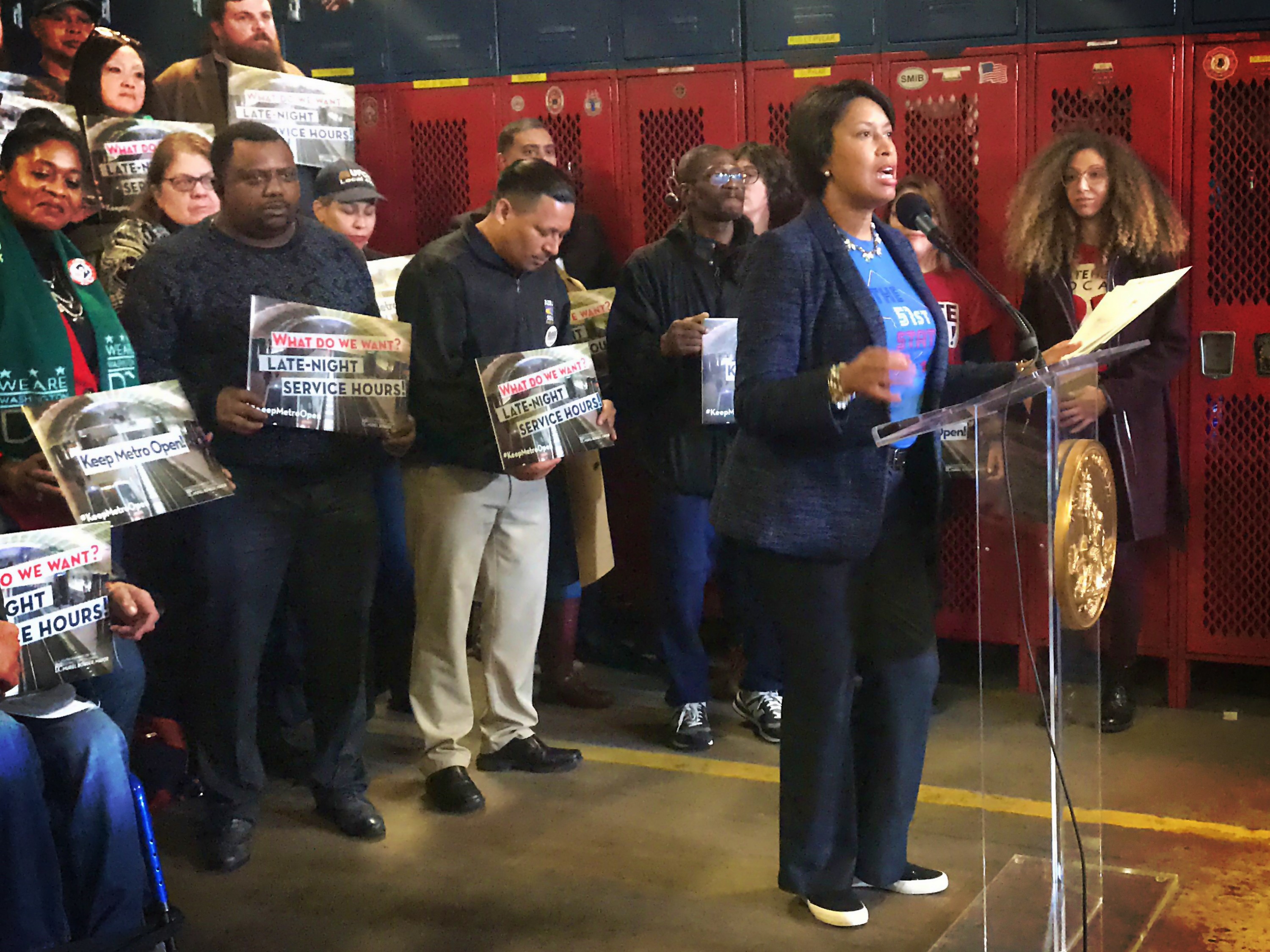
After more than a year of pressuring Metro leaders to restore late night hours to the city’s rail system, Mayor Muriel Bowser isn’t letting up.
In an unusual move, the mayor held a public rally on Wednesday in support of restoring late service across the street from a public hearing on the transit agency’s budget. Flanked by late night workers and business owners who say they’re affected by the hour cuts, Bowser made an impassioned case for the restoration of the system’s old hours.
“[Late night] workers help us welcome 20 million visitors to Washington D.C. each and every year. They staff our hospitals, maintain our offices, keep the lights on in Congress, bring us concerts and theater, and support all of our sports venues as well. These workers are the lifeblood of Washington, D.C.,” she said. “So this question is not just a question of, ‘should D.C. be able to stay open a little bit later?’ It’s whether this region should support its workers and stay open later.”
Bowser has made similar arguments ever since the transit agency first implemented them back in 2016, saying that the cuts have a disproportionate negative effect on low income late night workers and on nightlife businesses.
Metro, for its part, has argued that it needed the extra hours to perform a backlog of maintenance work. The system went from closing at midnight during the week and 3 a.m. on weekends, to closing at 11:30 p.m. during the week and 1 a.m. on weekends.
At the time the new hours were instituted, the rail system was experiencing frequent delays and major safety issues. In 2015, a train on L’Enfant Plaza’s Green and Yellow lines filled with smoke, causing one 61-year-old woman to die from smoke exposure.
Since Metro cut late night hours, it has been able to reduce delays by 78 percent, the transit agency told DCist in November.
The cuts were approved for two years, allowing Metro time to work through the backlog. But when the deadline rolled around, the agency decided to keep the shortened hours, much to the chagrin of D.C. lawmakers, including the mayor. The city threatened to issue a jurisdictional veto, but in the end the reduced hours continued into 2019.
This January, the system reported 92 percent on-time performance. Metro officials say the limited hours have allowed them to make the system safer and more reliable, but that there’s more maintenance to be done.
“I would say we’ve been in ICU—now, we’re still in the hospital, but we’re walking around on our own,” says Metro spokesperson Dan Stessel.
Metro General Manager Paul Wiedefeld has budged in the mayor’s direction on this issue, proposing a 2021 budget that would partially reinstate late night hours starting in July: the system would close at 12 a.m. on weekdays, and at 2 a.m. on weekends. The transit agency has also experimented with providing ride sharing subsidies to workers struggling to find a way home after their night shifts.
The mayor’s office hasn’t been satisfied.
“I think it’s a step in the right direction,” says Shawn Townsend, the director of nightlife and culture for the mayor’s office. “But I think that we are always going to push to get back to where we once were. We’re not a nine to five city anymore, as the mayor always says.”
As Metro gears up to pass its budget this spring, the mayor has renewed her push on the transit agency to restore later hours. Part of that effort—and a key feature of Wednesday’s rally—was the release of a report detailing the negative effects of early closures on the city’s nightlife economy.
According to the study, which was commissioned by the mayor, jobs related to nightlife make up 7.1 percent of the total jobs in the District—about 65,000 jobs.
Of those, about 57 percent are part time, according to the study. It found that many of these workers have a difficult time finding a reliable, affordable way to get home from work at the end of their late shifts.
“An overwhelming amount of the nightlife industry stated [in the study] that the reduction in hours has impacted their business and their workers aren’t able to commute back and forth,” Towsend says. “I think that’s enough in itself for the mayor and this administration to stand up and say you know what, we need these hours.”
Kamal Ali, the owner of Ben’s Chili Bowl, showed up at the rally to echo the mayor’s concerns. “This survey’s great,” he said, referring to the report, “but I don’t need a survey to know that sales are down. I don’t need a survey to tell me that customer experience is down, that my workers’ experience is down, and that service in general is down.”
Towsend points out that it’s not just bartenders and late night restaurant workers that need late night Metro service—it’s also nurses, janitors, security officers, and other service workers whose jobs require them to be out late into the night.
Metro spokesperson Dan Stessel says that the mayor’s support for the partial late-night service expansion the agency has put on the table is “appreciated,” especially as the Metro Board considers the proposed budget.
“She is doing what her constituents would expect, which is to push us to work harder, and work harder we will,” he said.
Metro will continue to explore ways to expand service within the bounds of the system’s maintenance needs, including exploring new technologies that could speed up overnight maintenance work.
“We want to provide as much transit service as possible,” Stessel says.