Margaret Barthel

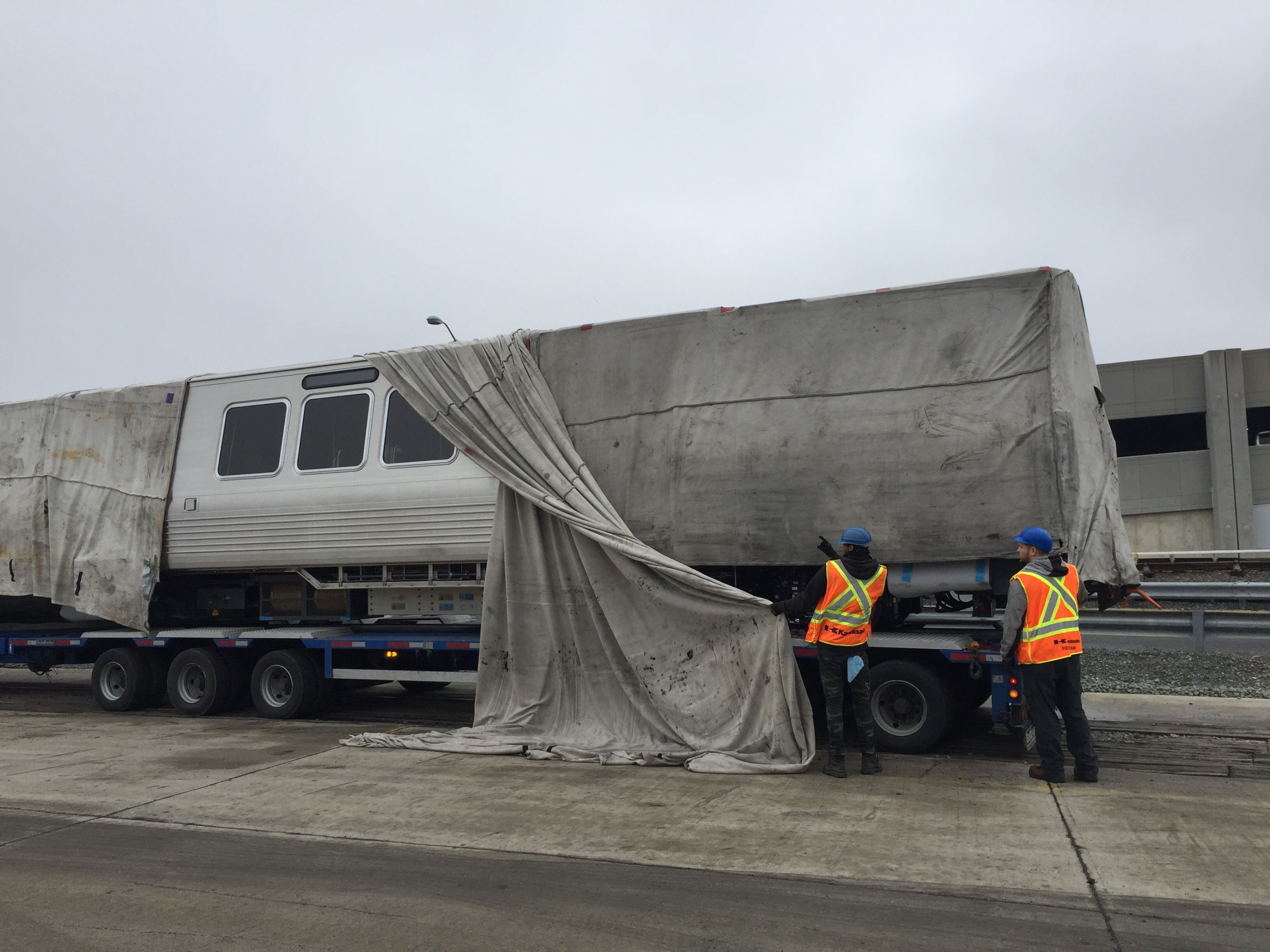

On Wednesday, WMATA’s final two new 7000-series cars arrived in its rail yard near Greenbelt. Those are the shiny (mercifully uncarpeted) models with the blue seats.
In all, the agency ordered 748 of the rail cars from Nebraska-based manufacturer Kawasaki Rail Car, Inc. The delivery required a five-day journey across country by flatbed truck. The first of them went into service in the system in 2015, and they’ve been delivered in batches ever since. On average, they cost $2 million a pop.

Workers unwrap one of the last two new 7000-series rail cars.
The 7000-series cars currently make up about 60 percent of Metro’s fleet. Metro officials say they’re far more reliable and able to go longer distances between breakdowns than the older models they’ve replaced, including the 1000-series, 4000-series, and 5000-series. That’s been critical to improving the system’s performance. Metro recently logged a 92-percent on-time rate in the month of January.
Barbara Richardson, Metro’s Executive Vice President of External Affairs, worked on the 7000-series project from beginning to end of the ten-year process. She says the design of the cars represents a significant amount of rider input—right down to the color scheme inside. Richardson says the cars marked the start of the turnaround of the system’s safety and efficiency.
“It also showed a glimpse of the beginning of the rebuilding of Metro, and what could be possible,” she says.
The final two cars won’t go into service immediately—they’ll spend six to eight weeks getting tested before they begin to carry the public. Ultimately, Metro hopes that they will remain in service for 40 years, given a midlife review.
“It’s a constant cycle, and you have to rebuild, and you have to do overhauls, and you have to keep them going,” says Richardson.
The end of the tracks for a Metro car is a scrap yard in Baltimore, where they’re sent after Metro has removed all proprietary technology. (Though, as WAMU has noted before, there are more fun options for disposing of the old cars. Who wouldn’t want to reminisce about all that dirty carpet?)
The delivery comes as Metro is already working to procure the next model. It is soliciting and weighing bids from contractors seeking to build the next generation of its rail cars. They’ll be called, you guessed it, the 8000-series.
New cars have to be “essentially custom built,” Richardson says. “The cars have to be designed specifically for this rail system.”
That process hit a snag in the form of opposition from public officials worried about the security implications of awarding the contract to China Railway Rolling Stock Corporation, a state-run company in China. In December, Congress passed bipartisan legislation that would prevent transit systems from buying rail cars manufactured in China, and President Donald Trump signed it into law. Metro said it would no longer consider the CRRC bid.
When they are built, the 8000-series cars will look similar to the 7000-series, but with some improvements inside, including signage tweaks, more hand holds, and up-to-date cameras and security technology on board. Plus, there’s good news for all those riders constantly in need of electricity for laptop or smartphone: the 8000-series will have power plugs, too.
Metro officials said they’d have an update on the procurement process within the year. They said it would take at least four years for the 8000-series to debut in the system.
This story originally appeared on WAMU.