Martin Austermuhle
Where some people see a spreading Coronavirus pandemic, Adilisha Patrom saw an opportunity.
Over the weekend, the 29-year-old Howard University graduate turned an empty storefront on Florida Avenue NE into a pop-up Coronavirus supply store. The sign standing on the corner outside is advertising enough: “Protective Face Mask Sold Here. Limited Stock.”
Inside, a pair of tables sit solemnly in the middle of a bright, sparsely decorated room. And on those tables is the equivalent of Coronavirus gold: more than a dozen bottles of Purell hand sanitizer, an equivalent number of bottles of Clorox bleach, a sampling of face masks, and pre-packaged bags containing a mix of the products. Handy coronavirus preparedness kit, if you will.
“I’m an entrepreneur 100 percent of the time,” says the Florida native.
Patrom owns Galaxy 5000, a hair extension store next door, and says the decision to turn what is otherwise an event space she operates into a Coronavirus emporium of sorts was inspired by how the current global pandemic intersects with her own personal story.
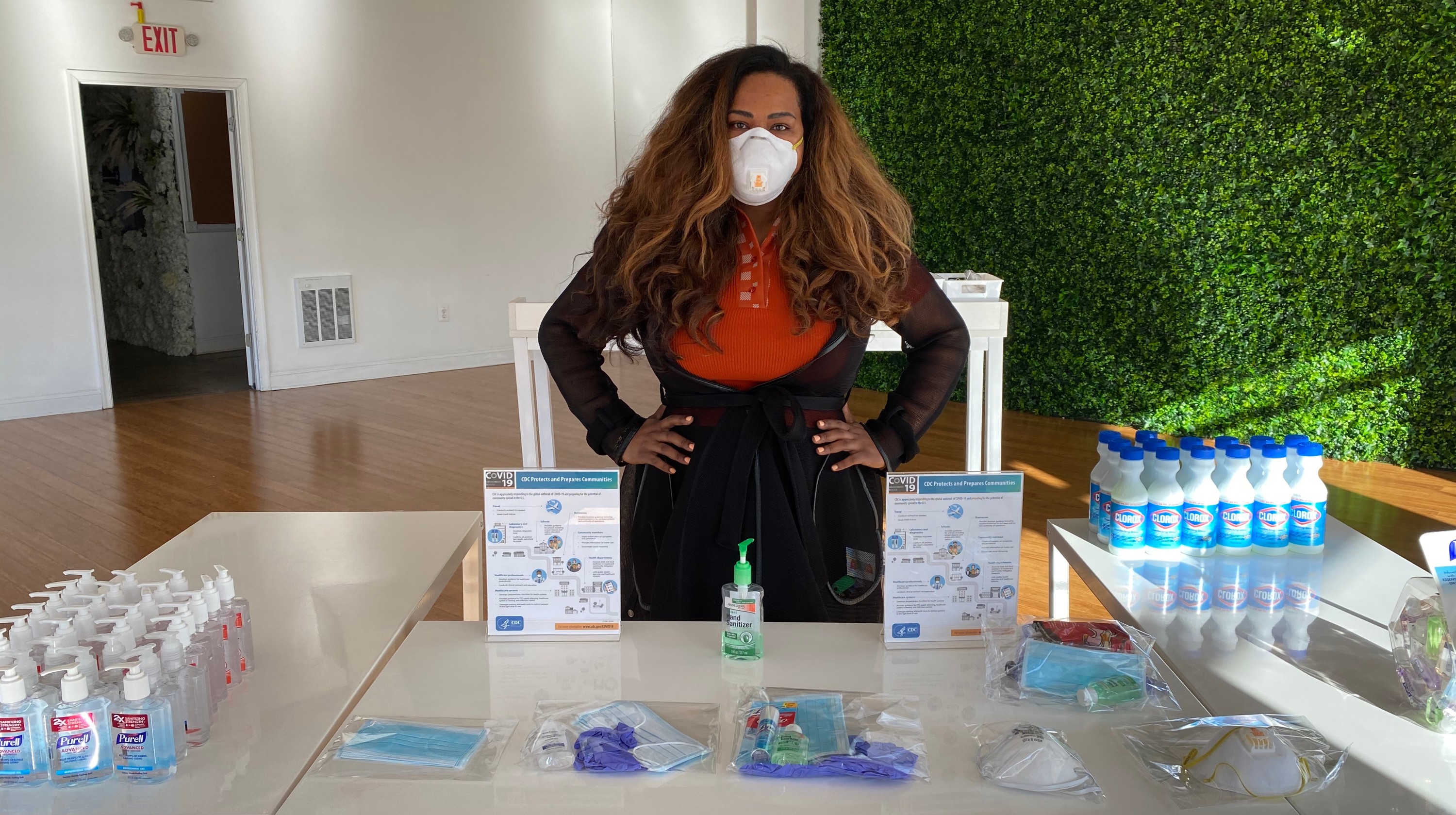
The face masks were easy enough to find; she says she’s got a healthy stock of her own, largely because she wears one every day to make sure she doesn’t catch anything that might put her dad’s compromised immune system at risk. For the rest of it, she reached out to distributors for her hair extension business that still had hand sanitizers and other products still in stock.
“My dad was diagnosed with cancer back in November. Since then, his doctors have educated us on the importance of face masks, and the different type of face masks, because we were doing it all wrong,” she says. “That just burst in me… what can I do to help people in the community that may not have the resources to go online as well if stores are sold out, where can they go locally?”
Now, it’s true that in times of crisis many of our worst capitalist instincts take hold. People rush to the stores to get their hands on whatever they can. (“Seriously people—STOP BUYING MASKS!” tweeted the U.S. Surgeon General this week.) And some of those who succeed sometimes turn around and resell their now-scarce wares.
On Amazon, third-party sellers have been selling hand sanitizer in recent days for grotesquely inflated prices. (Ebay isn’t much better.) That’s raised concerns over possible price-gouging if the virus continues to spread, though there’s not much most state laws can do about it unless a formal Coronavirus emergency is declared. D.C. Attorney General Karl Racine warned residents this week to be on guard for possible Coronavirus-related scams.
And it’s no surprise that some people may not respond too positively to the store. “Oh my God what the f**k??” tweeted Sean Maiwald, who first noticed the store on Wednesday. “This is performance art right?” came one response. “Smart business people,” read another.
Patrom says she’s no price-gouger, nor did she raid her local supermarket only to turn around and resell the goods. She may be charging a markup, but she insists it’s not much. An eight-ounce Purell bottle goes for $5, she says. (Walmart and Target advertise these for $2.99, but good luck finding one.) Masks range from $5 to $30. A package containing Lysol, a travel-sized hand sanitizer, mask, and gloves will set you back $25.
“It’s not like these crazy prices we’re seeing now,” she says. “I would never charge $50 for Purell.”
And she says she’s given away some of what she has. A package is on its way to her brother in New York, and a 70-year-old client of hers is getting a free sampler of the products she has on display.
“Just as long as I have it, I make sure other people have it around me,” she says. But that may not be for long; her stock of products isn’t huge.
Patrom is also trying to educate people on the Coronavirus. She’s got a box of fliers outside the store that include information on the virus, including the basic protective measures (hand-washing, avoiding close contact with others, covering your mouth when coughing or sneezing) everyone should take.
And she’s not just a preacher, but a practitioner. Instead of shaking hands (this reporter’s included), she opts for the “Wuhan handshake”—a double tap of the feet as a greeting. And she always wears a face mask of her own (“I get all the strange looks,” she concedes.)
For all the thinking she’s done about the Coronavirus, Patrom insists she’s not too worried about it. (It probably helps that the region hasn’t had any confirmed cases yet.) But she admits that having access to the products she’s now selling has somewhat put her at ease.
“I’m not worried at all, but I feel like I’m prepared,” she says. “If you’re doing things to make sure you’re prepared, you don’t have to go into a frenzy. Because I’m prepared it takes away all of my fears and worries.”
This story originally appeared on WAMU.