Rachel Kurzius
Developers have broken ground on a food hall coming to Benning Road NE. There is another slated for the Mount Vernon neighborhood, as well as ones coming to Fort Totten and to McPherson Square. An interior mall in Foggy Bottom previously plagued by vacancies may change its luck when it reopens as a food hall next fall.
And after a popular food court by Farragut West shuttered at the end of last year, the renovations to the building will now include … you guessed it … a food hall.
This is just a sampling of plans that contribute to the phenomenon, which is not even limited to food. At the end of March, D.C. will see its very first fitness hall. (More on that below.)
The idea that everyone is decking the halls all year long leaves us with a series of questions: Are food halls good for vendors? Where does D.C. stand nationwide in terms of this trend? Are we approaching a food hall glut? Perhaps most importantly, what the hell is a food hall, anyway? After chatting with a variety of experts, we’ve got some answers.
Okay, I’ll bite. What’s a food hall? Is it just a fancy way of saying food court?
So glad that you asked. One of the most common ways to define a food hall is the idea that the food is the main event, rather than a fueling station while, say, shopping at a mall.
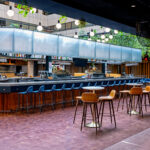
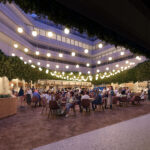
Food halls have become destinations, in part, because they’re designed to allow people time to linger. “A food hall offers a gathering place with comfortable atmosphere,” says Kirk Francis, a co-owner of Brookland food hall and incubator kitchen Tastemakers, as well as Captain Cookie and the Milkman, a mobile bakery available in a few local food halls. “Most offer free wifi and bathrooms meant to make people comfortable.”
The concept fits into the community-building notion of a “third place,” a space beyond home or work that people can spend time socializing and relaxing. The idea is that someone can run in for a coffee or quick lunch, or meet up with a large group of people for an extended period of time, with options catering to each person’s individual preferences and dietary needs.
Beyond that notion, people tend to have some expectation for what kind of food they’ll find: “a collective of chef-inspired, non-chain, fast-casual concepts,” says Trip Schneck, an executive managing director at Cushman & Wakefield, who focuses on food and beverage consulting. “We think these things should be hyperlocal—the last thing you want to do is bring a bunch of carpetbaggers in from out of town and form a food hall.”
He adds that the popularity of food halls has led to the overuse of the term. “I’ve seen it in D.C. where people will just change the name from food court to food hall but they still have a Shake Shack, a Sweetgreen, and a Sbarro,” Schneck says. “If you see those things, you are in a food court, not a food hall.”
To put it another way, each food hall is intended to be “individual in its branding, its design, its merchandising, its programming, its social media perspective, because it’s becoming a part of the neighborhood and community it serves, whereas a food court is copy and paste,” says Michael Morris, the principal at Cana Development. “A food hall has a sense of discovery, there’s the idea of needing to meander and experience it. The seating and the food is spread throughout.” There’s also a major focus on aesthetics, and creating spaces that will look good on Instagram and other image-heavy social media.
But as Francis notes, food halls themselves are the repurposing of an age-old concept. “An open marketplace or gathering place has been a hallmark of human civilization ever since people started congregating,” he says. “This is just the latest iteration of the marketplace.”
So is D.C. ahead of the trend here?
No!
Currently, the United States has 225 food halls, per Schneck, who predicts there will be about 400 operating nationwide by 2021. In October 2019, Washington Business Journal counted 10 food halls in the D.C.-area, with at least that many more coming down the pike.
It all began with Eastern Market, which reopened in 2008 (persnickety people argue that Eastern Market isn’t quite a food hall and is more of a traditional market because the majority of its vendors do not sell prepared foods but instead hawk produce, meats, and other non-prepared foods), though the place that is most often given credit for starting D.C.’s modern food hall craze is Union Market, which opened its doors in 2012 (some sticklers—pointing to the cheesemonger and knife sharpener, among other stalls—are even wary of calling Union Market a full-blown food hall).
But it turns out “the District is a little behind where you see like-sized markets” when it comes to the development of food halls, according to Morris. The city with the most is New York City, with near-30 currently in operation.
So why is D.C. behind the curve? Schneck attributes it to the strength of the area’s real estate market. A lot of developers in other cities used food halls as a solution to filling otherwise unused space or finding ways to increase the value of their properties. But developers in D.C. didn’t have that problem. “Developers haven’t had to be as creative as developers in other markets,” he says. “It didn’t require a ton of creative thinking because landlords were getting their desired rents and I think now, with the amount of development that’s going on in D.C., the smarter landlords are looking at their assets and saying, ‘How am I going to retain my tenants? How am I going to increase rents?’ And they’re looking at food and beverage as a way to do that.”
And for independent operators looking to set up a food hall, the high value of land in D.C. can get in the way. April Richardson founded Savor at Studio 3807, the first food hall in Prince George’s County. She says the cost for the large space food halls require is too expensive in the District “unless you’re a mega developer. I am a huge fan of individual, everyday people owning them, but in D.C., it’s cost-prohibitive.”
After the success of Savor, Richardson is now in talks for a second food hall in Prince George’s, this one more than double the size in Suitland, and she’s inked an agreement for one in Baltimore.

Why exactly do developers and landlords see food halls as such a boon?
Imagine you’re looking to fill a huge space on the ground floor of a new development with a place to eat. (Schneck says that, from a developer’s perspective, food should always be a hedge, meaning a way to reduce risk in an investment.) “If you do a 10,000 square-foot restaurant and it fails, you have two years of newspaper in the window,” says Schneck. But food halls generally offer significantly less risk: if one of the vendors doesn’t pan out, one empty stall amid more than a dozen bustling other options is far less conspicuous, and it’s easier to find a replacement.
Morris agrees. “Most well-run food halls see pretty stable occupancy and that provides stability,” he says. “They’re able to fill very large spaces.” At a time when traditional malls and big-box stores are faltering, leaving a question of how to fill those large, vacant spaces, food halls provide an answer.
For instance, 2000 Penn, a mall in Foggy Bottom owned by George Washington University, has dealt with high turnover and vacancies for much of the last decade. Captain Cookies has had an outpost there for five years, which Francis says has been a hit with GW students, but he notes that “the giant building has been pretty underutilized for the past eight years” (that’s when cornerstone tenant Kincaid’s left, leaving a 10,000 square foot vacancy in its wake). Now, developers in charge of the property are rebranding the space as a food hall called Western Market. Francis is hopeful the rebranding will lead to increased food traffic.
But is it good for vendors?
For vendors, food halls can be a chance to have a high visibility outpost without putting up the kinds of capital required for a brick-and-mortar location. That’s why some have started calling food halls the new food truck.
“It does offer the opportunity to go from idea to execution more quickly, and to fail faster and more cheaply,” says Simone Jacobson, the co-owner of Thamee, a Burmese restaurant on H St that just became a James Beard semifinalist. But before she opened Thamee, Jacobson launched the Burmese food stall Toli Moli in Union Market.
“We started with exactly zero dollars” of investment money, says Jacobson, though they had done a handful of increasingly successful pop ups for their concept before heading to the food hall. “We would never have been able to test our concept and get press and get a customer base and open this full-service restaurant” without first being in Union Market. “It worked for us.”
One major benefit she notes is that fewer upfront expenses allow vendors the chance to pivot and experiment. In her case, Toli Moli began by largely offering Burmese dessert falooda until they noticed the outsized interest in their savory offerings. “You can take a small footprint and then turn it into whatever you want it to be,” she says.
Jacobson says that another major boon was the informal network of other business owners at Union Market. “The biggest benefit was that I was connected to other like-minded women of color entrepreneurs,” she says. “That bonus of being there has lead to additional funding, networking, advice, and support.”
Some food halls have even formalized those kinds of benefits. Richardson says Savor also serves as a business incubator for its vendors: “They get legal, they get accounting, they get business consulting—everything they will need to be successful in the food hall and outside the food hall.”
Morris says that, at the food halls from Cana Development, vendors “have an entire team surrounding them: a full-time marketplace manager, events manager, an active PR agency involved, active social media, a full-time videographer and photographer, we audit vendors on a quarterly basis. It creates a very unique community environment that vendors tend to gravitate to.”
In an average Cana Development food hall, 60-70 percent of vendors are minority or women-owned businesses, according to Morris. “That’s largely tied to the fact that average vendors are able to open and operate for significantly less than a street front location and achieve like or better sales—the overall profitability is higher.”
But how much money vendors make from their sales also depends on how their rent is structured, and that varies based on the food hall. A lot of the time, the legal document used is a license rather than a lease.
Schneck advises real estate partners to use licenses because they allow for “maximum flexibility so you can replace underperforming vendors.” Those licenses are short-term (often around 18 months) and have performance thresholds. “Most of these things that we’re seeing, the landlord builds them out and they charge high percentage rents—I’m seeing anywhere from 20-30 percent rent models,” he says, noting that rent number includes utilities, janitorial services, and marketing.
On the other hand, Francis says that Tastemakers operates using a flat fee rent model. “Each booth, depending on size, is paying between $350-1,000,” he says. “Many places have a combination of flat rate and percentage, some just have a percentage.”
Francis operates as both a vendor in other foods halls and an operator of a food hall, and notes that a “flat rate offers the biggest upfront cost but also the biggest potential profit.” For instance, when a vendor is incredibly successful, which can put a strain on the building by generating trash and using a lot of utilities, a percentage rent ensures a landlord can cover those expenses. “It seems like a blend is the best way to go,” he says.
But first, vendors have to get in the door. And that can be tricky. “You have to convince the landlord to let you rent your space, and landlords are notoriously hard to convince, especially without a track record,” says Francis. “We still find it hard sometimes and we have a proven track record.”
That’s part of why Richardson founded Savor. As the president of DC Sweet Potato Cake, her baked goods were already stocked in Starbucks and Wegmans when she applied for a stall at a D.C. food hall (she won’t say which one). “We didn’t get in, and we kept getting the runaround,” she says. “At the time, not that many people of color or African American people were vendors there.”
So Richardson decided to build a space for minority chefs in an area of Prince George’s that had been considered a food desert.
It sounds like food halls are pretty successful. When don’t food halls succeed?
Schneck’s analysis shows that the vast majority of food halls that have opened across the country are successful, but many of the near-dozen exceptions share something in common: they were single-operators. One example was Isabella Eatery, the food hall in Tyson’s Corner from celebrity chef Mike Isabella, who handled all the different stalls.
“One guy trying to do all of the concepts, first of all, it’s not authentic,” says Schneck. “It completely eliminates your hedge as a developer. That thing wasn’t performing even before the Washington Post article [detailing sexual harassment claims against Isabella]. It’s not what a food hall is, it’s not a celebration of the region, and it’s a very risky proposition.”
Now, a more traditional food hall, with a slew of different operators, has opened where Isabella Eatery once stood.
A different issue is facing Tastemakers, says Francis, which is shifting part of its food hall to become more event space and expand its commercial kitchen. Using the Brookland space as a food hall has “gone decently well, but we’re seeing a lot more demand for event space and for kitchen space than walk-in retail,” he says. “The area is just heavily residential, and didn’t have the foot traffic to support a full scale food hall.”
D.C. has one wait-and-see situation happening. Anxiously-awaited food hall La Cosecha opened its doors last fall a block away from Union Market. (Just like Union Market, it’s run by Edens.) But on opening day, barely any of the vendors were ready to go. The Latin American food hall still has limited operating times and closed stalls. Months after opening its doors, construction still continues inside for some vendors. Among its woes include chef Christian Irabiéna pulling out of his plans for a modern Mexican restaurant there, citing the difficulty members of the immigrant community face in funding their ventures. Edens declined to comment on the status of the food hall, but as of the end of January, there was no timeline in place for some of the stalls to open.

Have we reached a food hall bubble?
With the number of food halls in the region slated to double in the coming years, are customers going to be sick of the concept soon?
“I think that’s nonsense,” says Richardson. “That comes from restaurateurs who have brick and mortars getting nervous.”
But Richardson notes that the best way to ensure the continued success of food halls is to make sure that operators are intentional about their concepts when they create them and that they don’t feel sterile: “I like to see food halls that are a little more targeted—I would love to see a vegan food hall.” She notes The Block, an Asian food hall in Annandale that opened a second location in Bethesda and a third forthcoming in D.C. as an example of a place with a well-thought-out concept.
Morris agrees. “As long as the market is differentiated and the product is unique,” he thinks food halls can continue to open with success.
Shneck answers that question with a little math: “There’s only 225 food halls [in the country], with about 15 vendors per food hall, so that’s less than 3,500 vendors in the country—compare that to 26,000 Subways,” he says. “I still think that we’re in the top of the second inning in a nine-inning game.”
And does this “hall” concept have applications beyond food in D.C.?
One Georgetown concept in the former Dean and Deluca space sounds exactly like the description for a food hall—only the self-described “maker marketplace” Artists and Fleas is selling art, apparel, vintage goods, and other products. Like a food hall, it has a series of more permanent vendors, and an area for events. Another similarity? It has food options for sale.
And sometimes, it’s not about echoing the set-up of a food hall as much as it’s about trying to replicate the branding.
The people behind a new fitness venture in the District are hoping that the same feelings the phrase “food hall” evokes will come through their concept: a fitness hall. Meet BYNDfit, D.C.’s first fitness hall, which opens at the end of March. The idea is to provide a mix of boutique group fitness classes, alongside a more traditional gym and all of its amenities, with some high-tech new offerings, like virtual reality.
So why call it a fitness hall instead of, well, a gym?
“‘Fitness hall’ conjures up that feeling, that sentiment, that excitement about the feeling of entering a food hall,” says Carl Pierre, a co-founder of BYNDfit. “It’s the difference of quality of food in a food hall—the food that you’re getting will challenge and push boundaries. It really sets your expectations high.”But as far as comparisons to food halls go, BYNDfit operates as a single operator rather than having third-party vendors come in.