 Mikaela Lefrak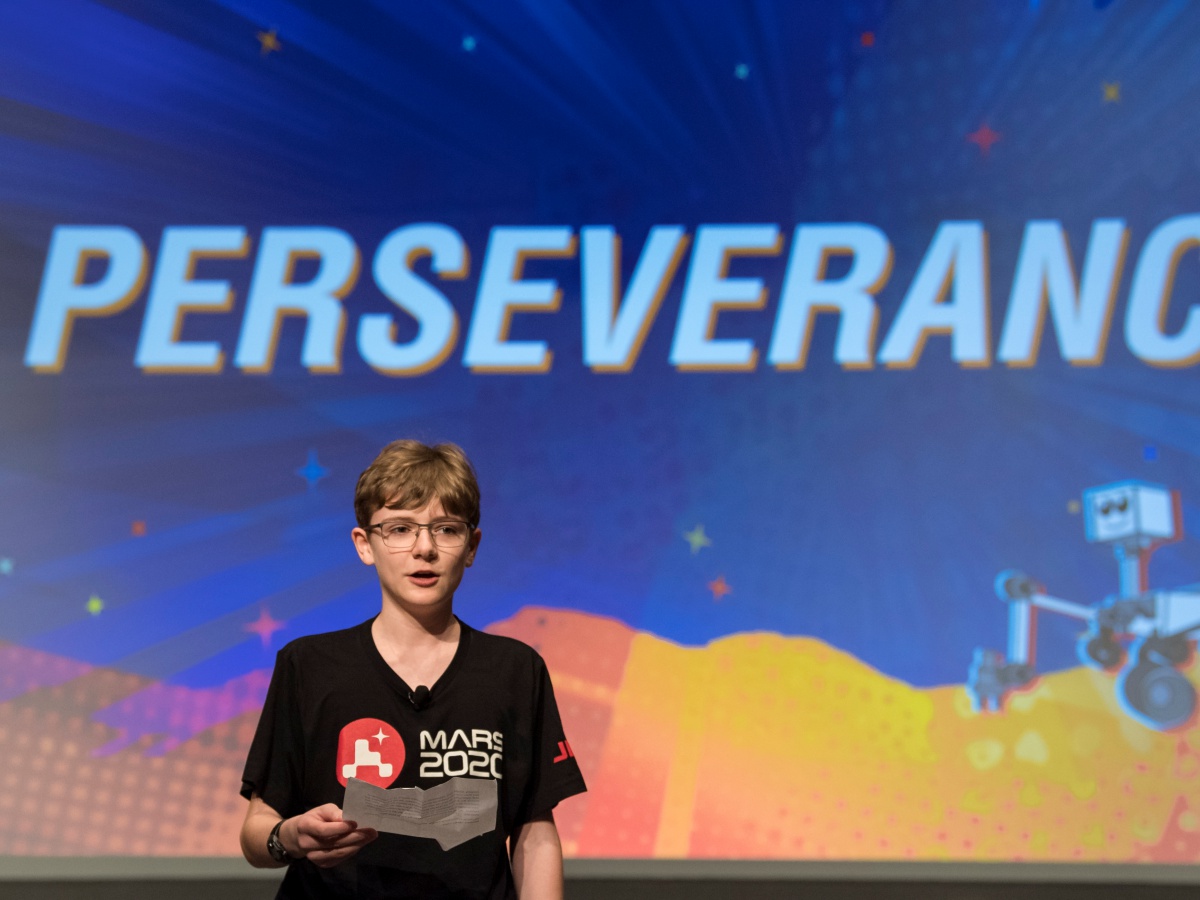
The next NASA rover heading to Mars has a new name: Perseverance.
Its name is the brainchild of Alex Mather, a seventh-grader from Springfield, Va. NASA held a name reveal on Thursday at Mather’s school, Lake Braddock Secondary School in Burke, Va.
“Space exploration is hard,” said Thomas Zurbuchen, NASA’s Associate Administrator of Science Mission Directorate, to the crowd of students and adults. “But it’s so exciting.”
Mather read his winning essay on stage, beginning with the names of past rovers: “Curiosity. InSight. Spirit. Opportunity. We have the spirit and insight to explore the Moon, Mars and beyond. But, if rovers are to be the qualities of us as a race, we missed the most important thing. Perseverance.”
“We, not as a nation, but as humans, will not give up,” he continued. “The human race will always persevere into the future.”
A group of volunteer judges sifted through about 28,000 name submissions from kids around the country to select nine finalists — Perseverance, Vision, Clarity, Ingenuity, Fortitude, Courage, Promise, Tenacity and Endurance. The judging was then opened up to a public vote, and out of 770,000 votes cast, Perseverance … well, it persevered.
A laser-printed nameplate will be affixed to the rover’s arm, and Mather will get to go to the Kennedy Space Center in Florida this July to watch its launch. If all goes to plan, Perseverance will land on the Red Planet’s Jezero Crater on Feb. 18, 2021.
Mars rovers are a bit like Wall-E, but much more high-tech. Perseverance is loaded with 23 cameras, a robotic arm, and a small helicopter. It was built at NASA’s Jet Propulsion Laboratory in Pasadena, Ca.
Once it settles into its new environs, the rover will search for molecules that could be used as evidence of past life on Mars. It will also gather soil and rock samples that a future NASA mission will bring back to Earth.
In an onstage interview, Mather explained that he fell in love with the idea of space exploration two years ago as an 11-year-old at space camp in Alabama. He wants to shape his life around it — eventually. First, he said, he’ll get his high school diploma, then study engineering in college. After that, he wants a job as a NASA engineer.
Somewhat relatedly, NASA recently reopened the application process for its astronaut program (the listed salary range is $104,898 to $161,141 per year). You must be comfortable with “extensive travel” to apply.
This story originally appeared on WAMU.