On September 16, 2019, William Girardo and his wife were woken up by the sound of gunshots outside their Petworth home. In the aftermath, residents on the block began to gather in the street. “Our neighbor came out with his laptop and was like, ‘you guys have got to see this,’” Girardo remembers.
The computer, Girardo says, played footage from a home security camera showing two or three men getting out of a car and proceeding to open fire on a nearby house.
Less than 24 hours later, another shooting occurred on the same block, targeting the same house at 4th and Taylor Streets NW. For a second time, the neighbor’s security camera captured the scene.
Girardo and his neighbor both purchased home cameras with help from the D.C. government, which has spent more than $2 million over the past four years to significantly increase the number of private security cameras across the District.
“Oftentimes our best witness in cases is the camera,” says Robert Contee, the assistant chief of the investigative services bureau at the Metropolitan Police Department. He confirmed that detectives obtained home security footage to assist in the ongoing investigations into the back-to-back Petworth shootings, which remain unsolved.
Since Mayor Muriel Bowser launched the camera incentive program four years ago, the city has funded nearly 18,000 private cameras through its camera rebate and voucher programs. A DCist analysis of the program, however, reveals that its use varies dramatically across the city. In some neighborhoods, private security cameras abound, while others are home to hardly any at all.
Notably, the parts of the city that experience the highest level of violent crime are among the least likely to participate in the camera incentive program. In 2019, 37 percent of the District’s violent crime and 64 percent of its homicides occurred east of the Anacostia River. But this part of the city has received only 15 percent of the rebates and vouchers issued so far.
Meanwhile, the neighborhoods in the District that have most enthusiastically embraced the program are those that have undergone significant demographic and economic change. Out of the city’s 57 Police Service Areas, just 13 PSAs have received the majority of camera rebates and vouchers issued, and they encompass parts of the city that have grown more expensive and increasingly white in recent years, including Hill East, Petworth, H Street, NoMa, Woodridge, Eckington, and Edgewood.
‘This net around the neighborhood’
Bowser launched the Private Security Camera Incentive Program in February 2016, first offering it to priority areas before expanding the program citywide six months later.
Run out of the Office of Victim Services and Justice Grants, the city provides a rebate of up to $500 to residents and $750 to businesses, nonprofits, and religious institutions to help pay for a private security camera system. Residents receiving public assistance are eligible for a voucher to obtain security cameras free of charge.
To participate, both rebate and voucher recipients are required to register their cameras with MPD, but police can only access footage with the camera owner’s permission.
In this way, D.C.’s program differs from other cities where private home security cameras provide a live surveillance feed to law enforcement. Privately owned security cameras participating in programs in Chicago, New Orleans, and Atlanta capture footage that the police department can view at any time. (The Metropolitan Police Department does have access to more than 200 closed circuit television security cameras, and D.C. announced in November that it plans to spend $5 million to add another 140 cameras in areas with high crime rates).
Andrew Ferguson, a law professor at the University of the District of Columbia says that D.C.’s camera incentive program presents “no confused consent issues, no weird third parties acting as police. This is you buying a camera because the government is paying you to do so.”
Still, some worry about mission creep, with the possibility that in addition to security camera surveillance, D.C. might adopt facial recognition technology or artificial intelligence that predicts who is most likely to commit a crime. (Ferguson has argued that cities should have formal written policies that govern the use of “big data policing technologies.”)
“There are some pretty significant implications with just broader surveillance with regards to the way facial recognition or AI could be used to target citizens,” says Rahul Kapoor, who used the city’s program to install cameras on the home he bought in Shaw a year and a half ago.
Meanwhile, online forums like Nextdoor and Amazon’s Neighbors offer easy ways to share footage obtained with home cameras. And in big and little ways, empowering communities to surveil themselves can change the small-scale culture of a neighborhood.
Marcello Muzzatti, a resident in Tenleytown who bought his first security camera for his home through D.C.’s rebate program, gleefully shared footage to the neighborhood’s listserv of a man neglecting to clean up his dog’s poop. Andrew Breza, a Deanwood resident, tells DCist that footage recently posted on NextDoor showed an apparent alternative energy scam with a pushy salesmen asking to see residents’ Pepco bills.
And reports and footage of package theft proliferate online. One recent entry in Petworth’s Nextdoor group detailed how the poster recognized a man caught by a private security camera stealing packages; the resident called the cops, who quickly caught the perpetrator. With so many such reports, D.C. police recently joined Nextdoor to enable residents to report crimes directly through the app.
Ring users across the country “talked glowingly” to the Washington Post about the sense of security the cameras bring. But some also reported growing increasingly voyeuristic, watching everyone from postal employees to children walking down the street and sharing footage online.
There is also persistent criticism that these high-tech surveillance and community forums offer a tool for racial profiling. When Vice reviewed more than 100 user-submitted posts, it found that the majority of people reported as “suspicious” were people of color.
These companies “financially profit from the historic and perpetual criminalization of black and poor people,” Whitney Shepard, an organizer with Stop Police Terror Project DC, told DCist. “We believe true public safety comes from being in community with our neighbors, rather than surveilling and racially profiling them from behind an app.”
Still, thousands of Washingtonians have embraced camera surveillance in the hopes of making their homes and communities safer. While the program is also open to a variety of recipients, residents have claimed the vast majority of rebates.
“It’s created this net around the neighborhood,” Kapoor says. “God forbid something happens, but at least there’s cameras out there catching stuff.”
Michelle Garcia, the director of the Office of Victim Services and Justice Grants says the camera incentive program is “incredibly popular.” Her agency recently approved the 7,500th rebate and voucher application, funding a total of 17,708 cameras as of January 31, 2020. But the high level of program uptake overall in the District obscures the uneven geography of participation at the neighborhood level.
Gentrifying neighborhoods embrace the private security camera incentive program

Police Service Areas in some of the city’s safest neighborhoods—Friendship Heights, Spring Valley, Georgetown, and Chevy Chase—have received more rebates and vouchers for security cameras than any PSA located east of the Anacostia River except one.
But while participation is high in these whiter and wealthier neighborhoods west of Rock Creek Park, the city’s security camera program is even more popular in rapidly gentrifying neighborhoods.
In some, high crime rates persist amid steeply rising home prices. Northeast’s Carver-Langston neighborhood, for example, saw home prices increase 87 percent between 2008 and 2018, according to a Trulia analysis highlighted by Urban Turf. The PSA that encompasses the neighborhood (and Kingman Park) also had the highest number of violent crimes in the city in 2019.
Sydelle Moore, who serves on the Advisory Neighborhood Commission in Langston, says the home camera incentive program helps create a “community spirit around watching the streets.” She worked to promote the program in her capacity as the former president of the Langston Civic Association.
She says certain blocks in the neighborhood have consistently struggled with crime while others see little or no crime. “The difference is really people working together,” Moore argues.
Hannah Powell, a real estate agent who previously served as an ANC commissioner in her neighborhood, installed her cameras after a shooting on her block in Eckington, which was among the top 10 police service areas for violent crime in 2019. “I think there’s a peace of mind security that comes with it,” Powell says.
Still, other gentrifying neighborhoods with high levels of participation in the camera program are among the areas that saw the city’s lowest levels of violent crime in 2019, including PSAs in Michigan Park, Brookland, and a northern section of Capitol Hill which has received more camera rebates and vouchers than any other part of the city.
Overall, the top 13 PSAs accounted for 24 percent of both the District’s violent and property crime in 2019.
While PSAs do not fall neatly along census tract boundaries, limiting the ability to directly compare camera incentive program participation with neighborhood-level changes, the map below shows the overlap of the city’s PSAs and census tracts that have experienced significant demographic change.
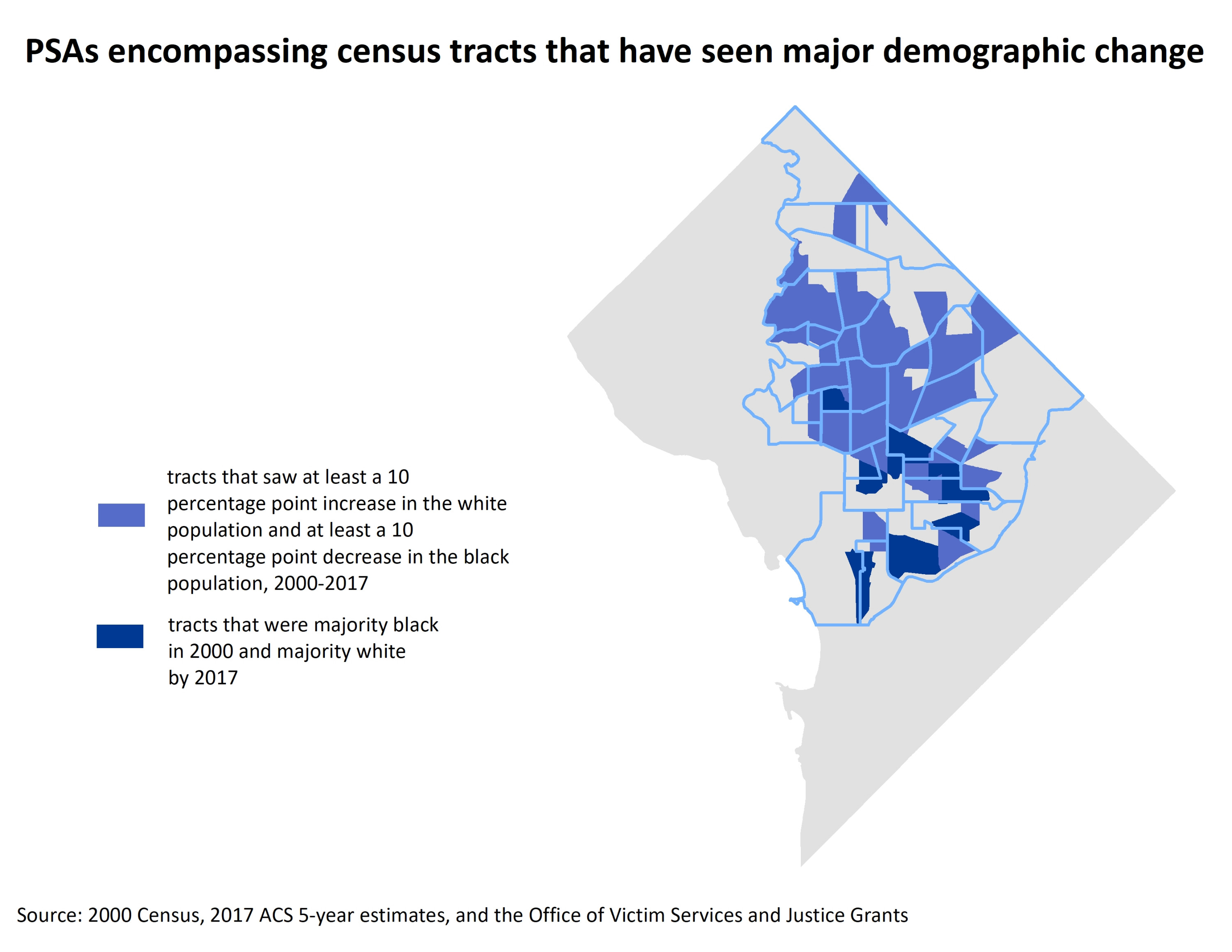
The PSA encompassing Petworth, which does happen to match up with census tract boundaries, has received the second-highest number of camera rebates and vouchers over the four years the program has been in place. In 2000, the neighborhood was home to over 11,000 black residents, 85 percent of the total population, and just 204 white residents, a mere two percent. By 2017, white residents made up 21 percent of the neighborhood’s population, while the share of black residents fell to 56 percent.
The PSAs covering an area north of Capitol Hill, H Street, and Hill East—the areas with the first, third, and fourth highest participation in the camera program, respectively—each also contain census tracts whose populations were a majority black in 2000 but a majority white by 2017.
In total, PSAs home to tracts that have seen similarly significant changes in their racial makeup—at least a ten percentage point increase in their white populations and at least a ten percentage point decrease in their black populations between 2000 and 2017—account for 74 percent of the camera rebates and vouchers issued by OVSJG in the first four years of the program.
These parts of the city have simultaneously undergone profound economic change. A report by Governing shows a surge of college-educated residents to these neighborhoods and finds that many have seen median home values more than double since 2000. In one census tract in Hill East, for instance, fewer than 20 percent of adults living in the tract held a college degree in 2000, but by 2013, 58 percent of adults did. During this time, median home values increased by 175 percent.
Overall, D.C. is one of just a few major cities in the country where gentrification is actually displacing people from their neighborhoods, according to a study from the Institute on Metropolitan Opportunity. Looking at American Community Survey data from 2000-2016, researchers found that the share of low-income residents in D.C. neighborhoods that are experiencing economic expansion fell by 28 percent.
“People’s perceptions of what’s disorderly or how much of a problem certain things are varies tremendously both across neighborhoods and by racial and socioeconomic make-up of the neighborhood,” says Robert Sampson, a social science professor at Harvard who studies crime in American cities.
In these parts of the city, newer and older residents may have different expectations and desires around law enforcement’s reach into their communities. “Longtime residents might not be that concerned about a car getting broken into, but if you’ve never lived in a neighborhood where that happens, you might be really concerned,” says Rashawn Ray, a sociology professor at the University of Maryland and a fellow at Brookings (Disclosure: The author of this piece is also employed by Brookings.)
Gentrifying neighborhoods also tend to see an uptick in the number of both 911 and 311 calls and increased enforcement of nuisance laws. Stepped up policing as well as increased surveillance “is usually a symptom of gentrification or it usually goes hand-in-hand,” says Gabrielle Rejouis with Georgetown Law’s Center on Privacy and Technology. “The cameras and the apps and the calls to law enforcement enforce this shift and play into this othering and pushout.” She argues that surveillance “can signal that you don’t belong there.”
Still, residents in neighborhoods undergoing demographic change say they have seen support for the camera incentive program among both newcomers and longtime residents.
“When I installed cameras my neighbors were supportive” says Powell, who bought her home in Eckington in 2014 after living in various D.C. neighborhoods for over a decade. “Neighbors who have been in this neighborhood for a long time were supportive, so were neighbors who were fairly new to the neighborhood.”
Despite high crime rates, Wards 7 and 8 have seen low participation

In other parts of the District, a very different set of dynamics play out. While residents east of the Anacostia River express serious concerns about public safety in their neighborhoods, this part of the city has seen relatively little participation in the camera incentive program.
In a recent survey conducted by the Washington Post, 37 percent of Ward 7 and 8 residents report that they don’t feel safe from crime in their neighborhoods, a higher share than in any other ward in the city, and 64 percent believe the mayor is doing a poor or not-so-good job of reducing crime. Meanwhile, Ward 7 and 8 constitute the only part of the District where a plurality of residents see crime as the biggest issue confronting the city.
But police service areas in the Seventh Police District, which encompasses most of Ward 8, have seen a particularly low level of participation in the camera incentive program. The PSAs that encompass Washington Highlands, Garfield Heights, Congress Heights, Bellevue, and Barry Farm have each received fifty or fewer camera rebates and vouchers (the entire Seventh District has received roughly the same number of rebates and vouchers as the single PSA in north Capitol Hill).
“I don’t think anybody else on the block has cameras,” says Elizabeth Clark, a Congress Heights resident who recently upgraded her private security camera system and plans to request a rebate.
While PSAs in the Sixth Police District, which contains most of Ward 7, have received more rebates and vouchers than the Seventh District, its participation remains below every other police district in the city despite being home to the highest number of violent crimes in 2019 at the district level.
Christine Phillips, who has lived in Deanwood for nine years with her husband, a native Washingtonian, and their daughters, installed private security cameras after her crawl space was broken into twice. She would like to see more residents in her neighborhood participate in the program and believes a strong security camera presence will help improve public safety.
“When criminals are thinking about where they’re going to act out a situation they’ll be a little bit more mindful and think ‘that entire neighborhood they all have cameras’ so there’s really no where you can hide,” Phillips says.
So what accounts for the low uptake of the camera incentive program in a part of the city that ostensibly stands to benefit the most?
According to Mike Austin, who chairs the Advisory Neighborhood Commission that includes the Barry Farms and Congress Heights neighborhoods, many of his constituents simply don’t know about the program. “It’s not promoted enough,” Austin says. “There needs to be a stronger approach to getting the word out about this program and definitely the fact there’s a voucher component to this.” He adds that “price point is a huge deterrent for people because cameras aren’t cheap.”
To receive a rebate, residents have to pay the cost of the security camera system upfront, and they can run hundreds of dollars, in addition to costs for installation. Vouchers are available for residents who can prove they are receiving public assistance under Temporary Assistance for Needy Families, Interim Disability, or several other programs.
There’s also the matter of who is actually taking up the city on its offer: overwhelmingly, homeowners. Of the thousands of camera program applications from residential addresses approved by OVSJG, just 4 percent have come from renters. While Ward 7’s homeownership rate is about on par with the overall rate in the District, residents of Ward 8 are the least likely Washingtonians to own their homes.
“When you own property, you want to protect it. When you don’t own it, it doesn’t mean that you don’t want to protect it, it just means that’s not your job to deal with those particular things,” Ray says.

But economic barriers and a lack of awareness about the program aren’t the only things driving down participation.
“There’s a history in low-income, particularly minority communities, of generalized mistrust with regard to law enforcement and with regard to the city,” says Sampson, which may make residents in neighborhoods that experience a high level of violent crime reluctant to participate.
While Austin says his constituents are upset about the level of violent crime in their neighborhoods, they are hesitant to share camera footage with MPD. “Unfortunately there’s a big theme amongst our community that we don’t snitch, we don’t tell, we don’t help the police, we don’t assist the police, and that’s an issue. Folks feel like with the cameras, they’ll be seen as aiding the police,” he notes.
The fact that MPD has requested footage by sending police cars directly to the homes of those who own security cameras also makes some fearful of retaliation, says Austin, who is challenging Ward 8 Councilmember Trayon White in the Democratic primary.
Garcia, the director of OVSJG, says that her agency is sensitive to this concern. She says that when MPD is canvassing a crime scene, they will often coordinate with a camera owner in the immediate aftermath of a crime to arrange another time to return in an unmarked vehicle so officers who are not in uniform can retrieve the camera footage.
Footage from participating cameras has assisted MPD in making arrests in 13 separate homicide cases over the past four years, according to OVSJG’s monthly reports.
In remarks made this past summer, MPD Police Chief Peter Newsham said that, in his estimation, private security cameras “are the number one thing that has helped the Metropolitan Police Department apprehend violent offenders in our community.”
Still, the city’s homicide rate reached a ten-year high in 2019, raising the question of how effective the camera program has been in deterring homicides in the first place.
“When we look at the homicide rates over the past two years, a lot of what we’re seeing are homicides that are escalations from conflicts,” Garcia says. In these instances, “people are not stopping to look around and see, ‘oh wait is there a camera somewhere around here?’” she observes.
But Contee, the assistant chief of MPD’s investigative services bureau, believes that camera surveillance might still serve as a deterrent in cases of violent crime. “I don’t know that you can get a true measure on crimes people don’t commit as a result of a camera being there,” he says.
Nonetheless, the high rate of violent crime in a neighborhood may not be enough to compel residents to participate in the camera program. Sampson notes that residents in these communities “might not be worried about violent crime on their property, but in their neighborhood.”
In areas that have a dearth of security cameras, some even worry that participating in the program might actually make their home a target.
Clark says that being the only person on her block with cameras “does put me in a place of a little bit of insecurity because I think people might think, ‘oh you have money for a camera’ and on top of that ‘what are you protecting in your house?’”
A growing, multi-billion-dollar business

As local governments and hundreds of police departments across the U.S. have embraced private security cameras, neighborhood surveillance has become a multi-billion-dollar industry. Since September, the number of police agencies that have partnered with Ring to access footage from home security cameras (with permission from the owner) has more than doubled to nearly 900, according to a recent analysis by the Washington Post.
The alleged ability of private security cameras to deter crime is one of the main selling points made by D.C.’s public officials promoting the incentive program. Ward 6 councilmember Charles Allen, whose 2016 bill established the program, wrote in a statement at the time that “it is clear that security cameras deter crime.” In her own statement, Mayor Muriel Bowser declared that “the installation of private security cameras in the city is another step to deter crime.”
Since the camera incentive program was introduced, the District has indeed seen a decrease in some of the types of property crimes that often come to mind when one thinks about home security cameras, such as burglary and theft from cars (though motor vehicle theft has gone up and down over this period). In general, the number of violent crimes committed in the city has also seen a downward trend (homicides are an exception), including several years preceding the launch of the camera incentive program.
But Sampson notes that like street lamps or car alarms, it is difficult to know how much the presence of security cameras has contributed to crime reduction. A report by researchers at the Urban Institute shows that in some cities, surveillance cameras were linked to a reduction in crime, but other research finds that the evidence is mixed.
MPD does not currently track every instance footage from a camera program participant is shared with the department and how many times the footage shared contributes to an arrest by MPD. “That may be something we may want to consider doing,” Contee says.
But with reviewing private security camera footage now a routine part of MDP’s work, the city would like to see more residents participating in its camera incentive program. “It’s an intricate part of what we do every day now,” says Contee. “We’re reviewing camera footage that’s just an additional piece of evidence that helps us to close cases,” he notes.
While the camera incentive program can assist MPD in its investigations after a crime has occurred, even proponents of the program say it does not address the factors that lead certain neighborhoods to experience a higher level of violent crime than others.
Austin, the ANC commissioner in Ward 8, encourages his constituents to apply for rebates and vouchers but describes the camera program as “low-hanging fruit.”
“I think generally people should get the cameras. It’s better to have the footage,” he says, while noting that it isn’t enough. “There needs to be a concerted effort to address the root causes of violence.”
And in neighborhoods that have seen major demographic shifts amid rising home prices, advocates warn that the proliferation of private security cameras might exacerbate the challenges confronting many residents in the District who are currently excluded from the city’s economic success.
“You are going to have more people swept up because they’re just being surveilled all the time,” says Claire Cook, an organizer with ONE D.C. which promotes equitable community development in the face of neighborhood change.
Meanwhile, residents who have installed the cameras say that it has given them a newfound sense of both security and unease.
Weeks after purchasing his home security camera system, Girardo reviewed camera footage showing a man walking up the steps to his Petworth home, ducking down, getting up to leave, and then coming back an hour later.
One night, a neighbor was outside and saw the man walk up to Girardo’s stairs and realized that he was using an electrical outlet on the porch to charge his phone.
“It was really unnerving until we know what was going on,” says Girardo, who then bought a cover to lock the outlet. “I don’t know if it was better that we knew or didn’t know that they were coming up to our porch to use our electricity to charge their phone. That was our first time using the camera for something that we didn’t expect.”