Margaret Barthel
Local transportation authorities are responding to the spread of the new coronavirus in the D.C. region by boosting their cleaning regimens, posting public health messages and establishing policies to protect staff and riders alike.
There are now multiple confirmed cases of COVID-19 in D.C., Maryland and Virginia. None of the transit agencies or companies reached by WAMU were currently aware of confirmed COVID-19 patients using their services, but area public health officials are still tracing the contacts and movements of those affected.
It’s not clear yet what the effects of public worry over COVID-19 might have on public transit ridership locally. But Amtrak says it is cutting back on three nonstop Acela trains between Washington and New York because of decreased demand.
WAMU has reached out to the Centers for Disease Control and Prevention (CDC) for further information about movements of COVID-19 patients, particularly in and out of area airports.
A spokesman for Baltimore-Washington International Airport did not respond to direct questions about COVID-19 cases moving through the airport, but noted that the airport does not have routes servicing countries with significant outbreaks. A spokeswoman for the Metropolitan Washington Airports Authority referred questions about COVID-19 cases flying through Dulles International and Reagan National Airports to the Virginia Department of Health, which referred questions about contact tracing to local health authorities in Fairfax and Arlington. A spokesman for Fairfax County referred similar questions to the CDC.
“We provide information to CDC regarding any flight information, and CDC handles those investigations. I don’t have any additional details to report on this case,” the Fairfax spokesman wrote in an email to WAMU.
For now, every transit agency or company WAMU reached out to emphasized the importance of good hygiene habits — frequent hand-washing, avoiding touching one’s face — over and above increased cleanings.
For example, there’s only so much Metro can do when everyone’s grabbing the same handholds on trains and buses, said Metro spokesman Dan Stessel.
“If we happen to clean that pole at 9 am, and at 9:05 someone contaminates it, let’s say, and at 9:06 that’s you on the pole, then that doesn’t do any good,” he told WAMU.
Metro’s internal pandemic task force has been meeting for more than a month. With several confirmed cases in the region last week, the agency moved into Phase II of its pandemic response plan, which includes distributing hand sanitizer to bus operators, suspending all non-essential employee travel and more closely monitoring employee absences for illness patterns.
Several other agencies are joining the public health messaging effort by putting up information on websites and social media for employees and riders. VRE devoted the back cover of RIDE, its onboard magazine, to encouraging riders to “Help control the spread of germs.”
“It is truly personal hygiene that’s going to make the biggest difference,” said VRE spokeswoman Karen Finucan Clarkson.
Beyond begging riders and employees alike to take personal precautions, most local transportation agencies say they are increasing cleanings of local buses, rail cars, and facilities.
Last month, when news of the first U.S. cases of COVID-19 came to light, Metro started stockpiling cleaning supplies, and it increased the cadence of its rail car cleanings from once to twice per week.
On Sunday, Metro noted that it had performed extra cleanings of its MetroAccess vehicles, after information surfaced that a now-confirmed COVID-19 patient traveled to a facility in Rockville that MetroAccess frequently services.
“While there is no evidence that anyone who has been exposed to the virus traveled to that event by MetroAccess (or via other public transit), the facility is routinely serviced by MetroAccess. Out of an abundance of caution, extra cleaning of MetroAccess vehicles has been performed and daily cleanings will continue,” the agency said in a statement.
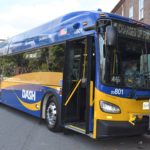
Alexandria’s DASH buses and King Street trolleys are being cleaned daily, with special emphasis on surfaces that riders handle a lot, like handrails and door handles. Spokeswoman Whitney Code said DASH will be hiring additional staff to ensure that the cleanings are thorough.
“We have a generally clean fleet. We take pride in that,” Code told WAMU. “This is just an extra measure to make sure that we’re ensuring the safety of the community.”
Protecting and supporting employees who keep transportation options running is another major priority of local agencies and companies at this stage.
Several agencies beyond Metro — including DASH and Amtrak — are making hand sanitizer available to employees and some customers.
Nationally, Lyft and Uber have promised to provide compensation to drivers who are diagnosed with COVID-19 or have been quarantined in conjunction with the disease, to make up for lost earnings. Lyft also says it will temporarily suspend passenger accounts if they receive an indication that that a user has been diagnosed with COVID-19.
“We will reactivate their account once they receive the proper clearance from health officials,” reads a company FAQ.
Here’s a roundup of the precautions area transportation providers are taking. We’ll update it with more information as it becomes available.
Metro
- Metro is implementing Phase II of its pandemic response plan, which includes distributing hand sanitizer to bus operators, suspending all non-essential employee travel, and more closely monitoring employee absences for illness patterns.
- On Sunday, Metro noted that it had performed extra cleanings of its MetroAccess vehicles, after information surfaced that a now-confirmed COVID-19 patient traveled to a facility in Rockville that MetroAccess frequently services.
- The agency increased the cadence of cleanings of its buses and rail cars starting last month.
MARC
- The Maryland Transit Administration, which runs MARC trains, has “proactively initiated an enhanced daily wipe-down of bus, rail, and paratransit vehicles to include disinfecting areas with high passenger touchpoints.”
- MTA says it “will make additional adjustments to cleaning schedules based on guidance from the MDH and CDC” as the situation develops.
VRE
- VRE does a thorough cleaning of its trains once a day. “We pay specific attention to head rests, arm rests, poles, things that passengers are coming into contact with,” said spokeswoman Karen Finucan Clarkson.
- The agency is also reminding riders and staff alike that VRE trains are equipped with restrooms, and they encourage everyone to wash their hands.
- VRE already runs a passenger health education campaign during cold and flu season, distributing relevant messages about good personal hygiene and encouraging sick people to stay at home.
Amtrak
- Amtrak is increasing the frequency of cleanings of trains and stations to multiple times a day — sometimes even on an hourly basis.
- The agency says it has “increased the quantity of sanitizers and disinfectant wipes available for customers and employees throughout our trains and stations.”
- Amtrak is sharing good personal hygiene guidelines with staff and riders.
- Amtrak is waiving change fees on existing and new reservations made before April 30, 2020.
- Three Acela trains that make nonstop trips between Washington and New York have been temporarily suspended because of reduced demand.
Baltimore-Washington International Airport
- A spokesman said in an email that BWI Marshall Airport is working alongside the Maryland Department of Health and federal health authorities on the response to the coronavirus. “We have been in close communication with these authorities since the onset of the outbreak. And we continue to work with our airline partners and other airport tenants on these issues,” he said.
- The spokesman referred questions about whether known COVID-19 cases had traveled through the airport to the Maryland Department of Health, but noted that “there is not any airline service from countries that have experienced major outbreaks of COVID-19” at BWI.
Dulles International & Reagan National Airports
- “We are following all CDC-recommended protocols for cleaning at our airports and sharing with our employees important information provided by the CDC about the virus and following the CDC’s recommendations on healthy habits, such as hand-washing and covering your cough,” a spokeswoman for the Metropolitan Washington Airports Authority, which oversees Dulles and Reagan airports, told WAMU in an email.
- The CDC is conducting enhanced health screenings for overseas passengers from China and Iran at Dulles.
- Virginia Senators Mark Warner and Tim Kaine and local U.S. Representatives Gerry Connolly, Don Beyer and Jennifer Wexton wrote a letter last week urging the airports to do all they can to keep travelers safe. “The more we can slow the spread of the virus, the more time it gives healthcare professionals in our area to prepare, which will result in better care for those potentially affected,” the letter reads.
- The MWAA spokeswoman referred questions about COVID-19 cases flying through Dulles International and Reagan National Airports to the Virginia Department of Health, which referred questions about contact tracing to local health authorities in Fairfax and Arlington. A spokesman for Fairfax County referred similar questions to the CDC. WAMU has reached out to the CDC.
D.C. Circulator
- WAMU has reached out to the D.C. Department of Transportation for further information about measures being taken on Circulator routes to keep riders and employees safe.
ART Bus
- ART is taking a number of measures to keep its bus operators safe, including educating them on the virus and the need for hand-washing and distributing hand sanitizer to employees.
- ART is also installing hand sanitizer dispensers at all of its facility entrances.
- The agency will “deep clean and sanitize all buses thoroughly at the end of each night by using approved disinfectant to wipe down all stanchions, handrails, passenger seats, windows and all components in the driver’s area,” according to a statement posted on the ART website.
- “We have not been notified by our local health department of any confirmed patients having been on an ART bus or STAR vehicle,” a spokesman for Arlington County told WAMU in an email.
DASH Bus
- “DASH is increasing facility and vehicle cleaning with a special focus on critical touchpoints such as door handles, handrails and other surfaces” on all buses and King Street trolleys, a statement on the agency’s website reads.
- A spokeswoman for the agency told WAMU that DASH would hire additional staff to meet the new cleaning regimen.
- Internally, the spokeswoman said, DASH is making hand sanitizer and disinfectant wipes available for employee use.
Fairfax Connector Bus
- WAMU has reached out to Fairfax County for comment about measures taken to protect riders and staff on Connector buses.
RideOn Bus
- WAMU has reached out to Montgomery County for comment on measures the RideOn bus service is taking to protect riders and staff.
TheBus
- WAMU has reached out to Prince George’s County for comment on measures TheBus service is taking to protect riders and staff.
Lyft
- According to a coronavirus FAQ posted on the company’s website, Lyft has convened “an internal task force dedicated solely to this issue.”
- The company plans to temporarily suspend riders who test positive for the virus. “We will also follow guidance from the CDC and local health officials to identify other individuals who may have been impacted,” the FAQ says.
- Lyft has been in touch with its drivers to encourage good personal hygiene habits and to recommend that drivers frequently disinfect cars.
- The company will “provide funds to drivers should they be diagnosed with COVID-19, or put under individual quarantine by a public health agency.”
Uber
- “We have a dedicated global team of Uber operations, security and safety executives, guided by the advice of a consulting public health expert, working to respond as needed
- in each market where we operate around the world. We remain in close contact with local public health organizations and will continue to follow their recommendations,” an Uber spokeswoman told WAMU in an email.
- The company has been sending out CDC guidance on staying healthy to drivers and riders via in-app messages and posts on their website.
Via
- WAMU has reached out to Via for information about measures the company is taking to protect riders and drivers.
Free2Move
- The carsharing service sent an email to members on Monday with details on its cleaning plans. “We have increased the rate at which we do a complete cleaning and disinfection of our vehicles,” the email said. “We will also be implementing new strategies like steam cleaning, while continuing and increasing our use of disinfectant whenever servicing the vehicle.”
- The email also advises customers to wash their hands before and after trips.
This story originally appeared at WAMU
More about coronavirus in the D.C. area:
With Coronavirus Fears Spreading, Here’s The Status Of D.C. Events
Amtrak Cancels Nonstop Acela Service Between D.C. And New York As Coronavirus Drives Down Demand
D.C. Is Preparing For A Decline In International Tourism Because Of Coronavirus