 Jenny Gathright
 Debbie Truong
This story was updated on March 13 at 12:35 p.m.
All of the universities in D.C. and nearly all in the region have suspended in-person classes on campus, joining a growing number of colleges and universities across the country trying to contain the spread of the novel coronavirus.
Students at Catholic University of America, Georgetown University, Howard University, Gallaudet University, American University, the University of the District of Columbia, Trinity Washington University, and the University of Maryland have been told to stay home from campus after spring break and continue their courses online.
The University of the District of Columbia announced Friday that it would be extending its spring break until March 17 and then shifting to online classes or alternate remote teaching methods until April 6. UDC is asking students not to return to campus until April 6, but says it will keep library services open for students and staff who need internet access. It will also open campus laboratories on a limited schedule. UDC was the last university in the city to make the announcement. Late Thursday, students at UDC circulated a petition protesting a lack of communication from the university about its plans. As of midmorning on Friday, it had gotten nearly 900 signatures.
[For the latest coronavirus updates, see here.]
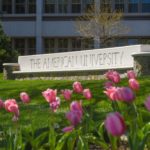
After initially saying it would suspend classes on campus and switch to online instruction temporarily, American University announced on March 12 that it will now pause all in-person instruction for the rest of the semester. (Disclosure: American University holds the license for WAMU).
The change in policy, Burwell said in a letter to the university community, came in response to two new developments over the past 24 hours: The World Health Organization’s declaration of COVID-19 as a pandemic, and decisions by D.C. authorities to declare a state of emergency and recommend that non-essential large gatherings be postponed or canceled.
Students were expected to return to the Northwest campus from spring break at the beginning of next week, but university President Sylvia M. Burwell said classes would not resume until March 18. American University students are being instructed to leave campus by March 23.
“We know this is challenging and stressful for students and their families and can cause financial and other hardships,” Burwell wrote. “American University will work with students to provide support to facilitate this transition.” The letter said students who can not depart campus due to “extraordinary circumstances” can contact the Office of Campus Life for emergency housing.
On Wednesday, Gallaudet University also announced it would pause in-person instruction after its spring break and resume with online instruction through the end of the semester.
Gallaudet students are expected to leave campus this month, unless they request special permission to remain on campus because of an internship, financial need, travel bans or a visa barrier. The Oiol Festival, an international sign-language arts and culture festival scheduled to be held on Gallaudet’s campus in July, has also been canceled.
[For a comprehensive list of event closures, see here.]
The University System of Maryland, the state’s public higher education system, urged universities to keep students off campus for two weeks after spring break, which starts Saturday. Presidents at each of the system’s 12 universities and three regional education centers must make the final decision to close campuses or move classes online.
Wallace D. Loh, president of the University of Maryland, said Tuesday night that classes after the week of spring break are canceled and will resume online March 30. Students will take classes online at least until April 10, according to a message Loh sent the university community.
The College Park campus sits in Prince George’s County, where the virus has sickened three people.
“These temporary measures will be inconvenient, even disruptive,” Loh said. “We will manage the transition to online platforms with as minimal interruption as possible.”
Earlier this week, officials at Catholic, Georgetown, Howard, Bowie State and George Washington University told students that classes would temporarily move online.
Bowie State University told students it would start online instruction after spring break ends on March 23, and asked them not to plan on returning to campus before April 6.
Catholic University said it was moving classes online until at least March 30. Catholic also said students who traveled for spring break are not required to return to campus until in-person classes resume, though officials said residence halls and dining services will remain open.
Howard University President Wayne A. I. Frederick directed faculty to move courses online or provide another alternative by March 23, according to a letter sent to the campus community. Students will learn online until at least April 6.
“Our priority remains the safety and well-being of our students and the campus community,” Frederick said. “We will continue to regularly assess risks to our community, and take steps to help mitigate and decrease any potential risks.”
Trinity Washington University announced late Thursday that it would cancel classes on March 16 and 17, and then move to “alternative remote formats” of instruction from March 18 to March 27. According to a letter from the school’s president, Patricia McGuire, that means classes will be held online or in other ways that don’t require meeting on campus.
Unlike some universities, Trinity Washington’s offices and campus will remain open.
McGuire said the decision to keep the campus open had to do with the size of the student body and their unique concerns. Only about 200 of the school’s approximately 2,000 students live on campus, and about half of those students stayed on campus during spring break because they either did not have a home to go to or could not afford to get home, according to McGuire.
“There’s a big assumption at some of the more elite universities that students can just move home and be fine,” she said. “Our students are different.”
A spokesperson for the university said 80 percent of the student body is eligible for Federal Pell Grants to help pay for school.
McGuire said the school is taking measures to reduce density and canceling gatherings of more than 20 people. Many students, McGuire added, will still rely on the campus internet because they do not have wifi or broadband access at home.
This story has been updated to reflect new information about more campuses moving courses online.