Martin Austermuhle
Small businesses and workers would get additional protections and renters would be spared from evictions or utility cutoffs under an emergency bill the D.C. Council will take up next week in response to the state of emergency declared on Wednesday by Mayor Muriel Bowser in light of the coronavirus pandemic.
The bill, written by Council Chairman Phil Mendelson, addresses both practical and legal issues that have arisen as D.C. has ramped up its response to the growing spread of the coronavirus—there are now 10 confirmed positive cases in the city—including whether the city’s lawmakers and neighborhood-level officials should even be meeting in person.
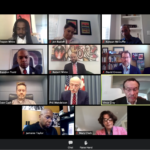
The bill would also allow the Council to meet and vote virtually, and authorize Advisory Neighborhood Commissions to cancel meetings during the state of emergency. It would also let Bowser delay her submission of the 2021 budget from March 19 to May 1, or five days after the end of a declared emergency. It would also allow for an extension of a declared emergency from 15 to 30 days before requiring that it be renewed.
[For up-to-date coverage of coronavirus in our region, check out DCist’s live blog here.]
It would also address the issues people are facing who are not able to work because of the coronavirus. The bill would allow workers sidelined by coronavirus to claim unemployment insurance, prohibit an employer from firing someone because they are quarantined or self-quarantining, let businesses file their taxes 90 days late without facing any penalties, and permit Bowser to give small businesses grants to help them manage “financial distress caused by a reduction of business as a result of the cause of the public health emergency.”
Landlords would also be prohibited from evicting a tenant during the state of emergency, and no utility could be cut off for non-payment during the same period. D.C.’s law prohibiting price gouging during an emergency would be expanded to include a public health emergency—the law currently only says “natural disaster”—and Bowser would gain more flexibility to provide public assistance to residents.
Under current law, Bowser gains a number of additional powers during a state of emergency. That includes the ability to evacuate residents to shelters, take or destroy property that poses a general risk, limit business hours and impose a curfew, and impose controls on the prices and sales of goods and services. (When asked on Tuesday if that power could be used to ration goods like hand sanitizer, Bowser said yes. “A public emergency, if I declare it, would give me that power,” she said.)
And most relevant to the coronavirus, a formal state of emergency would let Bowser turn all those recommendations for self-quarantining into enforceable orders. The law would allow her to “detain for medical reasons any person for which there is probable cause to believe that the person is affected with a communicable disease and that the person’s presence in the general population is likely to cause death or seriously impact the health of others.”
Bowser said this week that she has identified a location inside the city where the city could quarantine up to 50 people—though she wouldn’t say where it’s located.
The Council is expected to vote on the emergency bill on Tuesday.
This story originally appeared on WAMU.