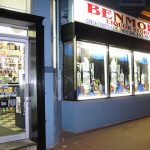
More than 500 customers walked through the door of Schneider’s of Capitol Hill on Friday.
That’s around twice the average business for the 71-year-old liquor store at the start of the weekend, but not an increase that can be attributed to St. Patrick’s Day, according to Schneider’s owner Rick Genderson.
“We probably get a little bit of a bump, but not like this,” says Genderson, who has worked at his grandfather’s store since 1980. “This is not from St. Patrick’s Day, this is from corona.”
As bars and restaurants around the District began closing their doors, bottles have flown off the shelves at many wine, beer, and liquor stores. Several shops reported an uptick by Thursday, as domestic cases of coronavirus climbed and more D.C. residents began stockpiling their favorite libations in anticipation of a long work-from-home period (at Cork, a specialty wine shop on 14th Street, customers also walked out with a free roll of toilet paper with their wine purchase.)
[For the latest on coronavirus in the D.C. region, click here]
Sales doubled at Calvert Woodley Fine Wines & Spirits in Van Ness from the previous Friday, according to owner Michael Sands. He attributes the boost to a heightened sense of urgency following President Trump’s speech and a slew of school closings on Wednesday.
“Wednesday night seems to be to me the clear dividing line,” Sands says. “The president’s speech and the sports leagues canceling their games, I don’t know if it seemed to be more real. I personally don’t think it’s a coincidence.”
Like other liquor stores that DCist spoke to across the city, Calvert Woodley sold the same ratio of beer, wine, and liquor but at a higher volume. At D’Vines, an upscale liquor store in Columbia Heights specializing in craft beers and fine wines, customers who would normally purchase two to three bottles of wine took home twice that amount, according to D’Vines general manager Adam Johnson. He also noticed customers picking up more handles of spirits.
On Sunday afternoon, a steady stream of customers grabbed six packs and perused D’Vines’ liquor shelves. Its neighborhood regulars didn’t seize the small shop with quite the same frenzy that captured the Giant up the block, where shoppers raided the aisles for toilet paper, pasta, and cleaning supplies.
“We’re not yet seeing a run on the bank scenario,” says Johnson. “We’re not experiencing what the grocery stores and convenience stores are experiencing which is pandemonium.”
Across the street from yet another Giant, on H Street, Craft Beer Cellar DC owner Erika Goedrich says business is up but not totally gangbusters. She has noticed that while the store offers mix-and-match options for their six packs, more customers are passing on experimental choices and opting for their reliable “comfort beer” like Bell’s Two Hearted, Port City Optimal Wit, and Right Proper Raised By Wolves.
“For the most part, nobody’s walking out with cases and cases,” she says. “People are buying six packs of the tried-and-true.”
Consumer behavior has shifted in other ways. At Sherry’s Wine and Spirits in Woodley Park, customers who would normally buy pricier items are buying cheaper ones, while those who usually purchase mid-level spirits are opting for rail liquors, according to Sherry’s general manager Ben Koizim.
“It is somewhat mirroring what happened during the [government] shutdown in terms of buying pattern,” he says. “Everybody is saving their money. The market is losing money and that’s bad for business.”
Although liquor stores may be experiencing a boost this week, there’s a sense that they’ll make hay now and then experience a downturn later. The walk-in rush has also been tempered as other sales have dried up in the wake of the virus. Sherry’s delivery business has gone up, but those gains level out after the store pays drivers and the app service.
“The pandemic is certainly not a net gain,” Koizim says. “This is a net loss for any small business. You’re not getting the out-of-towners, we’ve lost the World Bank convention, that’s a tremendous amount of benefit for the store.”
And while sales have been brisk at Schneiders, Genderson has seen other revenue sources disappear.
“We’ve had a lot of large parties and weddings, bar mitzvahs canceling,” he says. “We do a lot of business with caterers and a lot of that is going by the wayside.”
There might be plenty of Manischewitz left over, but both Genderson and Koizim reported a run on grain alcohol. Several customers have told Koizim that they plan on making their own hand sanitizer with high-proof liquor like Everclear.
Koizim predicted Everclear sales would go up and purchased 200 bottles in the first week of March. He was right. Even with increased supply, the store ran out within a week.
“You’re getting people who are usually high-end wine clients that are buying Everclear,” Kozim says. “Unless they’re hazing a bunch of freshmen, that’s probably what they’re using it for.”
In order to be effective, hand sanitizer must contain at least 60 percent alcohol, which most liquor intended for consumption does not meet, according to Julie E. Fischer, an associate research professor in the Department of Microbiology and Immunology and acting director of the Elizabeth R. Griffin Program at Georgetown University. The World Health Organization recommends a minimum concentration of 96 percent ethanol in a homemade hand sanitizer if a commercially-made version is not available.
Grain alcohol is sold at concentrations ranging between 120 proof, or 60 percent, to 190 proof, or 95 percent, alcohol by volume. But many of the homemade formulas posted online are not correct and if the mixture doesn’t contain a final concentration of at least 60 percent alcohol, then it won’t be effective, according to Fischer.
“A formula that is too weak wouldn’t be effective against SARS-CoV2 [coronavirus], and using alcohol directly on the skin can be damaging,” she says, adding that as long as you have access to soap and water, washing your hands vigorously for more than 20 seconds is more effective than hand sanitizer at eliminating not only coronavirus but other microorganisms that can cause diseases.
As Genderson restocks his shelves with grain alcohol, there’s still some products that just won’t budge.
“We’re not selling much Corona,” he says.