Margaret Barthel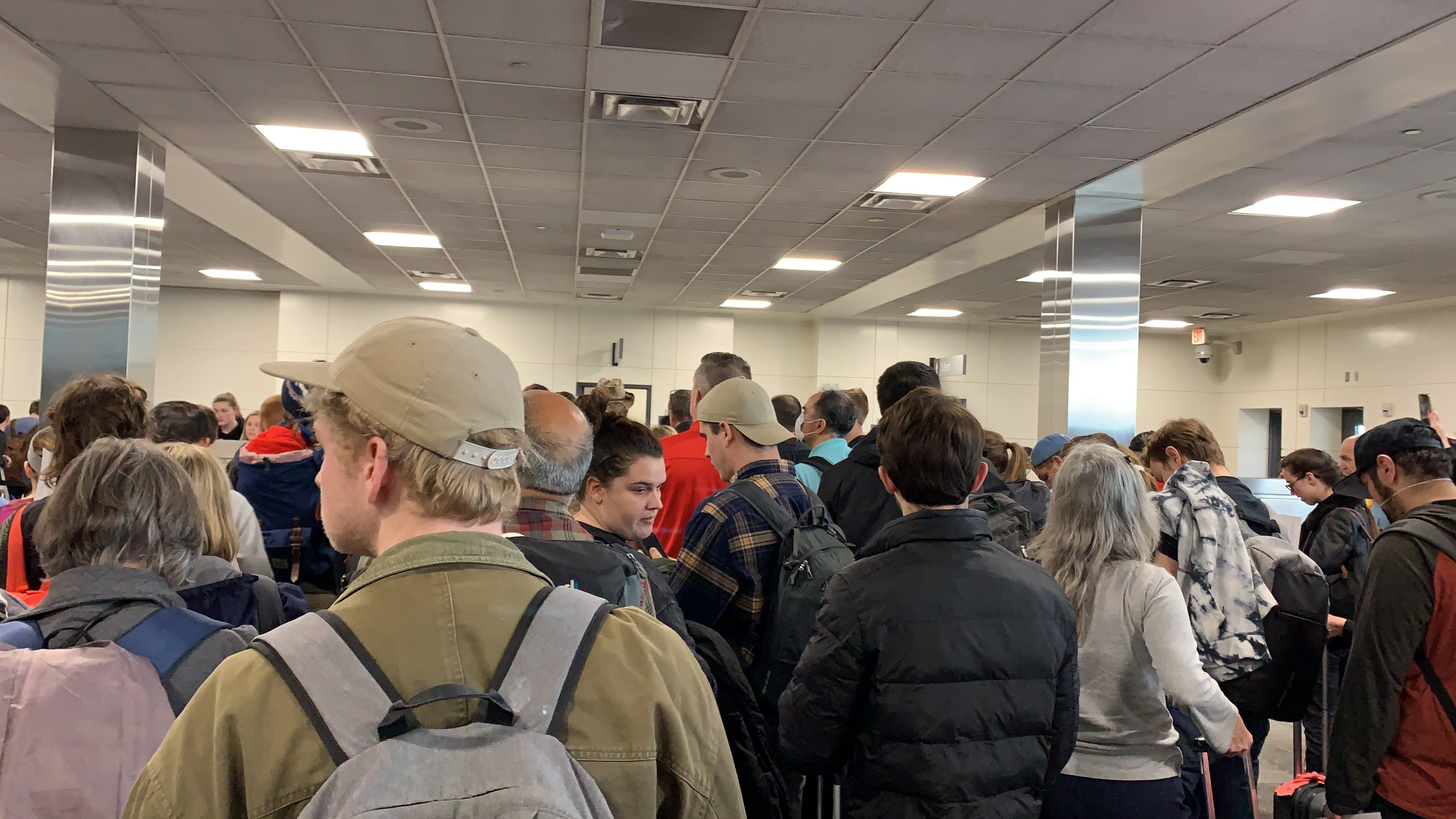
Dulles International Airport was flooded over the weekend with American travelers trying to get back into the country after President Trump’s ban on travel from certain countries in Europe went into effect.
The ban does not block U.S. citizens or permanent residents from entering the country, but it does require Americans coming from Europe to land at Dulles or one of a dozen other airports to be screened for coronavirus.
[Read the latest updates about coronavirus in our region here]
As a result, about 40,000 people arrived from Europe on Saturday, the first day the new policy took effect. The additional screenings, plus confusion and crowds, led to a tense, hours-long, close-quarters re-entry process for thousands of Americans, some of whom now worry whether they may have been exposed to the virus while navigating a system designed to prevent its spread.
Dulles airport. 7hr wait. Corona virus INCUBATOR. Thanks @gop #coronapocolypse pic.twitter.com/nTucMR4jFG
— SparksJoyOrNot (@SparksJoyOrNot) March 16, 2020
“I’m not sure what the solution is, but this was not it,” said Sara, who declined to give her last name because of her work with the government.
Sara, who works in public health, had been in Nice, France, to attend a class. She hesitated over whether to return to the U.S., concerned about being part of what she called the “first wave” of Americans racing home and worried that authorities would be ill-prepared for the crush of arrivals. But, given the quickly changing situation and the advice of family and colleagues, she decided to come home early.
“This has ‘poorly handled’ written all over it,” she recalls thinking at the time.
Confusion And Crowding Upon Arrival
Sara returned Saturday and said the disorganization started before she got off the plane. When the flight arrived, they were met by an official who said passengers would be allowed off the flight in groups of 80. As passengers began to move, they were asked to sit back down and fill out a form with basic medical information. Many took the form and deplaned anyway. Finally, hearing no further instructions from officials, Sara deplaned as well.
“I was like, ‘I feel like I’d better get off. If I don’t get off, will I ever get off?’” she said. “No one stopped me.”
After leaving her plane, Sara got on one of Dulles’ people-mover vehicles, which was as packed as they often are. Employees from United and the airport helped people board the vehicle and handed out customs forms, but were not wearing masks or gloves, Sara noticed.
Jennifer Kotting flew back into Dulles from Seville, Spain, via Heathrow Airport in London on Sunday and faced a similar experience on a people-mover. She told WAMU that she was in “really close quarters” on one transport for 40 minutes. She also said passengers were asked to divide themselves into arrivals who had traveled in Schengen countries versus the United Kingdom or Ireland — entirely based on the honor system.
“There was one woman trying to direct people, somewhat inefficiently,” Kotting said.
From the people mover, passengers say they were taken to a large room where medical staff was screening new arrivals.
“We’re all bunched in, there’s no hand sanitizer, there’s a couple people with masks and gloves on, but it’s chaos. People are pushing forward, they’re asking who has connections, who doesn’t,” Sara said.
Acting Director of Homeland Security Chad Wolf acknowledged the long lines and crowding at airports across the country on Sunday morning in a tweet.
DHS is aware of the long lines for passengers who are undergoing increased medical screening requirements. Right now we are working to add additional screening capacity and working with the airlines to expedite the process. 1(/2)
— Acting Secretary Chad Wolf (@DHS_Wolf) March 15, 2020
“It currently takes ~60 seconds for medical professionals to screen each passenger. We will be increasing capacity but the health and safety of the American public is first & foremost,” Wolf wrote.
“CBP has increased staffing at all locations to process travelers impacted by the proclamation as well as refined the screening process logistics to ease impacts caused by the large volume of travelers requiring enhanced health screening. Implementing these measures helped reduce the wait times,” Acting Customs and Border Patrol Commissioner Mark Morgan told WAMU in a statement.
Kellie Schachle, who was traveling home from a family vacation in Barcelona via London Heathrow Airport on Saturday, said she and her family spent more than three hours in line for the medical screening, and they were concerned about how close they were to other travelers.
“Social distancing was a ridiculous concept in this situation,” she told WAMU. She said passengers waiting together in line developed “gallows humor” about the situation, joking about exposure to the virus.
Entering A Medical Screening
Schachle said passengers were asked to fill out another form before the medical screening, with their name, email address, phone number, the flight they’d taken, and their seat number. She said the staff overseeing the form process were offering pens for passengers to share if they didn’t have a writing implement, which worried her. She was grateful that her family had brought their own.
That wasn’t quite Sara’s experience: she was asked to fill out a form with medical information after she’d arrived at Dulles, but before she got off her flight. When she got to the head of the medical screening line, she handed the form to medical staff in scrubs, masks and gloves, who looked at the information and asked her some basic questions about her health. Her temperature was not checked, and medical staff didn’t talk to her directly about self-quarantining or monitoring her health, though there were paper hand-outs on the table with public health information, which she took.
“It sort of refers to Wuhan, it’s like ‘what to do if you come back from China,’” she said. The information sheet was dated from late February.
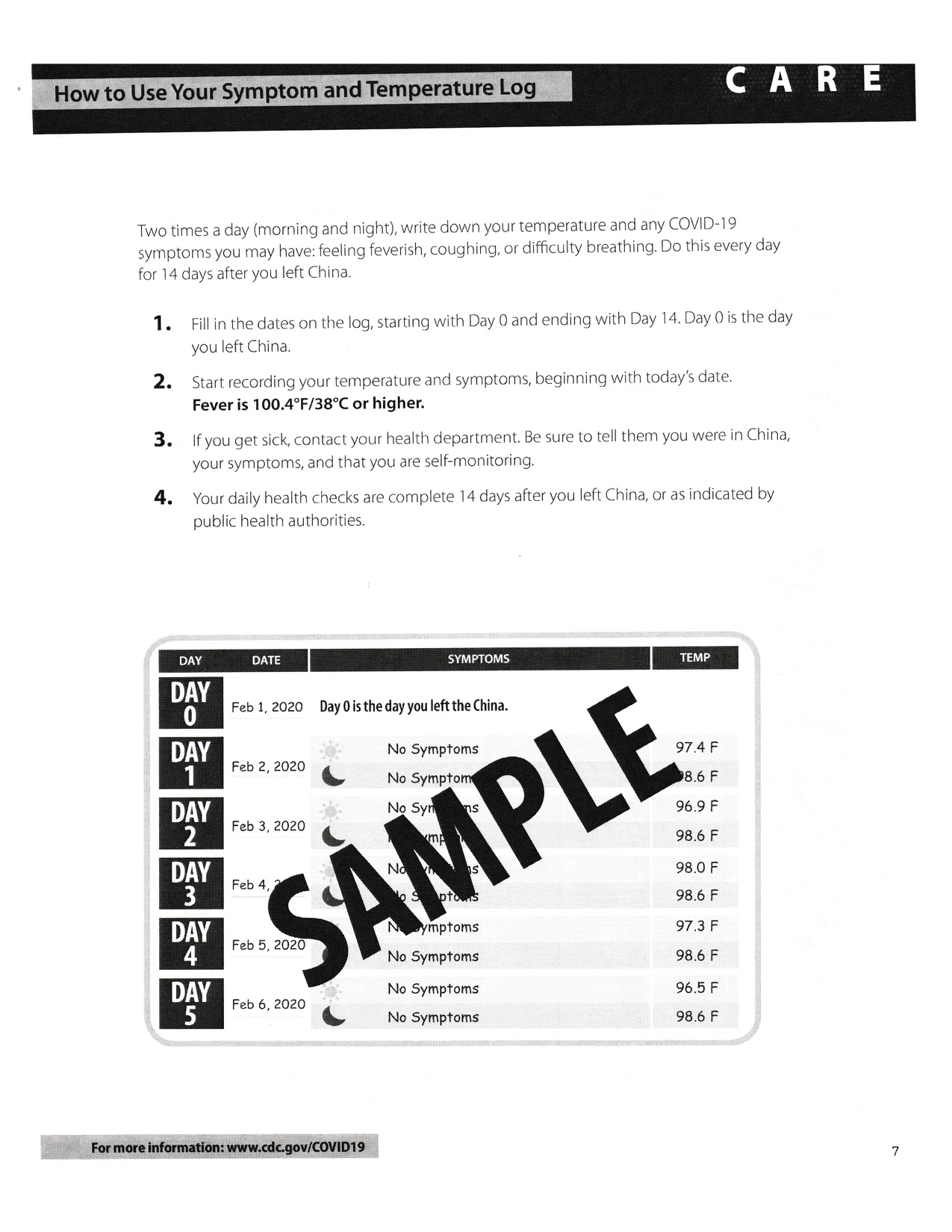
One of the handouts Sara received at her medical screening at Dulles Airport on Saturday.
“No one ever told me I had to stay home for 14 days, anything like that,” she said. No one asked her if she had questions about the self-quarantining process, and she’s not sure if it’s safe for her to go out for a walk.
“I think the people in scrubs were just looking for the people who looked obviously sick,” she said.
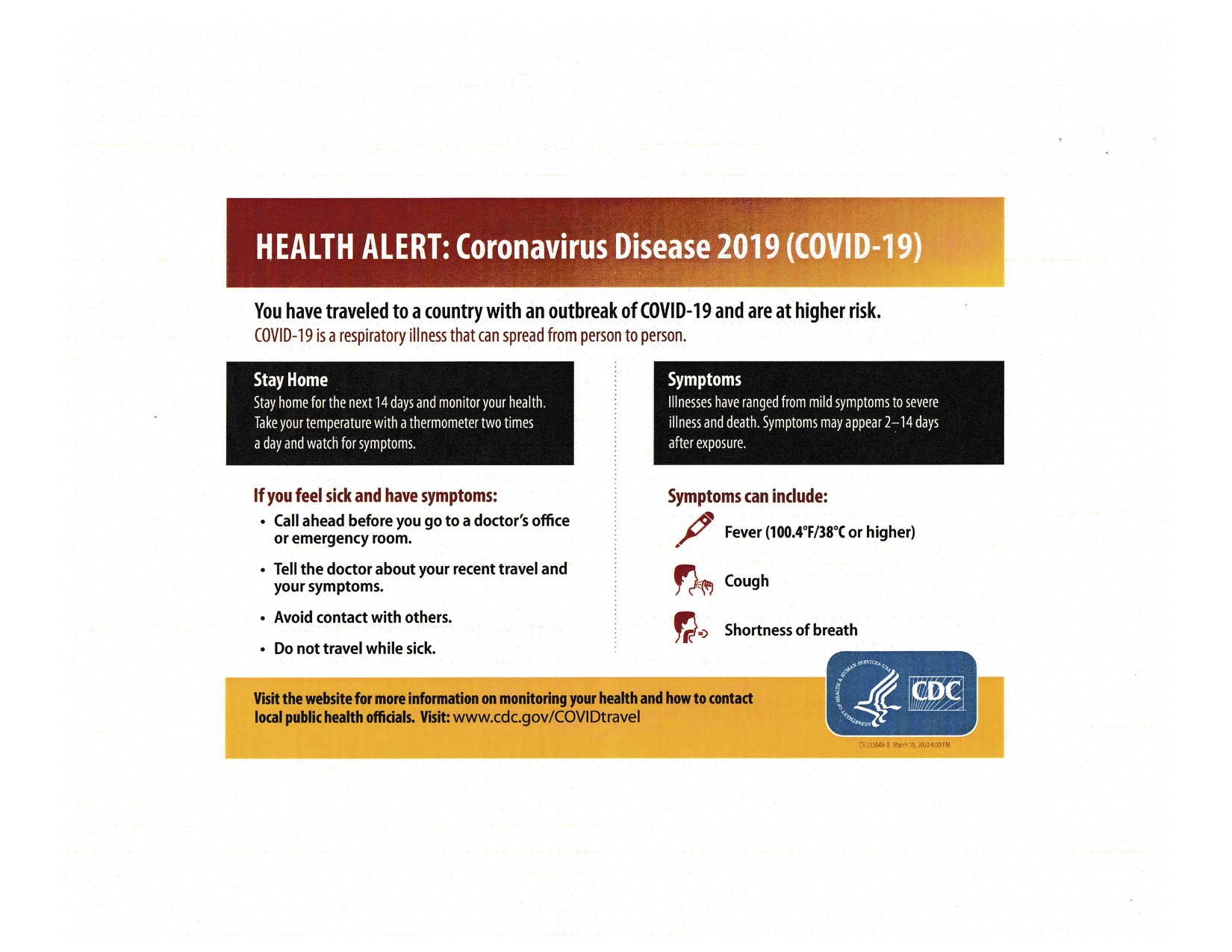
Another handout available to passengers going through medical screening at Dulles Airport on Saturday.
Kotting said she was given a medical information form to fill out before she left the U.K. But when she presented it at the medical screening, the medical staff looking it over hadn’t seen that version of the form before and had to write in details by hand.
Schachle said her family did have their temperatures checked in the medical screening, and then recorded on the forms they handed to the medical personnel. Kotting said the medical staff who evaluated her talked with her about self-quarantine. But both passengers agreed that the screening was cursory at best.
“If we’re going on this screening system that seems to be honors-system-based, and we’re just passing along some ineffective form and someone’s looking at us to see if we’ve coughed in the last minute or not, that is not a good reason to be funneling people into these really crowded areas at 13 specific airports,” Kotting said.
More Lines At Customs
Sara had to take another packed people-mover to get to customs.
“This one guy definitely looked sick. He was coughing, rubbing his nose, his eyes didn’t look good,” she said.
She described “a huge line” to get through customs, and no Customs and Border Patrol agents wearing gloves or masks. The line, Kotting said, was better on Sunday, though she didn’t see agents or airport staff wearing gloves.
A spokesman for CBP told WAMU that the agency “has issued guidance to all employees that outlines the current, comprehensive, risk-based use of Personal Protective Equipment including guidance regarding wearing masks in the appropriate circumstances. CBP has also issued comprehensive sanitary guidance to its facilities specifically to prevent the spread of COVID-19.”
Schachle and Kotting felt one bright spot in the experience was the professionalism of the staff shepherding a large volume of anxious passengers through the screening process.
“All of the personnel, the TSA, the passport guys, the spattering of medical personnel we came into contact with could not have been more professional, helpful — lots of apologies, ‘we’re sorry, this is our first day with this new policy,’” Schachle said. “I have zero complaints with the people who were trying to do their jobs.”
Self-Quarantining After A Flight
All three passengers plan to self-quarantine to the best of their ability for the next 14 days. None of them are showing symptoms of the coronavirus. But they worry that their experience at Dulles over the weekend exposed them to it — more than their actual travels themselves.
“We were extremely careful. Our hands are raw from washing,” said Schachle.
“I hate to be crass, but it was an all-out shit show,” Sara said, noting that the part of France where she had been didn’t have confirmed cases. “If I didn’t have corona beforehand, I feel like I have it now.”
She compared her experience at Dulles on Saturday to the screening process — also at Dulles — when she flew home from working to end the Ebola outbreak in Liberia. She recalled officials at airports in Africa and in Brussels requiring aid workers to have their temperatures checked before they came into the airport building, and they had to wash their hands and wash the bottoms of their shoes. And she was given a thermometer to take her temperature regularly as she settled back into home life in D.C.
Sara acknowledges that the volume of travelers to be screened and the scale of the outbreaks of the two diseases aren’t at all comparable. But she still thinks the process could have been handled far better.
“When you land in Dulles, there was nothing. No one was handing out hand sanitizer, no one was telling to not cough on people, or saying, ‘if you feel sick, come over here,’” she said. “There was nothing like that. We all were just in this hall herding towards these checkpoints.”
“I thought, here’s 10,000 cases right here,” she said. “I really just thought, ‘America needs to wake up.’”