As the Washington region reacts to the spread of the coronavirus, businesses including health clubs and spas are being ordered to close, the public is being urged to practice social distancing, and residents are left searching for new ways to exercise that don’t rely on gathering in large groups.
Dr. Kate Ayoub, a health and endurance coach based in the District, says residents aren’t looking for ways to exercise just for the sake of being in shape—for many people, exercise is a source of stress relief and mental health that they can’t access elsewhere.
“We know exercise is good for your mental and physical health, and finding ways to still exercise is still really important,” she says.
[For more updates on coronavirus in the region, click here.]
In response, trainers are offering advice on how to stay active on your own. Below is a round-up of recommendations from coaches and trainers across the District on how residents can stay healthy while practicing social distancing.
1. The Weights Are Over
Even if you can’t go to the gym, there is still a menu of exercises that you can do from the comfort of your apartment. Many District residents do not have their own set of fitness equipment at home (like a weight set or boxing bag), so trainers are assigning their athletes routines that they can do on their own—and routines that engage the whole body at once were stand-out favorites.
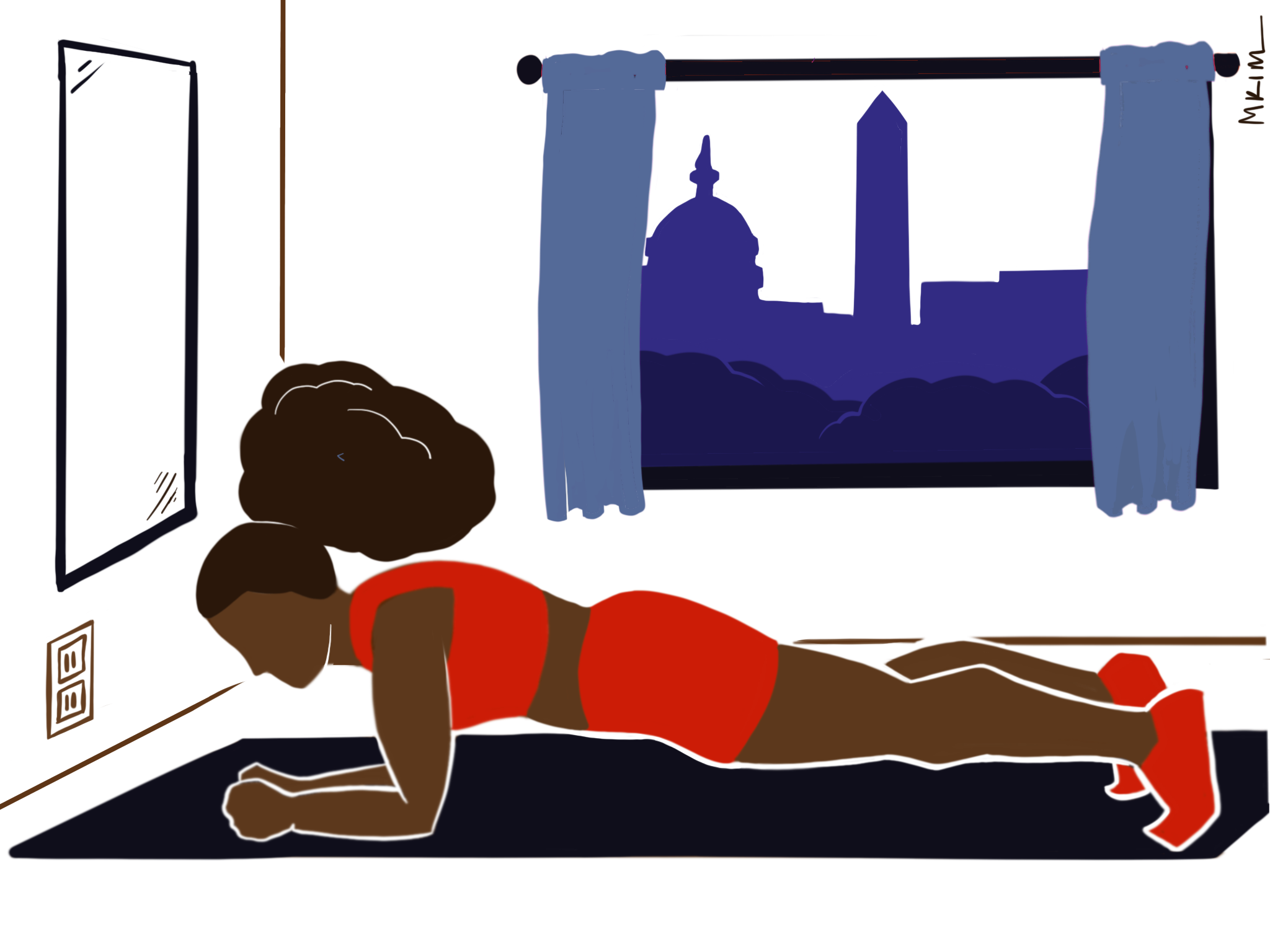
“If I’m at home and I don’t have a lot of equipment to work with, I’d do a full-body [exercise],” said Stephen Carter, a local personal trainer. A favorite is the plank, where the athlete holds their body above the ground using their forearms and feet.
Local running coach Emily Richards favors the burpee, a move that combines the push-up, the squat, and a jump into one motion.
“It’s an all-in-one exercise,” explains Richards. “It’s strength and it’s cardio.”
Victor Williams, coach and Director of Operations at NUBOXX, also recommends continuing any weight-based exercise you usually do at the gym, but substituting the weighted equipment with more repetitions. For example, if you do arm curls with 10 lbs, do that same motion for longer—and eventually, you’ll start to feel the burn.
2. Social, At A Distance
Another common recommendation from trainers is to plan your “isolated” workouts with your friends. When you’re staying at home, it’s easy to be “deprived of social contact,” says Dr. Ayoub. “So you can video chat with one of your friends while exercising.” Some athletes are using FaceTime or Google Hangouts to chat with each other while they work through their circuits.
Mike Schipp, a coach and Program Director with DC Triathalon Club, noted that coordinating your workouts with your friends also helps with accountability. Some of his athletes train at home using a stationary bicycle, so they can set up “virtual” rides where they all do the same workout at the same time.
3. Let’s Talk About Tech
If you don’t like setting your own workout, the internet is here to help. Richards recommends the Ironstrength Workout, a series of exercises users can complete at home with minimal equipment. Dr. Ayoub prefers the app Skimble, where athletes can search by what type of equipment they have available to them. Other favorites include Aaptiv, which mimic in-person boutique studios, and the Nike Training Club app, where users can sign for programs that include workout- and nutrition-based plans. Many of these apps are subscriptions-based, but offer free versions.
Many local trainers and fitness studios are also adjusting their own coaching to make sure that they can continue to offer fitness sessions: Yoga District and Bluebird Sky Yoga are live-streaming their classes. Shipp plans to build out a video series on his social media, and Williams and his fellow coaches at Nuboxx are planning remote video series too.
4. Getting Outside
Although local races and events are being called off or postponed, residents can still get fresh air and sunshine without meeting breaking social distancing. “In general it’s safe to go outside, just not in large groups,” Dr. Ayoub says. “Going for a walk, a run, or a hike is absolutely fine, but try to avoid touching your face.”
“You can be a runner and still practice social distancing,” notes Richards. It might mean running on your own instead of your regular groups or shifting your routes to low-trafficked areas in the city.
Most of the coaches and trainers we talked to emphasize that it’s important that residents still find a way to move their body and exercise, even if they can’t go to the gym or their favorite exercise class. There are ways to move our bodies and connect with each other even when we’re in physical isolation.
“All of this is so mentally and physically related,” said Dr. Ayoub. “It’s not just washing our hands.”