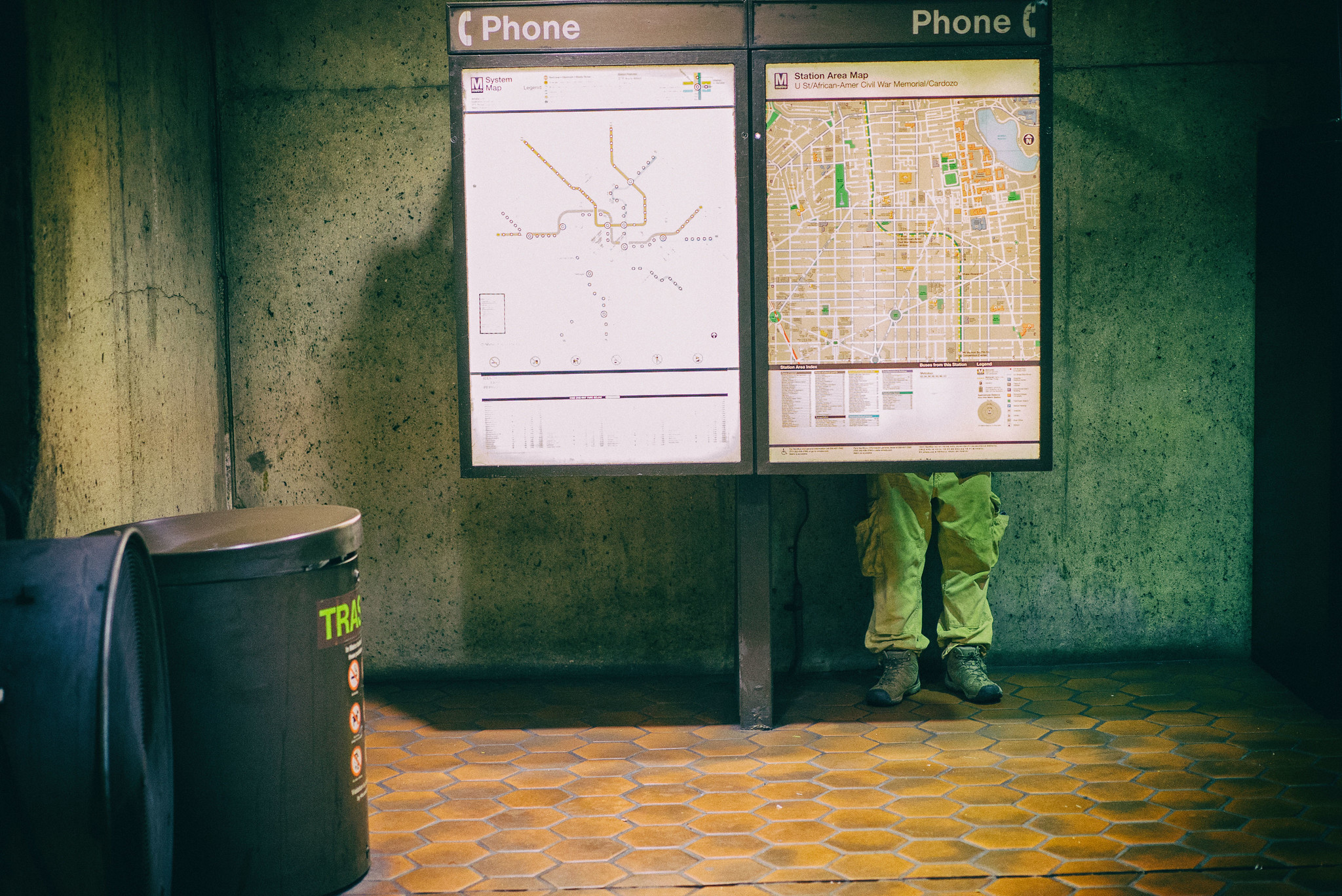
Patricia O’Riordan is worried about her husband, Terry. He’s worked for Metro for 25 years and is a mechanic for the system’s escalators and elevators in Virginia stations. And he’s still going to work full time, even as the region—and Metro—brace for the coronavirus outbreak.
“I’m the frantic one in the family,” she says. “He goes to work, and does his thing. I think he’s concerned but he doesn’t verbalize it.”
O’Riordan, who is 68 and retired, has two questions: Are transit industry workers like her husband being given protective gear like masks and gloves? And what information are transit agencies and employee unions distributing to help workers like her husband stay safe? So O’Riordan asked WAMU for some clarity as the station covers stories related to the coronavirus.
[Read the latest updates about coronavirus in our region here]
As area businesses and schools shutter, and some workers in the region start teleworking, rail, bus, air travel and ride-hailing continues. Many transit agencies have cut back service, but plenty of bus drivers, train operators, maintenance workers, cleaners and airport staff are still reporting to work—and interacting with the public in the process.
“We’re at a crisis right now that is like a war,” says John Costa, the president of the Amalgamated Transit Union, which represents transit workers across the U.S. and Canada.
“We’re first line responders, we’re trying to keep the economy going, we’re trying to get first responders to their jobs, but at the same time we have to be concerned for ourselves. And officials have to figure out: do we keep the service going like it is or do we shut it down and utilize it for essential reasons only?” says John Costa, “I think we’re at that point, and our members are starting to be concerned about that.”
Raymond Jackson, who leads ATU Local 689, Metro’s largest employee union, said he’s hearing concerns from workers.
“I can tell you, they’re scared, but they’re out there,” he says. “I’m proud of them.”
Antonio Pollard drives a Metrobus in Northern Virginia and is a Local 689 member. He said one of the things that keeps him going through the fear and the uncertainty of the pandemic is knowing that some riders—like people with disabilities—have no other option to get around.
“We’re concerned as much as anybody else about our health, but we’re also concerned about the others that can’t get to work, such as people with ADAs, disabilities,” he told WAMU. “We would like to help them and be there for them also.”
“We’re in the people business,” Pollard says.
‘Can We Get Some Face Masks And Gloves?’
Patricia O’Riordan isn’t the only one wondering about protective gear for workers.
“One of the most frequently asked questions from our workers is, ‘Can we get a face mask and some gloves?’” Jackson with ATU Local 689 said.
But it’s not quite that simple. Both Jackson and a Metro spokesman told WAMU that the agency is only giving out masks to workers according to guidelines from the Centers for Disease Control and Prevention. So transit agency police responding to a medical call, for instance, get masks.
“This is a marathon, not a sprint. That means we will be guided by public health experts in these decisions,” the Metro spokesman told WAMU.
Some workers, Jackson notes, are already required to have personal protective equipment like face masks as part of their regular job descriptions. He says the union has worked with Metro to iron out instances where those workers weren’t getting access to the appropriate gear.
Metro does not prohibit employees from bringing their own masks to work.
Policies To Protect Workers
Some transit agencies are making changes in workflow or service in an attempt to protect their workforce. The D.C. Circulator and Montgomery County’s Ride On bus services, for example, are asking riders to board through the rear doors of the bus in an attempt to maintain distance between riders and the bus driver. As of March 17, Metro gave bus drivers the authority to bypass riders waiting at stops if they were concerned about the vehicle getting too crowded. Protective shields in Metrobus cabs will now be required to remain closed.
Costa says ATU International has long advocated for better separation between bus drivers and the riding public, citing abuse and assault incidents dating long before the pandemic.
“This virus has just brought it to a bigger sense that now they’re wide open not just to being abused, but also to get a sickness and actually spread it,” he told WAMU.
Jackson, with the local union, wants the public to keep their distance from workers, too.
“We’re here for them, but I’m also going to ask them to maintain that distance away from our operators,” he says.
On Metrorail, station managers are now able to stay in station kiosks; access to those kiosks has been further restricted. Similarly, train operators are being asked to stay in their operating cabs unless there’s an emergency. Employees in the Rail Operations Control Center, which oversees the overall running of the rail system, have been split into two different teams working out of two separate locations. That’s to guard against the possibility of one of the teams needing to be quarantined after someone gets sick.
Figuring out how to staff the system in the event that large numbers of Metro employees fall sick is a concern beyond the operations center, too.
“Metro is acting urgently to further reduce the number of employees required at any time and working to create additional redundancy in Metro’s workforce to protect service continuity,” a recent statement from the agency reads.
The same statement came with a plea for the public to not ride the system except for essential trips, in part to protect the health of its employees.
Many local transit systems, including Metro, DASH bus and Amtrak, have also stocked up on supplies like hand sanitizer and disinfectant wipes and passed some of them out to frontline workers, especially those without easy access to a bathroom where they can wash their hands. The agencies also say they are providing employees with information about how to maintain good personal hygiene in the midst of the crisis.
For his part, Pollard says he’s regularly cleaning the area of his bus by the driver’s seat, especially the steering wheel and controls.
O’Riordan says her husband has access to disinfectant wipes at station kiosks, and he can wash his hands in station bathrooms. But she still worries.
“I’m just thinking, he’s there, on the escalators, people are going up and down them, and he’s touching the handrails,” she says.
Pay And Benefits
Most local transit agencies are reducing service as ridership plummets and public health imperatives for people to socially distance themselves become more urgent. Metro ridership was down almost 80 percent on Tuesday compared to the same day last year, and the agency announced that it would run trains and buses on a supplemented Sunday schedule for now.
Between cutbacks in service and concerns over employee health, many have questions about pay and benefits for frontline transportation industry workers.
The 32BJ chapter of the SEIU union, which represents workers at Dulles International and Reagan National Airports, called on Virginia Gov. Ralph Northam to extend emergency benefits to workers, including a statewide 14-day emergency paid sick leave policy and unemployment insurance for reduced business hours or closures.
“The workers who clean airplane cabins, escort elderly and disabled passengers to their gates, and clean our airport terminals come into close contact with millions of travelers every single day, yet the majority don’t have sick leave, healthcare or even adequate breaks to wash their hands,” the letter to the governor reads.
The union also requested the governor’s backing of its request that the Metropolitan Washington Airports Authority, which runs Dulles International and Reagan National Airports, provide workers with 10 days of paid sick leave permanently.
“MWAA should actively encourage sick workers to stay home whether caring for themselves or a family member during illness or quarantine or school closings. Airport workers risk significant exposure to communicable disease given high volume of passenger traffic. Access to robust paid sick days will ensure they are able to stay home when sick, to hasten recovery and limit the further spread of disease,” the group said in the letter.
WAMU has reached out to MWAA for comment.
For Metro employees, the pay and benefits picture is a little clearer—at least for those directly employed by the agency.
Metro says its service reductions mean it will need 60 percent fewer employees to maintain system operations. But a spokesman confirmed that employees will generally still be paid the usual non-overtime rate, with some variations based on which union they’re in or if they hold a non-union position.
“Metro and the union have been working actually side by side throughout this whole process,” Jackson with ATU Local 689 says. “As far as hours and pay, we’re working all of those issues out as we speak. I don’t think we’re going to have any problem with whatever service WMATA wants to put out.”
Workers employed by Metro’s contractors don’t have the same guarantee that their pay will continue.
“It’s certainly our hope that the companies who do business with us recognize the effect this emergency will have on their workers,” the Metro spokesman says.
Metro has requested emergency funding from the federal government, citing a loss of 85 percent of its ridership—adding up to more than $50 million in lost revenue this month.
Ride-Hailing Drivers On The Frontlines
Ride-hailing drivers also have concerns over pay as the pandemic unfolds and more people stick closer to home.
Syed Mehdi, a 21-year-old student at Towson University, drives for Uber full time around the D.C. region. These days, he’s not getting many rides—and that means his earnings are down by about half, he estimates. On a regular weekday, he usually makes about $100 over 4-5 hours. Now, he’s lucky if he cracks $100 in 8 hours.
“Now that the bars and restaurants are shut down, that’s a significant chunk of the business, especially on the weekend,” he says. “I don’t really know what it’ll look like down the road.”
But Mehdi feels lucky in comparison to other drivers he knows. He thinks he’ll be able to get a two-month extension on his auto loan payments, but other ride-hailing drivers rent their vehicles and are now struggling to cover the cost of that rent, much less make money.
Mehdi isn’t especially concerned about his health, either, even as he continues to take on passengers. He says he’s young and healthy. But he is worried he could accidentally pass the disease on to others, given his continued exposure to riders.
“I’m more worried about being a super spreader,” he says.
But, he’ll keep driving for now. “At the end of the day, I still need money,” he says.
Mehdi is taking some precautions to keep himself and his passengers healthy. He’s cleaning his car twice every day, and he’s declining passenger requests to sit up front with him.
Uber announced that it would suspend the often cheaper UberPool option on the app. Mehdi says that would impact riders in lower-income or student-heavy areas, many of whom use UberPool instead of the regular service. But from a public health perspective, he approves of ending the pool option. He wishes the company had taken the step earlier.
“Clearly, when the government is calling for social distancing, and saying ‘Hey, try to limit exposure as much as possible,’ you don’t want four people completely packed together,” Mehdi told WAMU. “They should’ve done it a week ago.”
Lyft and Uber have promised to provide compensation to drivers who are diagnosed with coronavirus, or have been quarantined in conjunction with the disease. And Uber announced it would offer drivers 14 days of paid sick leave, based on average earnings.
But that’s not giving any relief to healthy drivers, like Mehdi, who are still dealing with drastic drops in pay due to the pandemic.
“Right now, it’s bad, but like, what if the government imposes a no non-essential travel curfew?” Mehdi says.
If that happens, transit agencies and transportation companies alike could be in for an even bigger financial hit—one that could drastically affect workers, too.
This story originally appeared on WAMU.