 Rachel Sadon
 Jenny Gathright
 A.C. Valdez
The extraordinary measures that the city has implemented to stop the spread of coronavirus will remain in place until April 27, Mayor Muriel Bowser announced today. Schools will continue distance learning and the ban on mass gatherings will remain in place until that time.
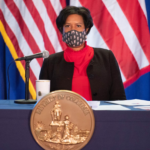
The announcement came as the city recorded its first coronavirus-related death. “Let me clear: we expect to see a spike in COVID-19 positive cases in the coming days and weeks,” Bowser said. “I cannot stress enough that the threat of this virus poses very serious consequences for our community. Everyone is susceptible … it does not discriminate based on age, race, or gender.”
The mayor did not directly address a question about whether the city was considering an order to shelter in place, saying that her administration had “essentially shut down our thriving economy in D.C.” in order to stop the spread.
[For the latest updates on coronavirus, see here.]
Because the school closures are extended, the city will seek a waiver from the U.S. Department of Education to cancel statewide assessments for this year. The city’s libraries and recreation centers will also extend their closures until April 27. All District of Columbia Public Schools and Department of Parks and Recreation playgrounds will also be closed until that date. Charter schools are also expected to remain closed.
Public fields that can not be locked will remain open, but residents are urged to practice proper social distancing at these locations.
D.C. Health Director LaQuandra Nesbitt said during the briefing that the city had determined that local hospitals, which are bracing for the months ahead, were prepared for a spike in cases because patients have been calling in and coordinating with their healthcare providers before going into medical offices. She also said that the number of ventilators exceeded the number of intensive care beds available, which indicated that local hospitals were being “very creative.”
The District’s hospitals have 404 ventilators, and 147 are currently in use, Nesbitt said. Of the city’s 351 ICU beds, 69 are currently available (and that number is up from two days ago, when 40 were available), according to Nesbitt, who said it is important to keep in mind that this is an area where hospitals are able to increase their capacity.
“General medical surgical beds that are not intensive care beds can … readily become intensive care beds or ventilator assistance beds,” Nesbitt said. “When you eliminate your non-essential services or your elective surgeries, then you have less of an ability for complications to occur, and the need for intensive-care beds that may be used post-surgically.”
D.C. officials also announced a $25 million dollar local recovery fund for businesses, nonprofits, independent contractors, and self-employed individuals. Applications for short-term financial assistance through the new program, administered by the office of the Deputy Mayor for Economic Planning and Development, are scheduled to open next week. Local businesses can also apply for disaster loans through the federal government’s Small Business Administration.
As mass layoffs began this week, particularly affecting the service sector, more than 11,800 workers have filed for unemployment insurance as of Friday, according to Unique Morris-Hughes, the director of the D.C.’s Department of Employment Services. The agency is eliminating some restrictions and the seven-day waiting period to receive unemployment insurance benefits.
[For more on how to apply for unemployment and other benefits, see here.]
The announcements from D.C. come as elected officials in the region continue to move forward with aggressive measures aimed at slowing the spread of the coronavirus. In a press conference on Friday in Maryland, Montgomery County Executive Mark Elrich urged people to continue with social distancing strategies, cautioning that the county was “one step away” from a shelter-in-place rule.