Margaret Barthel
 Jenny Gathright
It’s one minute before 6 p.m. on Friday, and Steve Dunn is ringing a cowbell on his street in Mt. Pleasant in Northwest D.C. Neighbors up and down the street gathered on their porches. Dunn’s husband, Tom Burkhardt, donned a sparkly cape, feathered hat and sunglasses to rally the crowd.
And as the clock struck six, the residents of Hobart Street started singing Bill Withers’ classic, “Lean On Me” in unison.
In another time, this might have been really corny. But after this week—after school closures, mass layoffs, orders to stay inside and a rising count of confirmed coronavirus cases in the region—it felt right. People need to connect. But they also have to follow the guidance of public health experts and elected officials, who are urging residents to stay home if they can, avoid gathering in groups larger than 10, and keep a safe 6 feet apart from other people.
[Read the latest updates about coronavirus in our region here]
Plans for the singalong on Hobart Street started when Dunn and Burkhardt’s neighbor Liz Marsh spotted an event on Facebook calling for a “Social Distance Stoop Sing” in Mt. Pleasant, after videos of Italians singing went viral.
“Inspired by our Italian friends, let us hold a moment of celebration in the chaos that is COVID,” says the event description. “We’ll do three rounds of Bill Withers’ ‘Lean On Me.’”
Marsh shared the event with her tight-knit neighbors over email, and the group agreed to meet outside at 6 p.m.
For Marsh, the group sing-a-long was really about extending neighborly support in a time when so many in the city are suffering. Marsh is a therapist, and even though this week has been a difficult adjustment, she says she is grateful that technology has allowed her to move appointments online and continue her practice. But she wants to support those in the community who don’t share her stability, including the many who’ve been laid off from their jobs at local restaurants, bars and other struggling businesses.
“I’m really concerned about our community and the people, especially in the service industry, that are going to be really challenged by the situation,” says Marsh. “This [singalong] is a demonstration of how our community, especially our niche neighborhoods like Mt. Pleasant, can band together to support local businesses and make sure that we are still feeling each other’s presence, even with physical distance.”
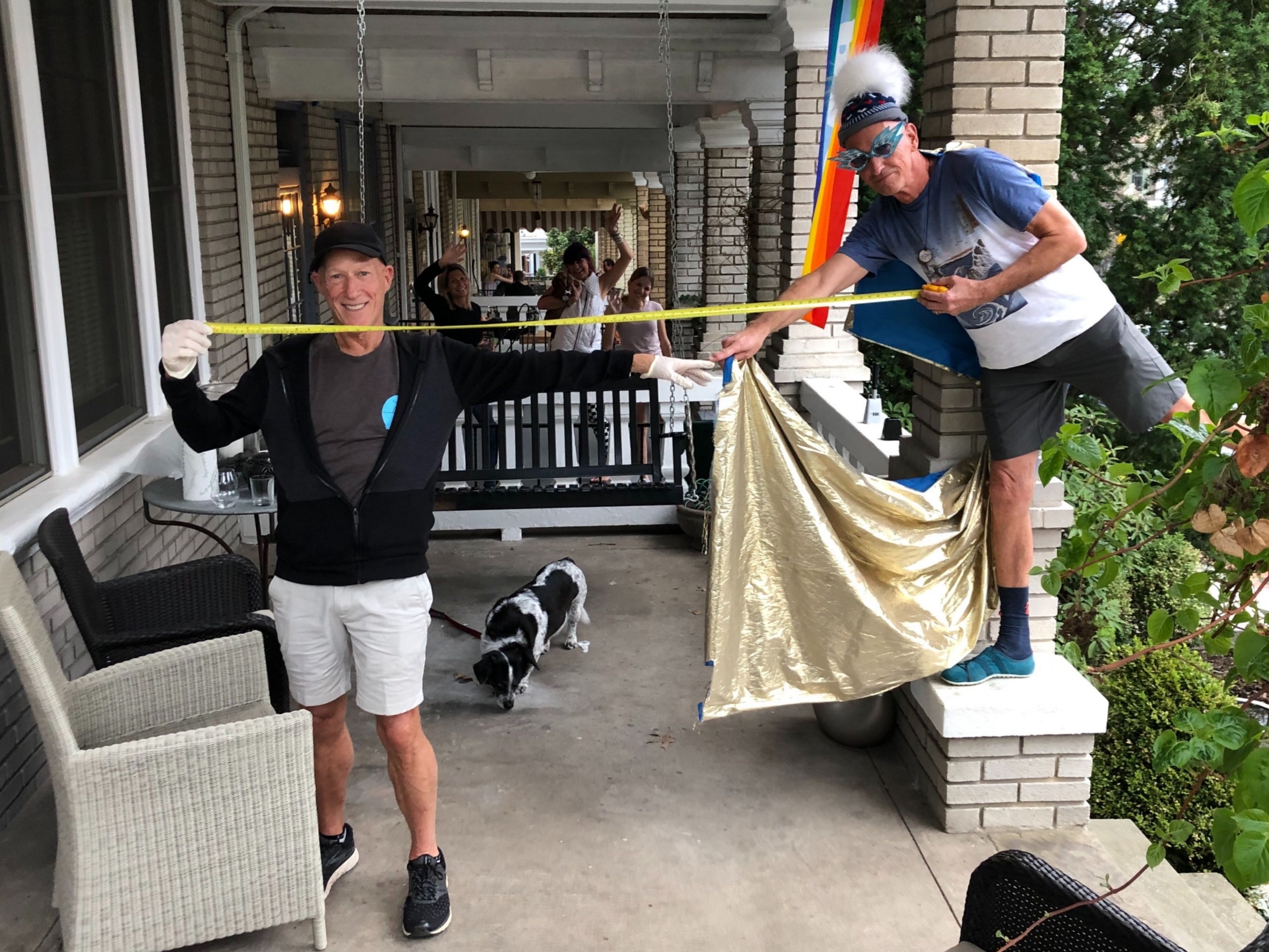
After two rounds of “Lean On Me” and one group attempt at the Gloria Gaynor anthem “I Will Survive,” the neighbors decided to call it a night. Some remained outside, enjoying the warm, 80-degree weather. Others went back into their homes.
“Same time next week?” a couple of neighbors asked.
“Same time next week!” Marsh says. “Maybe with a playlist. Start a playlist on the listserv!”
‘Creating Community’ Under The Coronavirus
Both Maryland and Virginia have more than 100 confirmed cases of COVID-19 as of March 20, and D.C. has close to 80. In the region and across the country, limited availability of testing kits has been a major stumbling block in understanding the scope of the outbreak.
D.C., Maryland and Virginia have banned gatherings of 10 people or more. The bans include bars, restaurants and other businesses like theaters and gyms, but exclude lifeline services like grocery stores and banks. D.C. Mayor Muriel Bowser announced on Friday that the District’s restrictions would remain in place at least until the end of April.
“The currently known and available scientific evidence and best practices support limitations on large gatherings and social distancing to prevent exposures and transmissions, and reduce the threat to especially vulnerable populations,” Maryland Governor Larry Hogan’s executive order banning mass gatherings reads.
In short: staying home and social distancing aren’t just about following the rules. It’s about showing care for the rest of the community by removing an individual link in the chain of transmission of the disease.
But it’s hard to stop being close to neighbors and friends in the midst of a frightening and uncertain time.
So, neighborhoods are getting creative to bridge the 6-foot distance and satisfy the desire for community in the midst of the pandemic. Apartment buildings and street blocks are hosting socially-distant happy hours, dance parties and more—in between Zoom calls.
Arlington resident Emily Dunn decided to organize a socially-distant scavenger hunt, following an idea from the Capitol Hill neighborhood in which she previously lived. The concept was simple—and, importantly, kid-friendly (Dunn has two young children) — participants posted cut-out shamrocks in the windows or doors of their homes to mark St. Patrick’s Day. Families walked around the neighborhood at a safe distance, finding all the shamrocks.
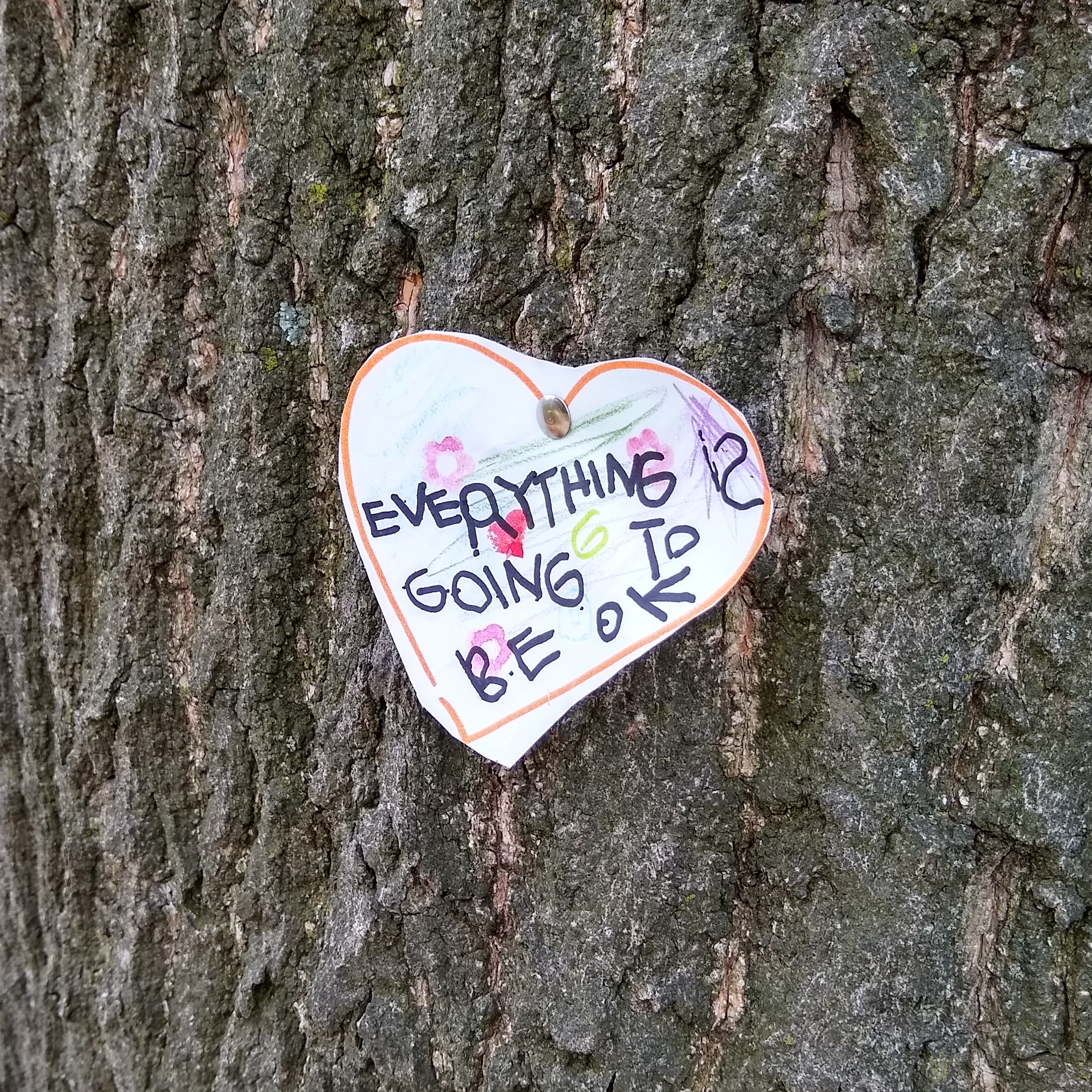
A heart tacked to a tree in Fairlington, part of a neighborhood scavenger hunt.
Some parents turned the hunt into a math game for their kids—another tool for parents keeping their children occupied and engaged while area schools are closed.
“It was super easy, super accessible for everyone, and it benefits people walking around and getting outside,” Dunn says.
Dunn says almost 50 people responded to her posts on Nextdoor, her neighborhood listserv and a number of other social media sites.
And the scavenger hunt in Arlington shows no signs of stopping. Today, neighbors replaced their shamrocks with paper flowers to celebrate the first day of Spring. Other neighborhoods put out stuffed animals on their porches and lawns and invited local kids to go on a “zoofari.” Dunn says that if the excitement around the idea keeps up, Cherrydale may organize an Easter-themed scavenger hunt, too.
Dunn says she heard about the Mt. Pleasant stoop-singers, and she understood their impulse to belt out songs of resilience.
“I think that these types of things are going to be continuing,” she says. “That seemed like a really great way of creating community.”
Music ‘Best Enjoyed Outdoors’
While Marsh and her Mt. Pleasant neighbors were serenading each other, across the Potomac in Arlington, Kent Withycombe was getting out his bagpipes. Typically, he practices in his basement to spare his neighbors (and his family) the volume of his chosen instrument.
Bagpipe music is “best enjoyed outdoors,” he acknowledged, noting that the instrument was historically classified as a weapon of war for its loud, assertive sound. His daughters, Withycombe says, sometimes liken his bagpipe practices to the sound of a “dying donkey.”
But, as it turns out, in a pandemic, sheer volume can be a good thing. It’s not just polite to be a bit distant from your audience these days—it’s a public health imperative.
Withycombe’s performance—think more “Scotland The Brave” and “Amazing Grace” than “Lean On Me” — was for the benefit of residents of a Ballston-area assisted living facility, who listened to Withycombe play for them from an open courtyard. Residents listened and applauded from their balconies or from inside the building, behind a set of French doors.
“I had to play more than I expected,” Withycombe says. “People were cheering.”
How’s this for the news we need right now?
Arlington resident Kent Withycombe gave a bagpipe performance for residents at an assisted living facility in Ballston.
📹: Betsy Withycombe. pic.twitter.com/Zg3RYrSFNZ
— WAMU 88.5 (@wamu885) March 21, 2020
One resident requested a bagpipe concert every night of the week. (That might be a lot, though: Withycombe, who has been playing bagpipes since he was a kid, says it takes a lot of stamina and coordination to handle the four reeds and leather windbag that give the pipes their distinctive sound.)
But the assisted living facility isn’t the only concert he’s given this week. It all started when Withycombe’s wife Betsy suggested that he practice his pipes on their driveway on Tuesday to mark St. Patrick’s Day. That was a smash hit with their neighbors, and a video made it onto social media — which led to the Withycombes’ invitation to the assisted living facility.
“Every time he plays, people are so excited and happy,” Betsy says.
The Tuesday practice turned into a socially-distant lesson in bagpipe mechanics for some neighborhood kids, she says. From 6 feet apart, she held a flashlight up while Withycombe told the kids about the instrument’s simultaneous tenor drone, bass drone, and chanter sound.
“Music is a great way to stay connected,” Withycombe says.
This story originally appeared on WAMU.