Margaret Barthel
Effie Avner says his Metrobus is still packed these days.
“It’s completely full before crossing 16th Street,” he says. That’s after just two stops and about a half mile traveled.
Avner takes the J1 or the J2 routes from Silver Spring, and then hops on the Red Line to Rockville, where he works as a legal analyst. Trains on his route are “almost completely empty,” he says—but his bus remains full of commuters. (Avner, for his part, will be working remotely soon.)
[Read the latest updates about coronavirus in our region here]
The crowds on the bus worry Avner, especially considering federal and local governments are urging citizens to practice social distancing and avoid groups of more than ten people.
Ridership across the Metro system is down dramatically, as the agency urges people to only take essential trips—to first responder jobs or to grocery stores, for instance. On Monday, Metro reported a decline in rail ridership of 90 percent, while bus ridership decreased by 65 percent. That prompted Metro to call out bus riders for continuing to use transit for “nonessential” trips.
“Metro wants to provide bus service for essential trips in the region, but if continued usage for non-essential trips becomes a public health concern, Metro may consider discontinuing all bus service,” the agency said in a statement.
But Avner and other riders say they’re not taking frivolous trips—they have no other option but to use the service to maintain their livelihoods. A majority of Metrobus riders make less than $30,000 per year.
Rising rider concerns over public health—coupled with transit leaders’ decisions to cut service as the pandemic takes hold—underscore the conundrum facing transit agencies across the region and country: Can agencies cut service while successfully balancing public health needs—and their budgets?
“Transit agencies are in a really tough position,” says Paul Lewis, of the Eno Center for Transportation, a think tank focused on national public transportation issues. “They’re having to make some decisions with a lot of competing forces.”
Public Health Concerns
Some riders think transit should actually be running at regular frequencies, to enable people to distance themselves from others on board.
“There’s no way to distance yourself from anybody else,” says Jonathan Atkinson, who takes two buses on his commute to Alexandria from Falls Church. One day last week, service was so infrequent that it took him three hours to get home. His buses are much more crowded than normal as a result.
Paul Lewis of the Eno Center says the services are trying to strike a tricky balance in determining their service levels.
“Transit agencies are also trying to meet the demand,” he says. “They don’t want to necessarily be running a bunch of empty buses if nobody’s taking the service, but again, with the social distancing piece, they’re trying to straddle that line.”
Others suggest that public health officials may advise transit agencies to cut service to stem the spread of the disease. A reference guide from the American Transportation Research Board about pandemic planning for transit agencies suggests that they should be prepared for public health officials to direct them to reduce service.
“Throughout the life cycle of a large scale viral response, a transit agency may need to reduce service due to employee availability to maintain and operate transit vehicles or to comply with public health department recommendations and directives,” the guide reads.
Lewis points out that transit systems in Wuhan, China, where the coronavirus pandemic originated, were closed during the worst of the city’s crisis.
“That was a complete quarantine,” Lewis says.
It’s not clear that any of the service reductions in the D.C. region are the exclusive result of recommendations from public health officials. But Chris Conklin, the director of the Montgomery County Department of Transportation, said public health concerns were part of his department’s calculation on reducing service last week.
Conklin estimates the county’s Ride On bus service has seen a 50 to 60-percent drop in ridership last week. But he says the agency is still trying to monitor overcrowding on its routes. MCDOT is maintaining “a large number of standby vehicles,” according to Conklin. Bus drivers are supposed to radio back to report busy bus stops, especially if they bypass stops to prevent overcrowding onboard, and the agency may dispatch an additional bus to service the route.
Conklin says there’s no way to know if the trips people are making on Ride On are “essential.”
“The definition of necessity can’t be clear cut,” he acknowledges.
“We know that our service is very important to people who are lower-earning employees. A fair amount of immigrant and minority communities use our services,” Conklin says.
Conklin also points out that Ride On’s service reduction gives them more time to thoroughly clean and sanitize the vehicles.
“We have a pretty tight operation, we don’t have a lot of spare vehicles sitting around, and with reduced service we’re better able to process the cleaning of those vehicles with less demand on our fleet operations folks,” he says.
Metro and other agencies have also increased cleanings.
A Tough Financial Picture
The pandemic, Lewis says, endangers both revenue from ridership and money from public coffers.
“There’s a decline in revenue associated with [a decline in ridership],” Lewis tells WAMU. “And if there’s a recession, there could be a decline in things like sales tax revenues, which affect their operating capital budgets.”
The national public transit industry is requesting a federal bailout of $25 billion to try to keep services running in the midst of the coronavirus crisis.
“Part of that is costs associated with increased sanitation and cleaning—these are new costs for agencies that they are implementing to respond to the health care crisis,” Lewis says. “The bulk of the revenue would be to cover lost farebox revenue and lost revenue from dedicated sales tax.”
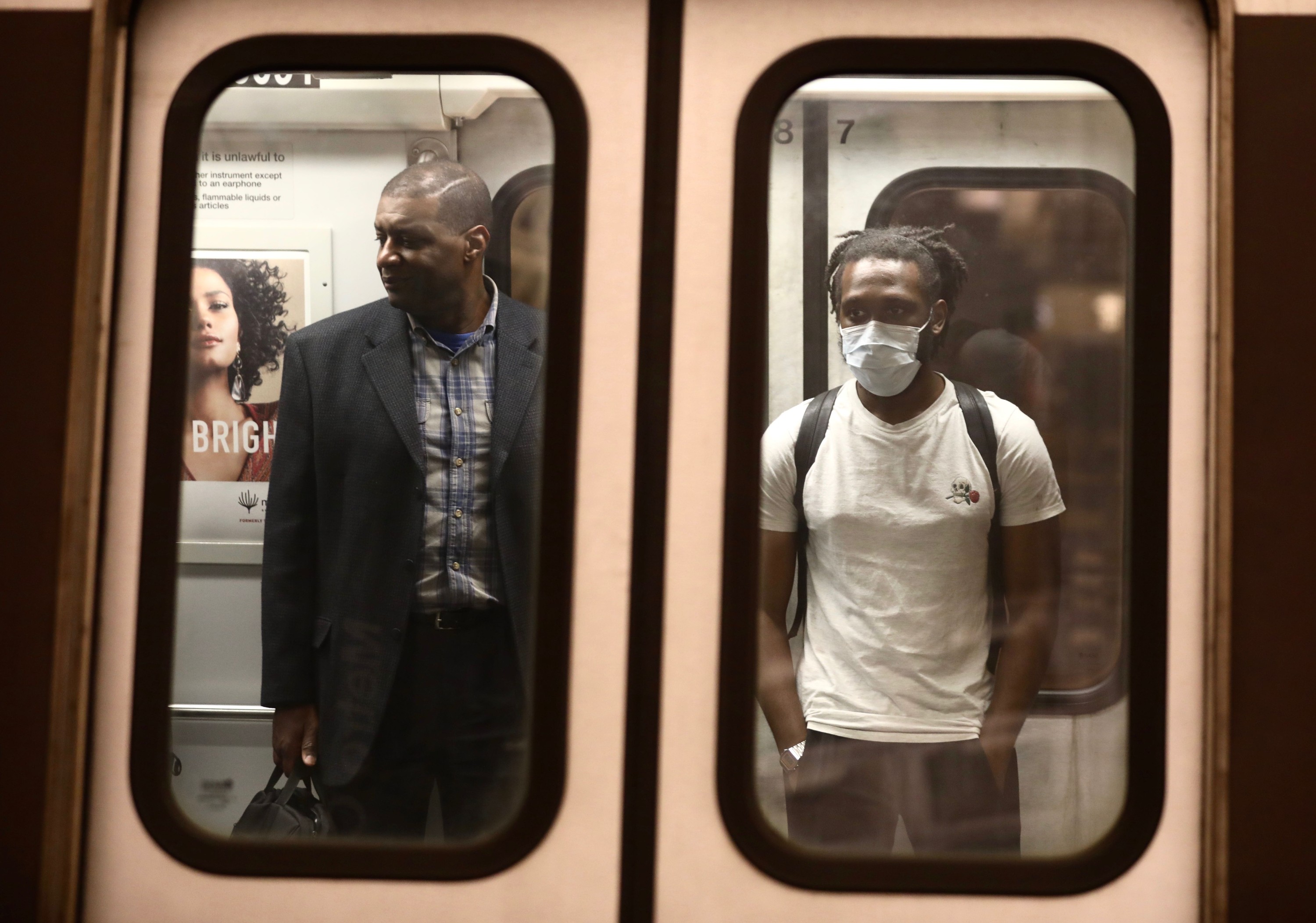
Metro reduced train and bus service several times during the coronavirus pandemic. Ridership has plummeted since the outbreak began.
Metro and the Virginia Railway Express are both requesting federal bailout money, with the support of local government leaders. In a letter to the Washington region’s Congressional delegation obtained by the Washington Post, Metro General Manager Paul Wiedefeld estimated that the agency is on track to lose $52 million per month during the crisis—after spending $17 million on protective equipment and disinfecting supplies now being used on buses, rail cars, and stations.
“We need support for transit operations, but traditional transit formulas are not designed to address our unique circumstances. We need immediate operating funding,” the letter reads.
Conklin says MCDOT is also feeling the pinch.
“The economic impact of the public health measures that have been put in place is very, very large,” he says. “We expect that we’ll be challenged from a budgetary perspective as a result.”
“Congress is taking these requests seriously,” Lewis says. “The alternative is to literally shut down regional economies.”
Employee Shortages An Increasing Concern
Even at reduced service levels, local public transit officials say they’re concerned about the health of their workforces, many of whom have to perform their jobs in public, risking exposure to the virus.
Metro says its latest service reductions—which closed 19 Metro stations and a number of other station entrances—were partly driven by staffing constraints and concerns over protecting the health of employees at work. Three Metro employees have tested positive for the coronavirus, including a transit police officer and a bus operator.
Metro is also concerned about preserving its stockpile of cleaning supplies.
Conklin says employee health and safety factored into several of Ride On’s service changes, too. Ride On was the first bus service of many in the region to implement back-door bus boarding, in an attempt to minimize distance between the public and bus operators. That meant forgoing fares.
Workforce health also played a role when Ride On decided to reduce service, according to Conklin. Ride On maintained its normal service levels as long as it had the drivers it needed to do so, he says.
“We knew that by operating a full schedule that would maximize the spacing between passengers. So we tried to keep our full schedule going as long as we could,” Conklin tells WAMU.
By reducing service, the Ride On now needs about half of the full complement of its staff.
A number of Ride On’s operating staff are over 60 years old, or have underlying health conditions that classify them as high risk. Some of them are choosing not to come in to work.
“They’re deciding for their own well-being that it’s not in their interest to be operating a bus day to day, and we’re making sure that we’re giving our workforce the leeway to do what they need to do for their own personal safety,” says Conklin.
Conklin did not anticipate worker layoffs. Neither does Metro—at least for direct employees.
Can Public Transit Survive?
Conklin doesn’t foresee stopping service on Ride On altogether, though he says MCDOT has a plan for running a “lifeline” service if the pandemic situation and the pressures on the service worsen.
Metro’s Wiedefeld has also committed to continuing to run scaled-back “lifeline” service. But some of his statements on the subject have been qualified lately.
“Metro intends to be there to provide service for essential trips in our community—as long as it is safe and appropriate to do so,” he said in a statement last week.
The American Public Transportation Association’s pandemic planning guide lists a sequence of actions agencies take to scale back service in the midst of a pandemic, including: shortening trains, dropping certain bus routes or bus runs from the schedule, moving to Saturday service schedules, moving to Sunday service schedules, and, finally, shutting systems down entirely. Most local agencies, including Metro, are operating Saturday or Sunday schedules.
Lewis is confident that public transit will ultimately be able to get back to where it was before the coronavirus. He points to what happened after the SARS outbreak in 2003, when travel in the U.S. was down by 50 percent. Two months after the outbreak, it had bounced back.
“This is a more serious event, but people eventually will need to get to where they need to go,” Lewis says. “I think we will see a rebound, but the question is when and how long that will take.”
This story originally appeared on WAMU.