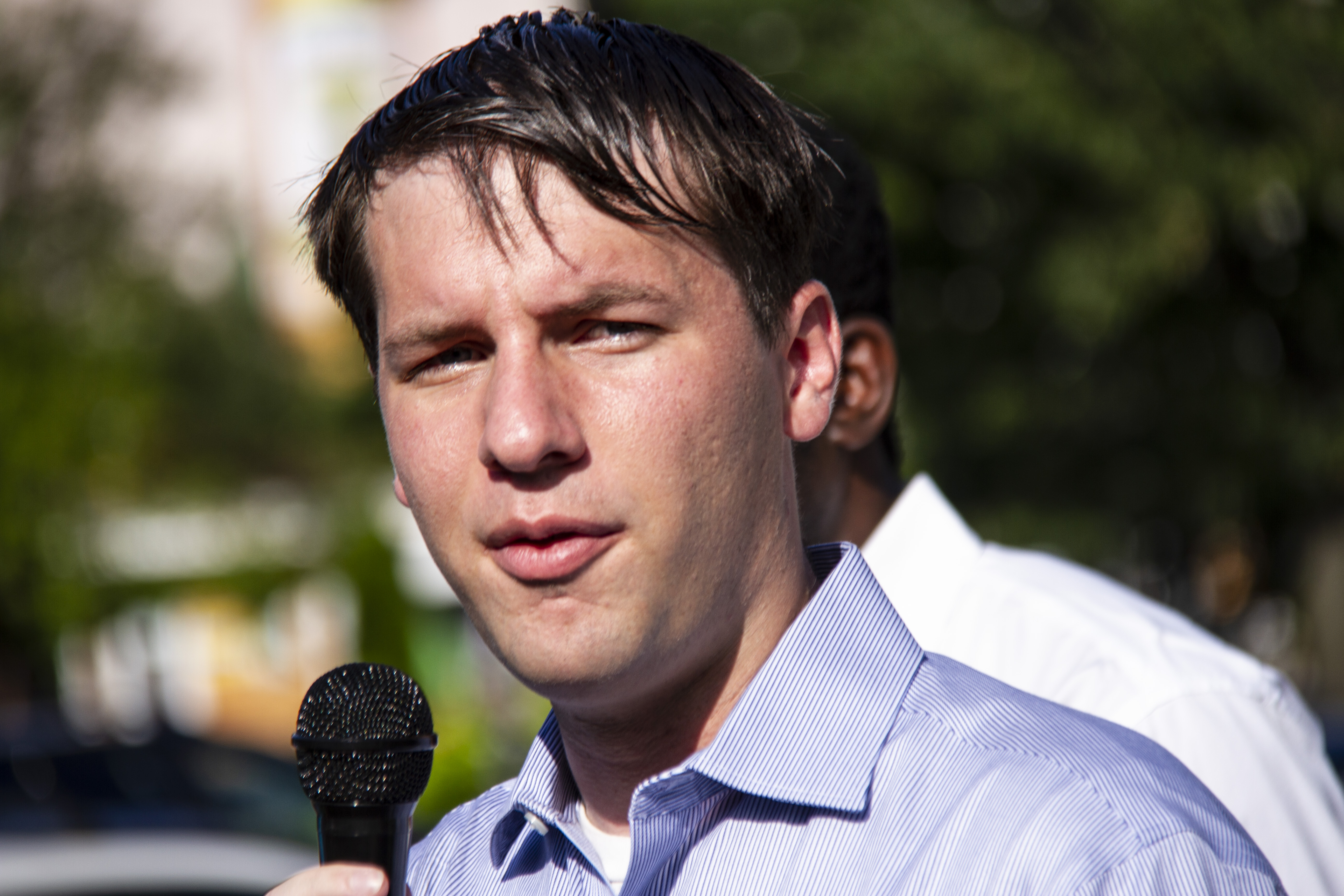
The pandemic has changed how D.C. political candidates campaign for office, as would-be lawmakers forgo door knocking, meet-and-greets, and other events that bring them into contact with the voters they’re otherwise desperate to reach. But one campaign strategy doesn’t seem to have stopped: conducting polls—and releasing the results if they’re favorable.
In the highly contested Ward 2 D.C. Council race to replace scandal-plagued ex-Councilmember Jack Evans, who in fact is running for his old seat, candidate Patrick Kennedy’s campaign put out poll results on Wednesday. The poll found that Kennedy—a Foggy Bottom advisory neighborhood commissioner and Evans’ former campaign chair—would grab 18 percent of the vote, followed by Evans at 9 percent and Jordan Grossman at 8 percent, if the Democratic primary election took place now. Still, it also found that more than 40 percent of voters were undecided.
The other candidates in the race include Democrats John Fanning, Daniel Hernandez, Brooke Pinto, Kishan Putta, and Yilin Zhang as well as Republican Katherine Venice. Currently, the District’s primaries are scheduled for June 2, although it’s possible the date may be pushed back because of coronavirus lockdowns. (Early voting at some locations is set to begin on May 16.)
These are the first published poll results in the Ward 2 race, and they may lead some of the candidates to reconsider their chances in a contest already altered by the electoral challenges posed by COVID-19.
It’s important to note that Kennedy’s campaign sponsored the poll, which was conducted by phone and digital questionnaires from March 16 through March 23. Polling firm SurveyUSA surveyed 300 registered Democrats who live in Ward 2—a relatively small sample size for the more than 31,000 registered Democrats in the ward (roughly 8,000 voted in the 2016 primary, in which Evans ran unopposed).
An additional caveat about the Kennedy campaign’s poll: It relied on “credibility intervals” for specific questions instead of margins of sampling error, the more typical metric. The credibility intervals ranged from 6 to 8.8 percentage points in either direction, meaning many of the results were statistically close given the sample size.
The results showed that Kennedy has the highest “net favorability” rate (the difference between the shares of poll participants who report having a “favorable” opinion of a candidate and those who report having an “unfavorable” one) among the eight Democratic hopefuls. Evans was the only candidate to record a negative net favorability rate, at minus 48.
“It’s clear Ward 2 residents value local experience, a proven track record, and responsive, trusted leadership,” Kennedy said in a statement Wednesday. He was first elected to ANC 2A in 2012, and has since served as the commission’s chair for five terms.
Ward 2 includes downtown, Dupont Circle, Logan Circle, Foggy Bottom, Georgetown, and several other central Northwest neighborhoods.
It remains to be seen if the field will narrow in the coming weeks, though the deadline for candidates to formally drop off the ballot by withdrawing their nominations is April 9. (Candidates may still drop out of the race after this date; their names would just appear on the ballot.)
A different Ward 2 poll was apparently conducted earlier in March, the Washington City Paper reported, with signs pointing to Grossman’s campaign as behind it. But the results of the purported poll haven’t been publicly released.
In addition to the primary contests, there’s also a special election for the Ward 2 seat this year because of Evans’ resignation in January. Kennedy’s poll did not test for that election, which is slated for June 16. Evans confirmed to DCist last week that he was dropping out of the special election, so he could “instead focus on a new start for the next four years,” he said. Whoever wins the special election will serve only through the end of Evans’ term, until January 2021.