Jacob Fenston
 Tyrone Turner
The hum of activity in the D.C. region went quiet this week, as leaders in Washington, Maryland, and Virginia implemented further restrictions to slow the spread of the coronavirus. But even as all businesses deemed “nonessential” shut down, many people still went out, braving the city to buy supplies or to get to jobs that can’t be done from home.
We spoke to people (from a safe distance) as they navigated life under the coronavirus pandemic in Columbia Heights, downtown D.C., and Arlington.

Corazon Chua and Consuelo Belotindos.
Sisters Corazon Chua and Consuelo Belotindos live in the same building in Columbia Heights. Their faith is helping them through the pandemic. “God knows when it will end or not, so we are just depending on him,” says Chua.
The two sisters were shopping at CVS and Target for some essentials—on previous trips, bottled water and bread were sold out. This time, Chua says, they prayed water would be in stock. “We keep praying, and God provided.”

Valerie Brown.
“I’m leaving my house, wasting money, trying to get to work, and can’t get to work,” says Columbia Heights resident Valerie Brown. She’s a home health care worker, and caught a bus at 6 a.m. to get to a client in Southeast D.C. She made it to Southeast, but no connecting bus came (bus service was severely curtailed this week), so she gave up and headed back home. “Can’t wait ’til this is over. That’s basically it.”

Allison Wilburg and her grandson, Samuel Clifford.
Allison Wilburg was on her way to her housekeeping job, with a third grader in tow—her grandson, who she takes care of. “He’s out of school, I have to take him with me,” she explains. Since the pandemic hit, her hours have been cut— he’s now working just five hours, two days a week. “It’s really tough financially because I don’t own my own home, I’m renting. To come up with like $1,900 a month, plus transportation,” says Allison Wilburg. The limited transit service makes it harder—and more expensive. “When I miss the bus I have to take Uber,” she says.

Greg Ip.
Greg Ip was coming out of an office building on Connecticut Avenue, near Farragut Square, carrying a computer monitor. He’s a journalist and writes about economics for the Wall Street Journal. “Getting a lot of eye strain staring at my laptop on my dining table day after day,” he says. “It’s been very busy, as you know—the news has actually gotten more hectic in the last week, so my colleagues and I, we’re hard at work from our homes,” Ip says. “I have teenage children, they’re home, so it’s cozy in the household to say the least. But, getting by, all things considered.”

Matthew Lesko.
“I’m out for my daily jog—I’ve been doing this for 50 years,” says Matthew Lesko, on a 6-mile run, heading for the Lincoln Memorial. “This time of year, it’s usually mobbed,” he says. This year, though, “I can do better time—not only there’s no people to run around, I don’t even wait for the traffic lights. Nobody’s here.”
Regarding the heart-covered running gear: “I don’t know if you’ve ever seen me around town, I wear question mark suits a lot,” Lesko says. Now, he’s moving on to hearts. “I wore question mark suits for about 15 years—I feel asking the right question is more important than getting an answer. Now I’m convinced it’s your heart that’s more important than asking the right question. If you don’t have heart in it, it’s not going to work.”

Isabela Ordoñez.
Isabela Ordoñez, 10, with her dog Rocky. She was at Gravelly Point in Arlington with her family, getting fresh air and exercise. Earlier in the day she and her brother made a poster that said “Coronavirus!!!! We Will Beat You!!!!” and brought it to the White House to take a picture.
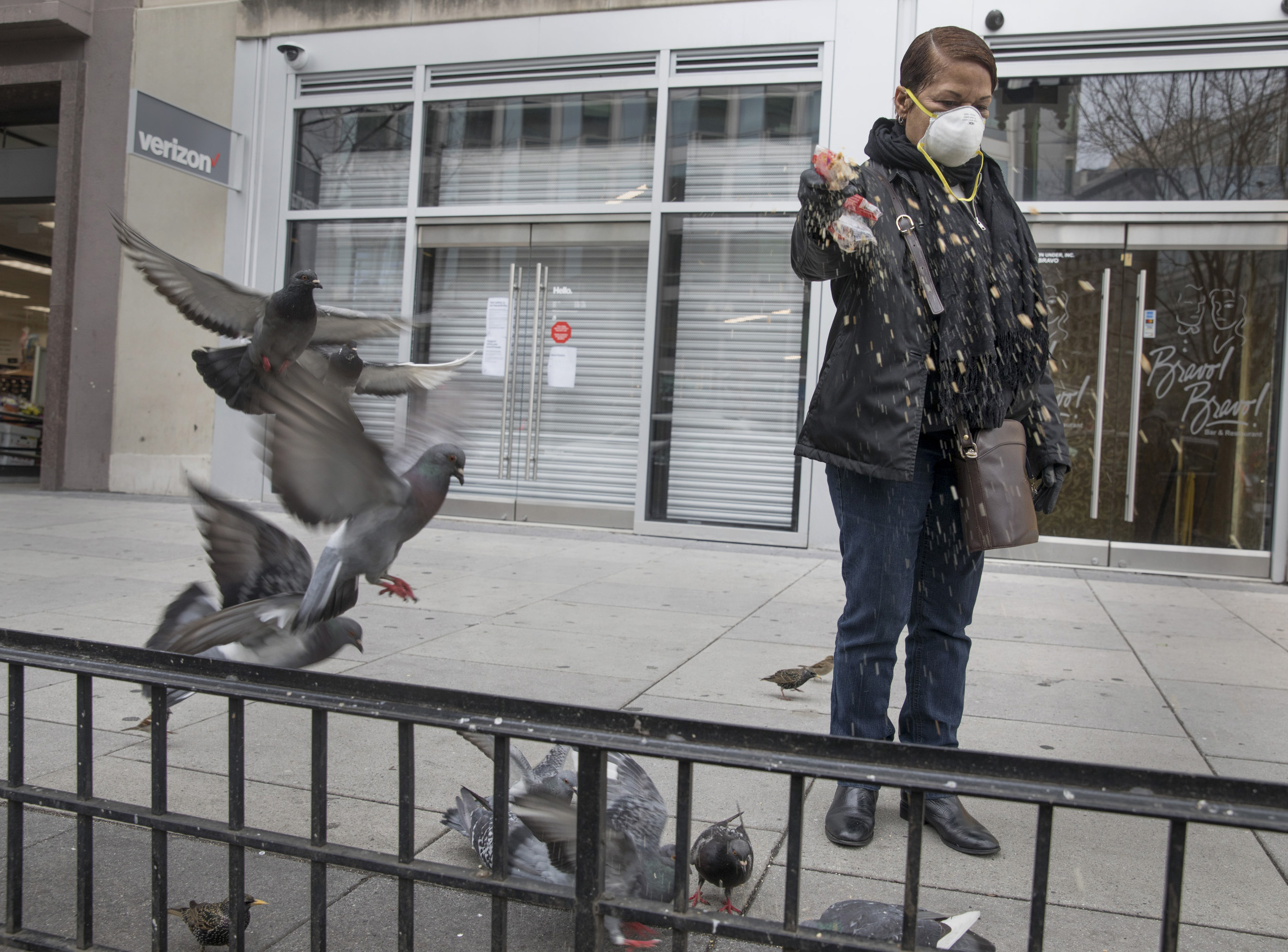
Robin Johnson.
Robin Johnson was feeding birds outside her office, an architecture firm. “I’ve been doing this three years now—they get breakfast, lunch, and dinner,” she says. “It puts a smile on your face,” she says through a mask.
Johnson says a lot of people in her office are working from home, and she could too. As she tosses peanut butter crackers to the sparrows and pigeons, she adds, “They gotta get fed. On the weekends I miss them.”

Heather and David Grote, and their daughters, age 4 and 2.
David and Heather Grote, of Rockville, Md., were dressed up, walking on the empty grounds of the Washington Monument, looking for a place to take a photo of their two daughters, with cherry tree backdrop. Just beyond the trees, yellow tape and police kept visitors away from the Tidal Basin.
“I hope the general public takes it seriously, where they find the right balance of staying home when they can, hand washing, and not stocking up on the N-95 masks that we need in health care,” says Heather Grote, a doctor.
So far, both parents have been staying home with the two girls—they’d planned to take a vacation this week. Instead it’s a forced staycation. “We talk about how there’s a sickness out there, that we need to be extra careful,” says Grote. “We were just talking about how we’re not going to be visiting the playgrounds for a couple weeks while we’re getting it all fixed. The good news is they have each other, so it gives them someone to play with.”

Scott Shoup.
Scott Shoup, who works for the State Department, is working from home, but was downtown for a physical therapy appointment. “We go out maybe once a week to the grocery store,” says Shoup. Right now, he says, his main concern is for elderly relatives and friends, who are at higher risk for coronavirus. “Personally—I’m not taking things cavalierly—but I went to Africa during ebola. So, this is serious, but it’s a different level of severity.”

Anna Blake and Moe Blake.
Anna and Moe Blake were wearing matching orange sweaters, posing beneath a grove of cherry trees near the Washington Monument. Moe is a tiny dog. They’re in town from Alabama, where Anna is a server at Red Robin. The restaurant is closed now, so here she is, staying in a hotel—where she sanitized every surface—and ordering takeout.
“I’m just taking it as a vacation and just doing what we can to just make the best of the situation.”
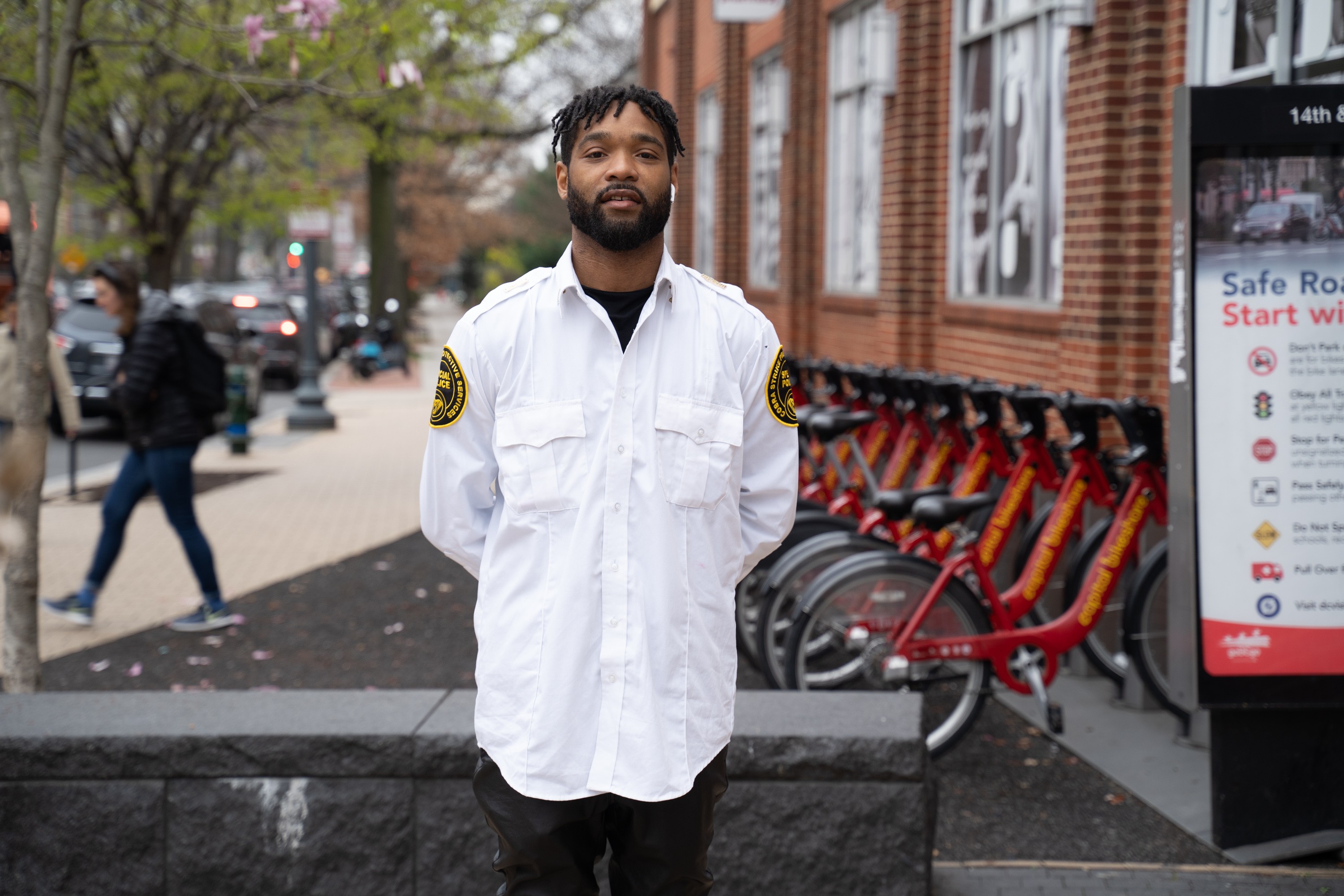
Silas Branch.
Silas Branch was working security at CVS, wearing a glove on one hand and an AirPod in one ear. “I’ve been working man, like seven days a week, so it’s not really different to me,” Branch says. He’s not too concerned about his own health—even though he is working with the public on a daily basis. “I got a pretty strong immune system, and I’m pretty careful,” he says. “Other people—my family members—of course, I do worry about them.”
In terms of financial concerns, Branch says he is in a good field right now. “It’s the best time to be a security guard or a special police officer or any type of emergency response now. They’re all working right now.”
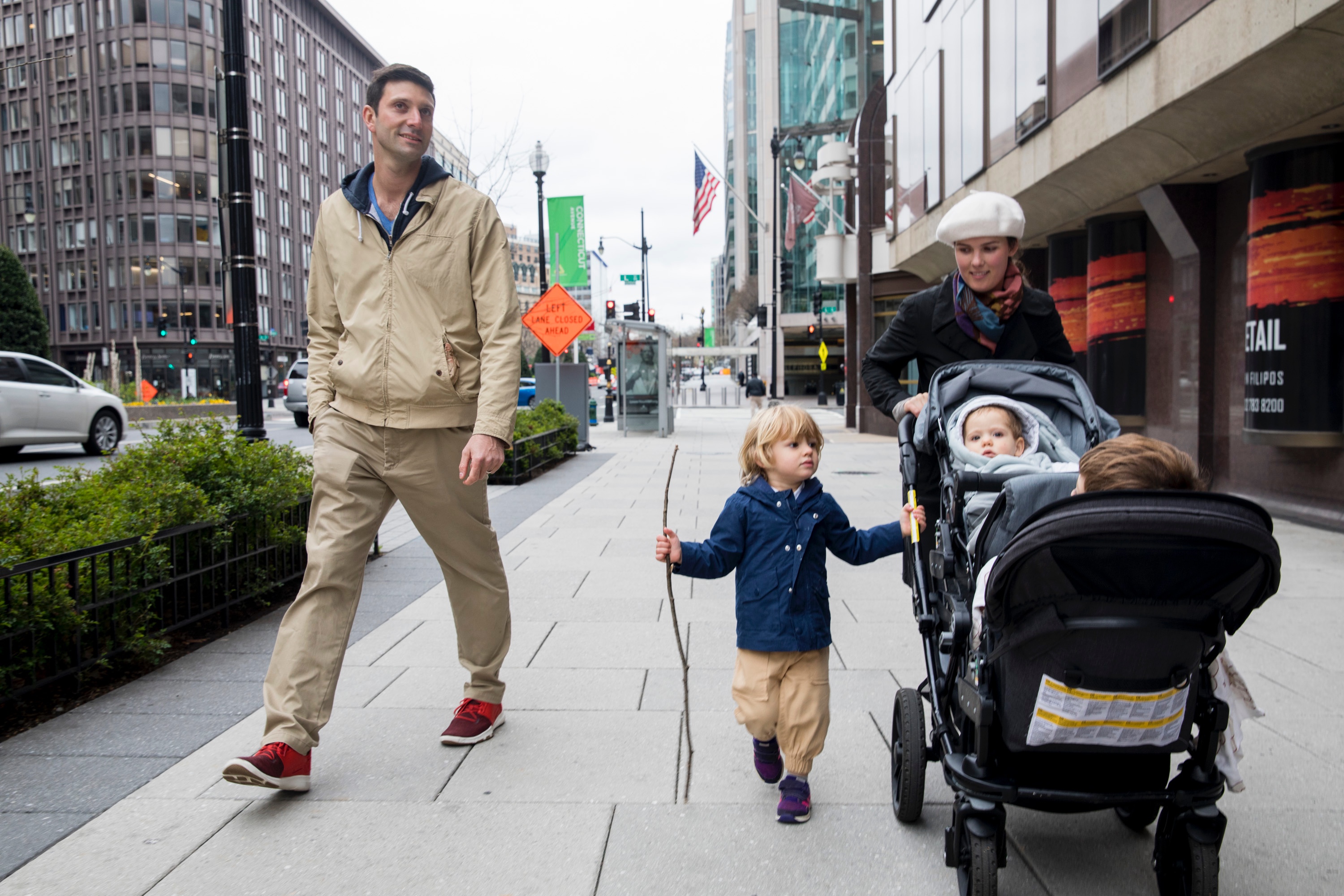
Ted and Christine Janis, with their three kids.
Ted and Christine Janis maneuvered a stroller packed with three kids through the empty sidewalks downtown, looking for a park that’s still open. “Yeah, we just got back,” says Ted Janis. “We’re State Department. We just got evacuated from Indonesia.”
They had to leave on short notice and are now staying in a temporary apartment.
“Cleaned out our fridge, and hope to see our stuff at some point in the next year, but who knows,” says Christine Janis.