Martin Austermuhle
When D.C. Mayor Muriel Bowser issued a stay-at-home order earlier this week, it came with penalties attached: up to 90 days in jail or a $5,000 fine for anyone who violates it. But in guidance issued Wednesday, D.C. Police Chief Peter Newsham told officers only to make arrests as a last resort.
“Our focus during this time is on ensuring individuals abide by social distancing requirements to protect public health. Accordingly, the goal of any interaction is to ensure voluntary compliance, not to make arrests,” says guidance from Newsham, which is being read to officers as they go out on their shifts.
Like similar mandates in Maryland and Virginia, Bowser’s order requires all residents to remain at home, unless they are performing an essential activity like grocery shopping, attending to medical needs, doing limited outdoor exercise, or traveling to work at a business or workplace deemed essential and allowed to stay open.
It also says that any resident who does go outside—for permitted exercise, for example—should practice social distancing by staying at least six feet away from anyone not in their immediate family or household, and bans gatherings of any more than 10 people at a time.
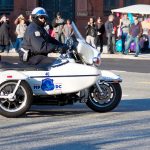
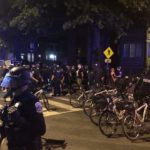
In his guidance, Newsham says that when officers see potential violations, they should “provide a warning while maintaining a safe distance.” Officers have already been given scripts to read out of the loudspeakers of their patrol cars, which they started using this week.
“[A]rrests should be limited to only those situations where subjects will not voluntarily comply,” says Newsham’s guidance, which adds that officers have to consult with a commander before moving to arrest anyone. But even then, Newsham says officers should “effect a non-custodial arrest”—charge the person with violating the order and issue them a $100 fine, but do not actually take them into custody.
Newsham also says that officers cannot stop drivers for presumed violations of the stay-at-home order; instead, they have to have suspicion another violation has been committed, like a traffic offense.
The guidance from D.C.’s top cop comes as dozens of states have imposed similar stay-at-home orders, many of which also carry penalties ranging from fines to arrests. Last week in Maryland, police arrested a Charles County man for refusing to break up a 60-person party he was hosting. He is being held without bail.
But police officials across the country have said those sorts of situations are outliers; more often than not, police are trying to avoid arrests for violations of stay-at-home orders. And that’s reassuring for some civil libertarians who have argued that while stay-at-home orders might be necessary for public health, sending people to jail could present a risk because of how infectious diseases can rapidly spread in confined spaces.
Still, others worry that police may not be the most effective messengers for public health advisories, and may be perceived negatively when they are trying to ensure compliance.
“Police have to understand how they might be perceived in some communities and that there might be varying reasons for compliance or non-compliance,” says Monica Hopkins, the executive director of the ACLU of D.C. “When confronting individuals who refuse to comply, officers should seek to understand why the individuals are not complying. There may be people experiencing domestic violence, minors who lack a stable environment to return to, or people experiencing mental health conditions.”
Hopkins says D.C. should partner with community organizations, churches, and mutual aid groups to spread the message that people should practice social distancing.