Matt Blitz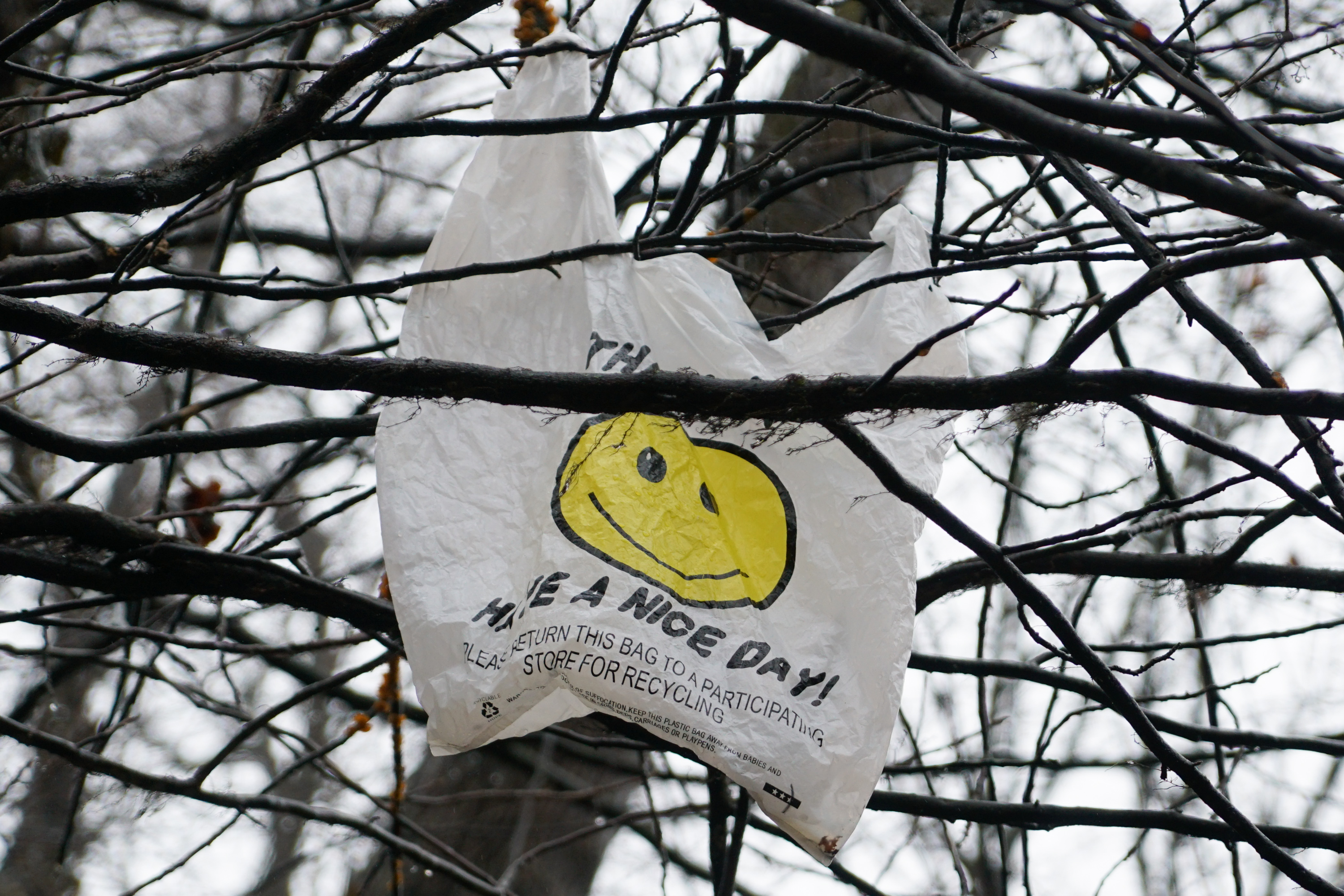
Update, 4/15/20:
Montgomery County Councilmember Will Jawando is planning to withdraw the emergency legislation to temporarily suspend the five-cent tax on disposable bags, he said in a statement.
“I appreciate suggestions and thoughtful collaboration with the Sierra Club, UFCW and our county officials to find alternative ways to ensure the safety of our front line grocery workers,” Councilmember Jawando said.
Montgomery County Councilmember Hans Riemer tells DCist that the measure “turned out to be too complicated … expensive, and [addressed] a minimal health issue,” adding that it would have cost the county hundreds of thousands of dollars to implement. “A lot of councilmembers just thought it wasn’t worth the effort,” he says.
A previous update to this story incorrectly stated that the Montgomery County Council approved emergency legislation to temporarily suspend the bag tax. The council did not hold a vote on suspending the bag tax on 4/14.
Original:
A decade ago, D.C. became an early adopter of imposing a nickel tax on disposable bags in an effort to clean up the Anacostia River. Montgomery County, looking to reduce litter and raise money for water clean-up, did the same thing in 2012.
Now, in the midst of the pandemic consuming the region, both jurisdictions are looking to get lax on the bag tax. However, their reasons differ: While D.C. is trying to keep its inspectors working from home, Montgomery County says that reusable bags potentially carry a health risk.
On Friday, the District officials made the decision to suspend the “aggressive enforcement” of the tax in response to the coronavirus outbreak. But this decision has to do with staffing and heeding the mayor’s stay-at-home order, D.C.’s Department of Energy & Environment director Tommy Wells tells DCist, rather than concerns over reusable bags’ threat to public health.
“To be consistent with the mayor’s order, we are not sending people out to enforce the bag law,” says Wells. “But the law is still in place and we still expect retailers to follow the law.” Breaking this law comes with a penalty of fines upwards of $800.
Wells reiterated that this curtailing of enforcement was about staffing needs—inspectors are teleworking currently—as opposed to concerns that reusable bags may be vectors for the virus. In fact, he encourages people to continue bringing their own bags to stores.
“To avoid the spread of the coronavirus, you want to reduce the number of vectors that you’re exposed to,” says Wells. “You’re probably better off bringing your own bags and bagging your groceries yourself.”
Meanwhile, Montgomery County is also looking to amend its bag tax law, but their reasoning is directly tied to precautionary measures in regards to the public’s health. The county board will be voting on April 14 on emergency legislation that would suspend the five-cent tax on disposable bags until two weeks after Maryland’s state of emergency has ended.
“We’re trying to limit the spread [of COVID-19] and protect the health and safety of both employees at grocery stores and … the health of other residents,” says Councilmember Will Jawando, who is the lead sponsor of the emergency legislation. “Hopefully, this incentivizes people to not bring things from home and use the bags at the stores.”
This is also about calming the public’s worry and anxiety, per Jawando. He says he’s heard from numerous constituents and local businesses that they don’t feel comfortable using reusable bags at this moment in time. (In early March, many coffee shops nixed the use of reusable mugs over concerns about the spread of the coronavirus.)
“I think it’s reasonable based on the science we do know,” says Jawando. “So, for those stores, retail outlets, and people who want to take that extra precautionary step, they aren’t penalized in doing so.” Jawando expects the emergency legislation to pass, saying that he has at least five of his fellow county councilmembers on board as co-sponsors.
In Virginia, there’s no current bag tax and counties like Arlington can’t impose their own due to the Dillon Rule. However, because of a bill that passed last month and is now awaiting the governor’s signature, local jurisdictions in the commonwealth would have the option to impose such a bag tax starting in 2021.
That D.C. and Montgomery County may be temporarily changing similar laws for different reasons highlights the confusion around what we still don’t know about the coronavirus.
The Centers for Disease Control’s website states that “it may be possible that a person can get COVID-19 by touching a surface or object that has the virus on” and, then touching their face, however “this is not thought to be the main way the virus spreads.” Additionally, the National Institutes of Health published a study in mid-March that found evidence that the virus can remain on surfaces and be viable for up to three days.
Dr. Michael Knight, an assistant professor of medicine at the GW School of Medicine and Health Sciences, says what we thought we knew earlier about the new coronavirus has changed.
“We have to realize that the initial recommendations that we got in January and February were based on data that we have from other types of coronaviruses … or respiratory infections,” says Knight, “It’s not that we were wrong originally, but now that we have new data, we have to adjust our approach.”
Knight thinks limiting the use of reusable bags as a precautionary measure and as part of a large mitigation strategy is a good idea. “Both cloth and plastic [types of reusable bags] can carry particles of the virus,” says Knight. “If you bring it to the grocery store, put it on down [there], and then it’s possible … you are bringing [virus particles] into your home.”
Of course, there is a safe way to keep using your reusable bags and that’s by cleaning them. But most people don’t do that.
A 2011 study out of the University of Arizona found that 97 percent of people never washed their reusable bags, thereby turning them into petri dishes of bacteria growth.
But there’s a simple fix. Knight says simply washing reusable with hot water and soap, just like we should be doing with our hands, “deactivates” the virus.