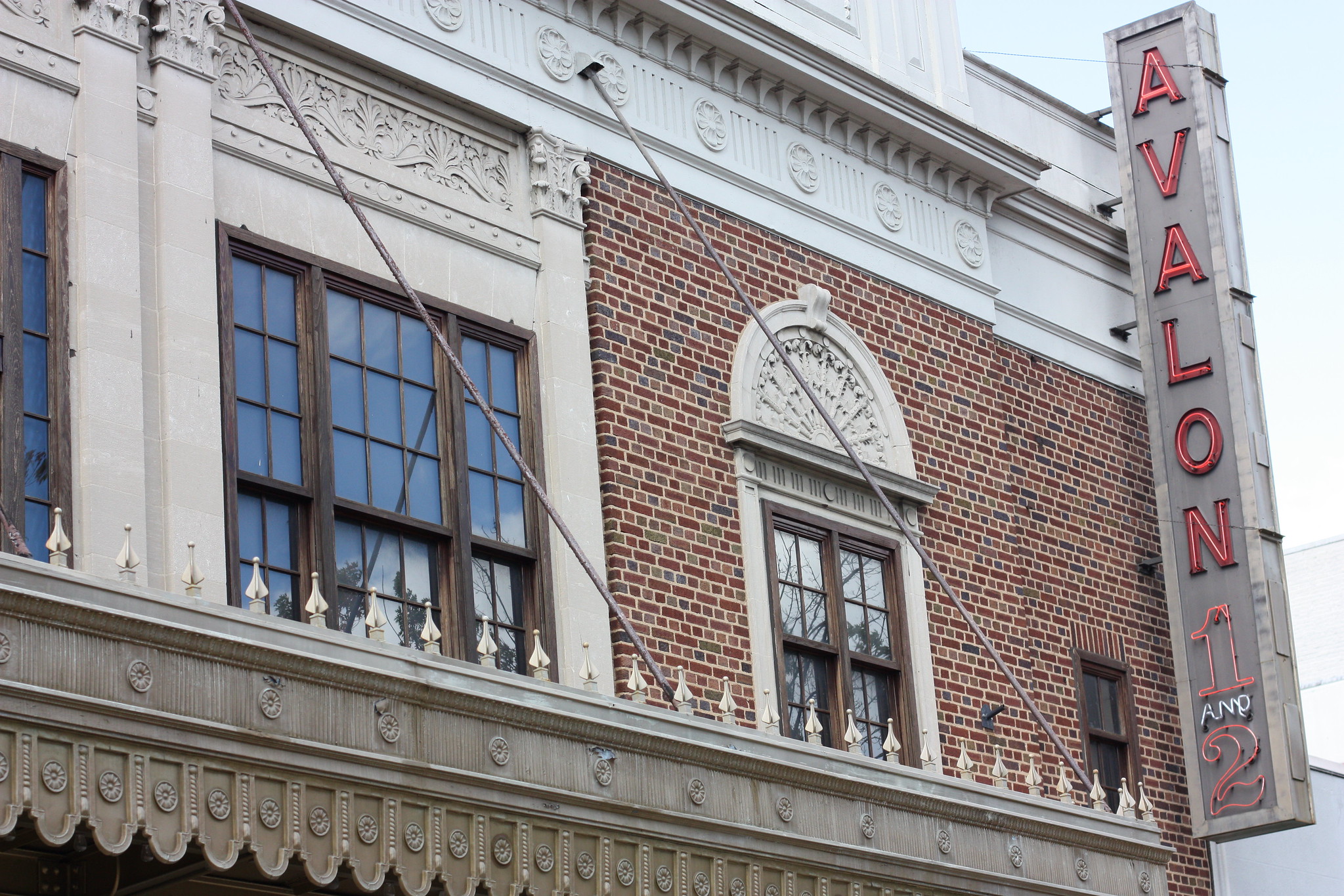
Bill Oberdorfer, executive director of the Avalon Theatre in D.C.’s Chevy Chase, visited the Connecticut Avenue movie house last Thursday to sign two checks. It was his first time there in three weeks; he’s usually there all day, five days a week.
“There was nobody around and it was just a weird feeling,” he says.
Movie theaters are almost never closed. Unlike many businesses, they see some of their biggest crowds on weekends and holidays. But like so many other fixtures of American society in recent weeks, they’ve gone dark at the behest of local officials, in an effort to tamp down transmission of COVID-19.
Theaters across the region are redirecting, laying off, or furloughing employees; cutting back on expenses; and in some cases trying for the first time to convert to virtual programming.
The immediate outlook is grim from multiplex chains to independently-run cinemas. AMC, which has two theaters in D.C. and several more in northern Virginia, may shut down entirely later this year, or at least file for bankruptcy, if its credit rating doesn’t improve, according to an analysis from S&P Global reported in The Wrap. (The closure last month of AMC’s historic Uptown Theater in Cleveland Park was not related to coronavirus). The national Regal Cinemas chain has laid off 24,000 employees, many of whom received no severance pay, according to a Deadline report.
Representatives for Landmark, the art-house chain that operates E Street, Bethesda Row and West End cinemas, didn’t respond to a request for comment. A note on the company’s website says, “Landmark will be back to providing our customers and employees a healthy and safe environment as soon as possible.”
For independent cinemas in the D.C. area, the threat posed by COVID-19 is nothing less than existential. Several operators told DCist they’re not confident they can last while shut down for more than a few months.
Others have taken more drastic steps. Arlington Cinema and Drafthouse laid off all its employees last month and is currently soliciting donations on GoFundMe, according to the theater’s Instagram account. The theater’s owners didn’t reply to phone calls, emails, or LinkedIn messages asking for comment.
“Letting ALL staff go was one of the most difficult decisions ownership has had to make considering we have had staff employed six, seven, and even twelve years,” the Instagram post reads. The theater account, in a reply to a comment, said employees will be offered their jobs back once the theater can reopen.
But there is cause for optimism for supporters of movie theaters as well. Several theaters have quickly pioneered new methods of reaching customers, with help from film distribution companies eager to show the films in their collection to a wider audience. Donations, many unsolicited, from community members have already begun pouring in. And most movie lovers believe strongly that the value of the theatrical experience won’t be permanently tainted by a pandemic that has left most typical moviegoers housebound.
“You can’t enjoy a scary movie or a comedy or a sad movie where you’re all crying together—you can’t duplicate that without being in a theater,” says Mark O’Meara, owner of Cinema Arts and University Mall theaters in Fairfax. “I think we’re all social animals.”

Moviegoing started to decline in early March as news coverage of COVID-19 surged. For a brief period, theaters in the area scrambled to sanitize seating areas and plan for filling venues to 50 percent capacity. By mid-March, those efforts were futile, as local leaders ordered non-essential businesses, including movie theaters, to shut down.
Aside from closing their doors and sacrificing most of their regular revenue, theaters also had to cancel planned events. AFI Silver had set piano and organ accompanists for more than a dozen silent films to screen in March and April, as well as dozens of special events booked through May. Clearing the schedule “filled up most of the first week,” says Todd Hitchcock, AFI Silver’s director of programming
Going dark and waiting until theaters could reopen wasn’t an option for most local venues. The Avalon’s programming director, Andy Mencher, immediately began calling distributors who had planned to show films at the theater in the coming weeks.
Before long, Mencher and Oscilloscope Films had devised a new streaming arrangement that’s since played out at independent cinemas across the country. For the film Saint Frances, a small-scale drama that opened March 13, Oscilloscope posted a streaming link on its website that costs $10 to access. The user chooses from a list of theaters before getting access to the movie, and then roughly half the proceeds from that “ticket” go to that theater.
It’s a reversal of the typical dynamic between distributors and theaters. Typically, theaters sell tickets to the movie and then return a portion of the revenue to the distributor. “We decided to really go into this by trying to still have a curatorial approach, trying to do things streaming that really made sense for the types of movies we played at the theater,” Mencher says.
Distributors for other movies displaced by the shutdown have followed suit. AFI Silver, the Old Greenbelt Theatre in Montgomery County, and Suns Cinema in Mount Pleasant are among the area theaters with similar partnerships. These streaming offerings have generated some interest but only a small fraction of typical revenue. O’Meara says his Fairfax theaters have sold 40 or so tickets per streaming movie, compared with 1,000 or so who might come in person for a popular theatrical release.
Theaters have also found other ways to keep loyal customers engaged. Hitchcock and two of his colleagues at AFI Silver have started a weekly podcast, Silver Streams, offering movie recommendations and promoting the theater’s streaming offerings. A bartender from Suns Cinema is planning to share video tutorials for the theater’s signature cocktails.
Mark O’Meara had been sitting in the office of his Fairfax theaters on St. Patrick’s Day when an idea struck him: If the restaurants adjacent to the theater could offer curbside pickup, why couldn’t he? O’Meara asked his manager to post on Facebook that popcorn and other concessions were for sale. Within 20 minutes, a line of cars had formed.
He’s been paying extra to the employees making the popcorn, and has kept the ones who aren’t working, including several teenagers, on the payroll. Friendly customers have helped: Several, he says, have handed him a $20 bill for two tubs of popcorn. “How can I not be glass-half-full with that stuff happening?” he says.
The single-screen Old Greenbelt Theatre has been hosting weekly videoconferences for ardent devotees of the theater to discuss a “flick of the week.” The most recent selection was A League of Their Own, in honor of Women’s History Month and what would usually be the beginning of baseball season.
Most of the calls have had between 12 and 15 participants. “The most important thing is for people to talk to each other,” says Caitlin McGrath, the nonprofit theater’s executive director. “They really enjoy getting on that Zoom call and seeing their neighbors.”
One call that attracted only two participants had McGrath wondering if she should continue with them. But later that day, one of the participants made a $500 donation to the theater. “They felt super special. It was basically a one-on-one experience for them,” she says.

The Avalon, the Old Greenbelt, and O’Meara’s Fairfax theaters have kept all staff on the payroll. AFI Silver has maintained salaried employees but hasn’t scheduled paid shifts for hourly workers. Two bartenders at Suns Cinema are getting $100 per shift they’re missing, for the time being.
Oberdorfer says the Avalon can survive for two or three more months, but the longer-term future will depend on support from small business loans and other federal and state offerings.
The situation is similar at AFI Silver. “We’re trying to keep it together in this immediate window with the funds that we know we have and the funds that we are hoping we’ll be able to supplement that with,” Hitchcock says. “The longer it goes, the worse it’s going to be.”
Suns Cinema is receiving $3,600 per month from community donations on Patreon. “If it weren’t for the community support, which has been great, there is no income for Suns outside of that: ticket sales, bar sales, concessions,” says Ryan Hunter Mitchell, the cozy theater’s co-owner. “If it were to go on too long, it does squash our ability to function.”
The Old Greenbelt Theatre, which opened in 1937 and was taken over and renovated in 2015 by the city of Greenbelt, has $30,000 in monthly expenses. “There’s no way we’re going to sell that many tickets to online streaming, or donations,” McGrath says.
Federal support could help the theater survive through June, McGrath says, but the prospects are less certain after that. The projector, lights, and HVAC system have been turned off, as has the outdoor marquee. A planned renovation that will add a second screen—a potential major new source of revenue—could be in jeopardy.
Drive-in theaters aren’t immune from the financial pressure either. Bengie’s in Middle River, Md., is the state’s only such venue, and it’s closed for the duration of the governor’s shutdown order. When asked how operations have been affected by the pandemic, its owner D. Edward Vogel replies, “How do you think it’s affecting the guy who saved all winter to get ready for spring?” His business has “always been precarious,” he says.
Even after orders to close businesses are lifted, movie theaters are expecting a slow period while the global movie industry—which has also been brought to a standstill—plays catchup to make new movies. As sets have shut down and productions have been shedding staff, many Hollywood studios have shifted most of their planned spring and early summer releases to later this year or even next spring. Organizers have canceled international film festivals, events that help set the template for each year of American moviegoing.
O’Meara is considering showing older movies at his Fairfax theaters once shutdown orders are lifted to entice people back before new releases resume, and he might launch a membership donation drive.
Still, the theatrical experience beckons him. During the first week of the shutdown, O’Meara sat down in an empty screening room and found himself transported by Bad Boys for Life, starring Will Smith and Martin Lawrence. “I jacked up the sound. It rolled the socks up and down my feet,” he says.
When theaters are allowed to reopen, “I’m going to be standing at the door all day every day just thanking people for coming,” he says.
Mitchell from Suns Cinema believes niche venues represent the future, more so than bigger theaters that may struggle to retain devotees even if they reopen. That may be particularly true if movie theaters are approved to reopen before new releases are available to show, adds Mencher from the Avalon. Plus, customers who do come to the theater might be reticent to buy concessions or sit in a crowded theater. “There’s going to be a whole hell of a lot of products that aren’t going to be moving,” he says.
McGrath of the Old Greenbelt Theatre hopes people appreciate that movie theaters serve as tangible reminders of the value of art and culture, which help people get through prolonged difficult periods like the current one. “When all this pressure is lifted, and you look around and think, how did you get through, remember the artists,” she says.
Ultimately, a theater is nothing without its customers, and the loyal ones will be rewarded in the end. At Suns Cinema, “we’re going to be giving a lot of Malört shots once we reopen for all the people that helped us,” Mitchell says.