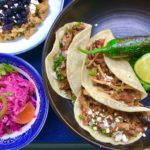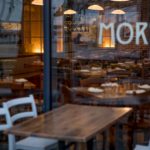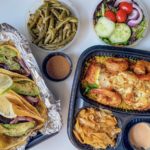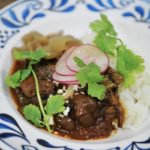
There’s something about food as a balm for tragedy. As D.C. restaurant owners who are open for takeout and delivery continue to feel out operations in an industry leveled by COVID-19, some are remaking menus to focus on more casual, comfort-driven dishes.
“I don’t think anyone needs fancy food right now,” says Sebastian Zutant, who co-owns Brookland’s French wine bar Primrose with his wife Lauren Winter, a designer for Edit Lab at Streetsense. “Primrose isn’t a restaurant that can succeed amongst delivery services. This time is right for something a little bit more comforting and homey and nostalgic. I said, fuck it, I’m just going to come up with delish shit.”
A handful of spots are launching pop-ups or specials over select hours: Middle Eastern newcomer Albi, which opened in Navy Yard weeks before the shutdown, introduced shawarma over lunch hours; U Street hot spot Seven Reasons is serving one line cook’s chicken burgers during the day; Estadio has sold out of Scrappy’s Bagels on weekends; and Komi turned their Happy Gyro pop-up, which debuted Greek-American casual fare last year, into their main takeaway option.
The chefs say they have made these changes for a number of reasons. For some, it’s necessity. After a devastating last month of citywide closures and layoffs and a future that remains uncertain, many restaurants are operating with just a few staff members and taking the precarious job of providing meals to go one week at a time.
Rather than trying to maintain full menus or fancier dishes meant for plated presentation, they say it makes sense to craft foods with ease of preparation and transport in mind and streamline a situation that is already stressful.
[For a list of restaurants offering takeout and delivery, click here]
After Primrose went from employing 22 people to four (a Go-Fund Me page is up for support), wine connoisseur Zutant and the remaining staff had to pivot from their usual Parisian-inspired ricotta gnocci and bone-in ribeye. Zutant brainstormed a casual menu with his sous chefs, asking the staff: What would you cook if you were at home?
The result is the restaurant’s new persona: Larry’s Chicken and Cheeseburgers. “New Reality = New Identity,” reads its website. Zutant, who says he had already been wanting to try fried chicken on Sundays before the virus struck, named the menu after a nickname from his brother and added a few Primrose staples, including duck liver mousse with cherry compote, steak frites, and an “OG” roast chicken. But the team is focused on handhelds—falafel, a double burger smothered in onion jam, chicken tinga tacos—and buckets of fried chicken ($30) that come with biscuits and Chapo’s hot sauce.
They also started a 6ft Wine Club (six bottles for $150 and virtual tasting classes on Wednesdays). The list is currently full, but Zutant says he hopes to open a dozen more spots in the coming weeks. Individual bottles are available at $35. Since launching Larry’s, the restaurant has been able to bring back a few staff members part time.
https://www.instagram.com/p/B9zowq9lUG8/?utm_source=ig_web_copy_link
For chef Michael Rafidi, who served sit-down dinners at newly opened Albi near Nationals Park for three weeks before D.C. shut down, it wasn’t about going casual so much as figuring out what food works for transport. His first solo project was years in the making, the Middle Eastern plates he torches over coals and local vegetables a blend of his Palestinian background and Maryland upbringing. Takeout has been a hard shift when the restaurant was just getting off the ground.
“We’re still trying to cook and do everything the same way, basically getting Albi in your house, not really fast casual,” says Rafidi. “Things don’t travel the same as they would if you put it on a plate. So, we’ll test, how does this chicken hold in a box for an hour, then eat it and do some R and D that way. Usually, we’re just tasting flavors. Now we’re asking, how does this travel?”
Though the restaurant’s evening takeout is a multi-course Levantine dinner for 2-3 (4 to 8 p.m. Wednesday through Sunday), a popular build-your-own shawarma entree with fire-seared kabobs lent itself well to carry-out during the day. Albi tried a few chicken, lamb, and smoked cauliflower shawarma wraps during the first week of closure, and guests came by asking for more. For the foreseeable future, they’ll be offering the traditional street food from 11 a.m. to 2 p.m. alongside kibbeh-spiced curly fires and soft serve on weekends. “I didn’t build this restaurant for years just to do take-out, but if we’re going to do it, we might as well do it well,” Rafidi says.
Other high-end places have pared down to serve their chefs’ version of comfort foods at a lower price point. Chef Tim Ma, who runs Eaton DC’s American Son, created a $14 line-up of Asian comfort foods built for “nostalgia”—including crème fraiche chicken wings from his Kyirisan days—for a hotel restaurant that had never previously offered delivery services. “Almost everyone started coming out with the same ethos of menu,” says Ma. “Abandon everything that we normally do and turn it into stuff we would like to eat.”
https://www.instagram.com/p/B-w-v9dBDqz/?utm_source=ig_web_copy_link
At Emilie’s in Capitol Hill, instead of the restaurant’s “New American” family-style plates and orders of Peking duck, carryout options include Vietnamese banh mi sandwiches, rice bowls featuring pea leaves and lemongrass grilled chicken, and Szechuan and Nashville hot chicken from sister restaurant Hot Lola’s. Chef Kevin Tien says he picked dishes that make him “feel better” when he’s having a long week, ones he ate while growing up in a Vietnamese family in Louisiana. The menu is subject to change and available from 10:30 a.m. to 8 p.m., in addition to pantry staples like loaves of fresh bread.
Cost for customers has been a driver for Tien, who is keenly aware of the precarious financial situations many people are in. Emilie’s had to let dozens of employees go and is cobbling together takeout with four line cooks and 10 staff. Three weeks has seemed like “three years,” he says. “It was like opening a new restaurant all over again.”
As much as Tien knew people in the neighborhood would want to support them, he revised to a more approachable price point ($6 to $16) so patrons could “stretch their dollars.” He hopes in doing so that customers can “spread the love around” and support more restaurants. He encourages skipping the third-party delivery service to order direct from the restaurants, so they get 100 percent of the profit.
Even so, Tien wonders how long takeout will be feasible. Sales continue to drop each week for Emilie’s. One restaurant owner Tien spoke with described the experience as “trying to pour water from an empty cup.”
“What comforts me the most is seeing our neighborhood guests come by multiple times a week,” says Tien. “What’s even more comforting is our restaurant community. I’m beyond amazed by how much other restaurant owners call or text to check in. Everyone has their own issues to deal with, but everyone takes the time to give ideas about what they’re doing. That’s been the brightest light for me, seeing everyone in this together.”