Elliot C. Williams
Mayor Muriel Bowser announced that the District is extending its state of emergency order until at least May 15. The extension is needed to continue to “flatten the curve” and reduce the number of confirmed cases in D.C., Bowser said at a press conference Wednesday.
The directive extends the stay-at-home order, school and nonessential business closures, the ban on gatherings of 10 or more people, and limited government operations. Bowser said more information on D.C. Public Schools will be provided on Friday.
The order also calls for new measures to protect the District’s most vulnerable populations. Under the mayor’s order, masks are required for hotel workers, guests, and visitors; people using taxis, ride shares, and private transportation services; workers and customers of food sellers; and strongly encouraged for anyone using public transit. Bowser previously directed shoppers to wear masks in grocery stores.
The mayor first declared a state of emergency on March 11 and closed essential businesses on March 24, with schools and non-essential businesses originally slated to close until April 24. Bowser said the closures could be extended further beyond May 15, and that she sees the date as a checking-in point. “If we need to extend it beyond that, we certainly will,” the mayor said.
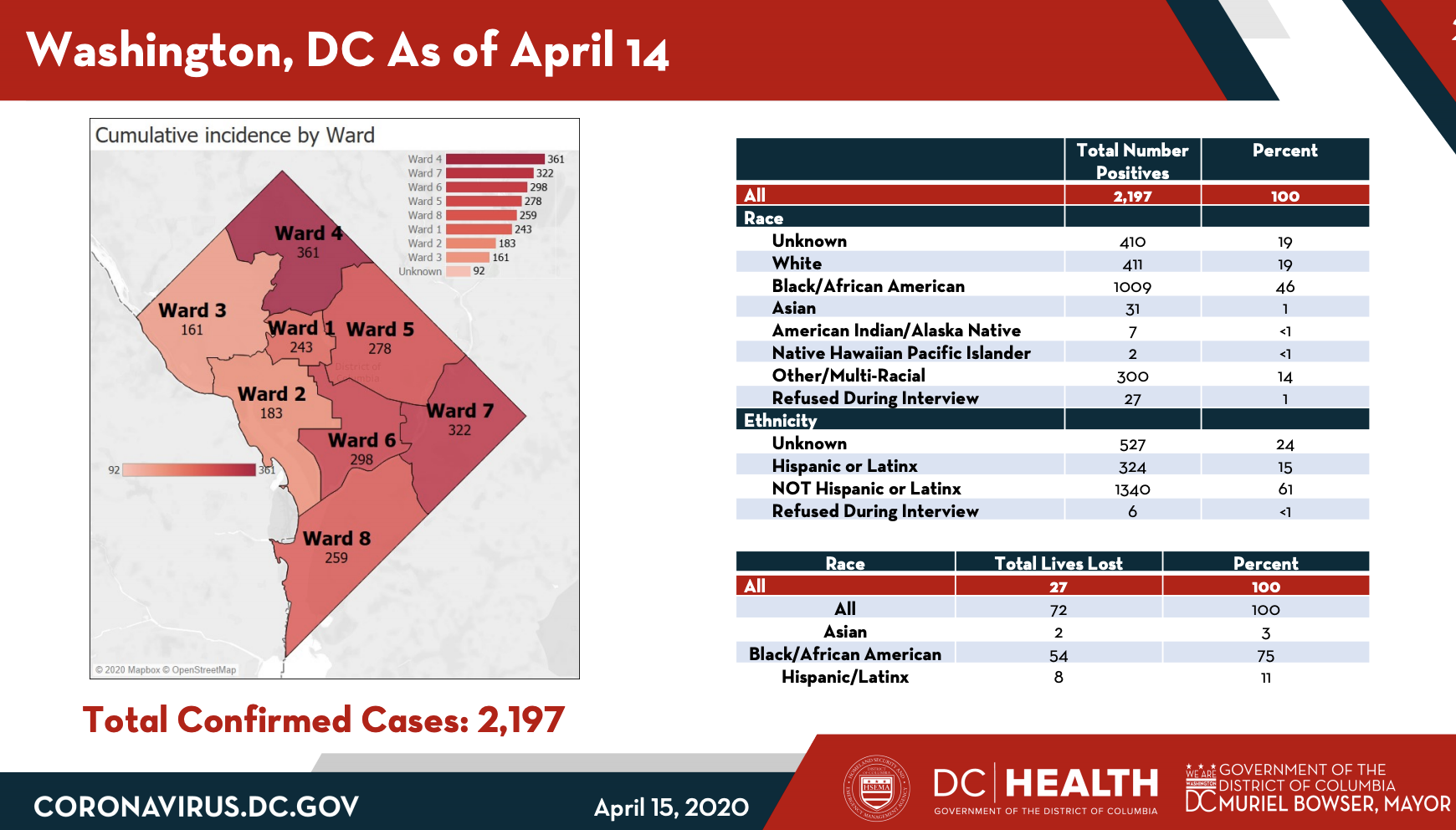
By Wednesday morning, the District’s total number of confirmed cases reached 2,197, with 72 deaths. Across D.C., Maryland, and Virginia, the death toll has surpassed 600.
Bowser’s announcement, which included new information about how vulnerable populations have been affected by the virus, also revealed staggering information about the city’s homeless population. Within the District’s homeless services system, four people have died, 62 people have have tested positive for COVID-19, and 225 individuals are quarantined. The District is providing hotel rooms for the medically vulnerable and individuals experiencing homelessness who are most at risk, Bowser said.
The mayor also called attention to the racial disparities shown in the data, and said more data needs to be collected labs to show how the pandemic is affecting black D.C. residents. As of April 15, black residents make up 46 percent of the positive cases and 75 percent of COVID-19-related deaths in the District.
“Of course, when we get to the other side, we need to focus and continue to focus on a generation’s worth of economic, housing, and educational disparities that this pandemic is putting a spotlight on,” Bowser said. “We, of course, cannot wait until the pandemic is over to make every effort to change the trajectory of African Americans in our city—and today’s mayor’s order will, we think, go even further to protect our most vulnerable populations.”
The city will also begin tracking data on confirmed coronavirus cases among individuals experiencing homelessness, patients in Saint Elizabeths public psychiatric hospital, people in custody in the District’s corrections system, and in the Department of Youth Rehabilitation Services (DYRS).
Four patients have died at St. Elizabeths Hospital. Currently, nine of the hospital’s 12 units—about 60 percent of the facility’s 240 patients—are under quarantine.
One person who had COVID-19 has died at the D.C. Jail, where there are 56 confirmed cases. Two weeks ago, the American Civil Liberties Union filed a lawsuit against the Department of Corrections over conditions at the jail. The Metropolitan Police Department says it has reduced daily arrests from an average of 92 to 29 people, and the Department of Corrections has halved its number of new entrants, reducing the jail population by 22 percent. Bowser also granted early release to 39 residents held on misdemeanor charges last week.
Over the past three weeks, DYRS’s population at New Beginnings and the Youth Services Center has been reduced by 40 percent. Within the system, 12 individuals (both residents and personnel) have tested positive for coronavirus, and one employee has died.
Bowser confirmed nine deaths among D.C.’s nursing home patients, but said the deaths aren’t clustered at one specific home.
The Department of Health Care Finance will start identifying residents who have underlying health conditions that put them at higher risk of facing severe illness or dying as a result of the pandemic, according to the mayor. The agency will then screen the individuals for coronavirus symptoms and “provide information on any medical care, case management, or other support that may be appropriate.”