Matt Blitz
Despite a pandemic, love remains in the air. As the region continues to attempt to flatten the curve, local jurisdictions are turning to innovative, socially distant ways to process marriage licenses and even perform wedding ceremonies.
On Friday night, the Superior Court of D.C. announced that it is asking couples to submit their marriage licenses online for remote processing and not requiring them to step foot in the courthouse. Upon submitting their applications, couples will get contacted by a clerk via email and phone to verify information.
While the court is processing licenses, they are not yet currently performing weddings. But that’s likely to change. In an email to DCist, a court spokesperson wrote that “court staff are working to get a video wedding ceremony procedure in place and hope to have that available shortly.”
The representative also wrote that there were a “significant number of applications” filed over the past month and they are processing them in the order they were filed. So it could take staff a while to get to the most recently filed applications. Couples with “emergency situations” should email or call the Clerk of the Court’s office, the spokesperson added.
Elsewhere, Fairfax County is already offering “virtual marriage license” appointments and marriages where couples take their oath before a deputy clerk of court online via video conferencing.
Several Virginia jurisdictions are still asking for marriage license applications in person. The City of Alexandria is still requiring in-person appointments (though only after April 26—before then, the city is not allowing for any marriage licenses.). Prince William County is also currently doing in-person appointments.
Arlington’s Circuit Court Clerk Paul Ferguson told DCist late last week that the court would consider mailed-in marriage license requests “on a case-by-case basis.” However, he declined to specify what criteria would allow the county to approve a marriage license at this time.
In Montgomery County, marriage licenses are only upon emergency requests and if a judge determines “good cause.”
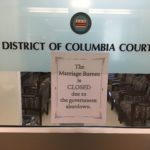
On March 18, the Superior Court of D.C. announced that they would stop issuing marriage licenses altogether and canceled all previously scheduled wedding ceremonies. Then, on April 6, the courts updated their guidelines by saying they would issue marriage licenses for “emergency matters only.” Eleven days later, the guidelines were revised again.
For a time, D.C. and other local governments were issuing marriage only in emergencies—but not defining what constituted an emergency. This led to confusion and speculation among couples, wedding planners, and officiants. Some were sending folks who were in need of emergency licenses to jurisdictions in Virginia that were still allowing in-person applying.
“I … [sent] them to Virginia,” Rev. Starlene Joyner Burns of US Capitol Elopements told DCist last week. “It’s the only place I know that is still processing marriage licenses.”
Burns says she has her own list of situations that she considers an emergency and has used that to advise her couples. “Someone is about to be hospitalized and needs someone to make decisions on their behalf,” Burns says. “Military, particularly someone who may be deployed. Immigration issues. Pregnancy is also considered a reason for an emergency marriage to me.” Over the last few weeks, she’s had several of these requests and says she was able to help most of them obtain licenses from Prince George’s County despite the courthouse being closed through June 5.
Jeff Maszal, who runs his own officiate and elopement company and has been marrying people for three decades, says he’s received 10 calls in just the past week from couples who want to elope for a very particular reason. “It’s someone who has lost their job and is trying to get on their partner’s health insurance,” says Maszal. He said the only other time that he’s seen this was during the Great Recession in the late 2000s.
“When a couple calls who one of them needs to get on the other’s health insurance, I don’t say no,” says Maszal.
There’s one catch, though. While the couple doesn’t have to be married in the jurisdiction they received the license from, they have to elope in the Commonwealth of Virginia within 60 days.
Maszal has recently worked with D.C. and Maryland couples who are more than happy to simply cross the bridge into Arlington and Alexandria for a quick three-person (the couple plus Maszal) ceremony in a public place. He says the common question he gets is if the Virginia license is valid in D.C.
“Yes, it’s just like a drivers’ license,” says Maszal. “It’s valid across states’ borders.”