Matt Blitz
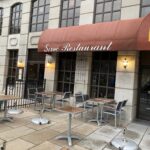
Shuttered and waiting on money from assorted federal and city level grants, programs, and loans, H Street’s Burmese restaurant Thamee is on the cusp of collapse. It was just two months ago when the restaurant was being lauded as a James Beard semifinalist, but the coronavirus pandemic halted that momentum. On March 16, they made the decision to temporarily close.
Co-owner Simone Jacobson says they made the hard choice due to safety concerns. “Our executive chef, who’s my mother (Jocelyn Law-Yone), is 67 years old,” says Thamee co-owner Simone Jacobson, “She’s in the high-risk category.” The fact that a number of their 28 employees live as far as Baltimore also influenced their decision to shutter for the time being.
Thamee’s owners do consider themselves lucky. Their landlord has waived two months of their rent and they received a $5,000 small business grant from the tech company Bumble. They are using that money to cover health insurance for six employees for an additional two and a half months (they previously agreed to cover their insurance for a month).
But those aren’t their only expenses. “I think people have the misconception that if you are not serving food and beverage, that you have no bills,” says Jacobson, “That’s obviously not true. We have to pay for security, electricity, and many other bills.”
While they are considering reopening in some capacity (many other food businesses have switched to takeout- or delivery-only models), Jacobson and her co-owner Eric Wang (along with Law-Yone) say they are in need of a lot more money to cover all of that. And fast.
“The brutal honesty is that if we don’t get these five-figure grants and loans soon, we can’t measure the life of our business in months,” says Thamee co-owner Eric Wang. Adds Simone Jacobson, “We are talking 30 days or less.”
Thamee isn’t the only local business where time is running low. Many are still waiting to even hear about the status of their applications for the various programs and grants, much less to receive the much-needed cash.
This has left them struggling to pay rent, payroll, utilities, employee health insurance, and other operating costs, and worrying whether their business can survive.
The biggest of these aid programs is the federally run $349 billion Payroll Protection Program, part of March’s CARES Act, which was designed to help small businesses with fewer than 500 employees make payroll, pay rent, finance mortgage interest, and take care of other operating costs. It’s a forgivable loan, meaning if employees and compensation levels are maintained for at least 8 weeks after the funds are provided it is likely to be forgiven.
However, the program ran out of funds in mid-April—less than two weeks after applications were first opened. Since then, controversy has swirled around the fact that some larger businesses—particularly national chains—applied for and received these forgivable loans. On Monday, however, Congress appropriated another $321 billion in funds to the program with specific amounts earmarked for lending institutions that serve minority or under-served areas.
While several area businesses (like Silver Spring’s Denizens Brewing Company) were able to be approved and, eventually, received the promised funds, a large number were left out in the cold. Of the seven businesses that DCist spoke to, all but one has yet to be approved for the program due to it initially running out of funds.
“For us, the PPP [money] is crucial,” Politics and Prose co-owner Bill Graham tells DCist. With 115 employees at three locations, Graham says that he’s been applying for every grant and program available but it’s the PPP loan (which caps at $10 million) that hopefully could keep them afloat. After not getting it the first time, though, he doesn’t know if it will be any different when he reapplies.
“It’s the uncertainty of not even knowing,” says Graham, “If we don’t get [that] money, we won’t get past June most likely.”
U Street Music Hall was approved for the program the day before funding ran out, but co-owner Will Eastman has yet to see any money, nor does he know how much they’ll end up receiving.
“We are in the direst of situations as a music venue,” Eastman says. He says the plan, when they do get the money, is to spend it on payroll and rent. But, like others, it isn’t simply just about the money, but the timing as well. “We needed it two weeks ago… we’ve been closed since March 11 with absolutely no revenue coming in.”
In the meantime, Eastman has set up a GoFundMe to help pay staff and has launched an online store. But while small donations are great, it’s the big PPP money that will ensure its survival. “There’s going to be no concert industry to speak of on the other end of this unless we can get some real help from the government now.”
On a smaller scale—but just as important for many local businesses—are the small business recovery microgrants being offered by the city. First approved in the March 17 emergency act passed by the D.C. Council, the microgrants will offer small local businesses $25 million to cover wages, employees’ health insurance, rent, utilities, and other fixed operating costs. The deadline to submit was April 1 (after being pushed back twice). The city received more than 7,600 applications and will grant about 2,000 of those awards, according to Washington City Paper. The amounts granted could go as high as $25,000, D.C.’s Office of the Deputy Mayor for Planning and Economic Development confirmed to DCist.
Three weeks later, though, that money has yet to be delivered. At a press conference on Tuesday, D.C.’s director of business development and strategy Sybongile Cook said that they are currently reviewing applications and will begin notifying businesses of their status by the end of the month. A DMPED representative told DCist the plan is to “disburse the grant funding as soon as possible after award decisions are made.”
Due to this delay, some are being forced to mull their options. Both locations of D.C.’s cat cafe Crumbs & Whiskers have been shuttered since March 16 (their location in Los Angeles also closed that day). Founder Kanchan Singh thinks that they may have to permanently close their original location on O Street in Georgetown if the money from the D.C. microgrant they applied for doesn’t come in the next few weeks.
“It’s not just about us getting the funding. It’s also about when we get the funding,” says Singh. “And the longer that takes, the more likely we are going to need to close [one of the locations].”
Both money and timing may still not be enough for some businesses. Ramunda and Derrick Young own Mahogany Books, a small book shop in Southeast that specializes in books by black authors and has only three employees. They didn’t apply for the Payroll Protection Program because having only part-time employees means their business doesn’t qualify.They did, however, apply for D.C.’s microgrants and various other small grants.
They said that a big chunk of their revenue comes from author events, which have all been cancelled. “I just don’t know that one grant will make up for that lost revenue,” says Ramunda Young.
The couple estimates that they will need between $30,000 and $50,000 to get through the next few months. But even if they are able to reopen soon, the owners are not confident that they’ll be seeing people in their store or at their events at the same numbers they did before, due to both potential worries about crowds and a lack of disposable income in the wake of job losses.
When asked what the future holds for Mahogany Books if it plays out the way they are fearing, Ramunda Young responds, “That’s a good question. I don’t know.”
There are other places businesses are going for cash, like the Save Small Business Fund from the U.S. Chamber of Commerce and Economic Injury Disaster Loans from the U.S. Small Business Association. With these sources, too, funds are running out or being delayed.
Svetlana Legetic, founder and CEO of the content company BYT Media (they do media, events, and creative consulting), says her business has gotten approved for an Economic Injury Disaster Loan of $15,000 but has yet to see funds nor any indication of when it will arrive.
Currently, the company is only bringing in about five to 10 percent of its typical revenue, mostly from remaining advertising.
While they are currently working on developing virtual events as potential another revenue stream, spring and summer are big seasons for the events business. “We sort of always make it through the winter to make money in the spring,” says Legetic.
All of the money that they are making is going towards rent (for an office they are not using, says Legetic) and health insurance for their 12 full-time employees. However, they are not able to pay staff, which includes an additional 18 contributors. Legetic herself has also stopped taking a salary.
She says her company needs the promised $15,000 it by the end of May or it is likely “over.”
“We’ll just be exhausted,” says Legetic, “It’s incredibly mentally challenging to wake up and still do all of these things with nothing but hope.”
With Congress voting to appropriate more for the PPP, D.C. saying that the city is rushing to make sure businesses get their recovery money, and other hyper-local grants becoming available, at least Politics and Prose’s Bill Graham thinks it may get better in the coming week.
“I’m cautiously optimistic,” says Graham, “because you have to be.”
This post has been updated to reflect that the city’s press conference took place Tuesday.