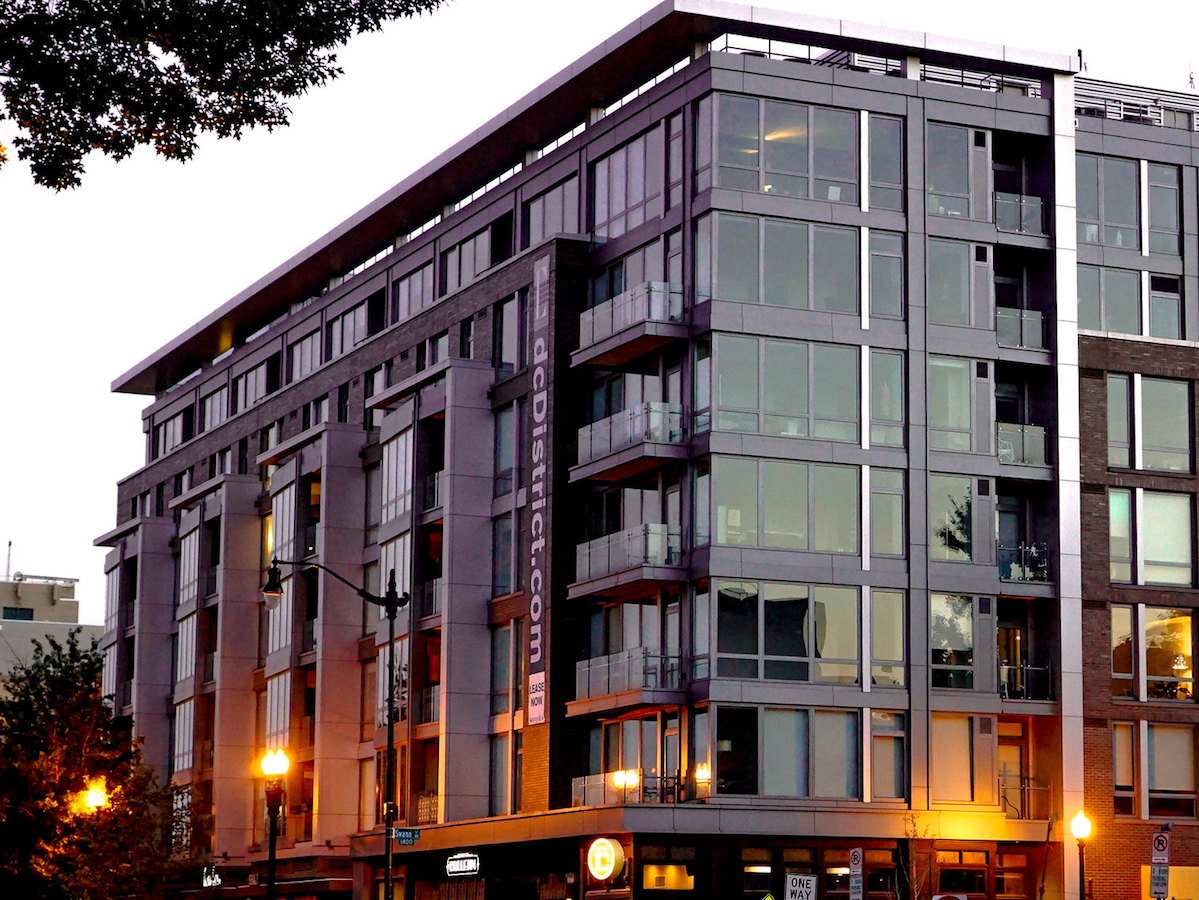
Sharing space in a residential building can be awkward or frustrating even in the best of times. But as the coronavirus changes how we interact in public spaces everywhere, D.C.’s apartment dwellers are left to grapple with a series of questions specific to the experience of living feet away from near-strangers: How are buildings dealing with common spaces? Is management giving adequate protection to staff? And, critically, are neighbors actually complying with social distancing guidance?
Jim Barnett, who lives in Quebec House in Cleveland Park, says the behavior of people in his building varies wildly.
“Some people are not wearing masks, entering occupied small elevator cars with others, shaking hands, and having parties in their rooms with four or more people,” he says. Others, though, are diligent about wearing protective equipment and keeping a safe distance with others. He has even observed some of his neighbors performing a “decontamination ritual” on their incoming packages (though he says this is done in the hallway, which he doesn’t find safe).
Sarah Woods, who lives in a Cathedral Heights apartment managed by Gelman Management Company, showed DCist a copy of an email that Gelman sent to tenants. It encourages residents to practice proper hygiene and informs tenants that a cleaning crew will be cleaning high-volume surfaces, such as laundry machines, doorknobs, and elevator buttons, more frequently.
But Woods remains frustrated with some of her neighbors, and she believes one of them frequently has guests over from the noise she overhears at night.
“I wish that everyone was taking this seriously,” she says. “I wish we were doing a better job of taking care of each other.”
D.C. Mayor Muriel Bowser on April 15 extended the emergency order directing people to remain home until May 15 and to practice social distancing (the order originally closed rooftop and common outdoor spaces in apartment buildings before she reversed that decision, allowing access if people follow social distance guidelines). Maryland and Virginia have similar orders. Social distancing guidance calls upon people to wear cloth masks in public and stay six feet away from others.
DCist spoke with a slew of people about their experiences living in D.C. apartment buildings during the pandemic, none of whom had major complaints about management or maintenance prior to the spread of coronavirus. Most people interviewed say their apartment buildings were quick to implement cleaning and sanitary measures, but one of the most persistent challenges is the handling of communal spaces like elevators and laundry rooms. (The majority said nonessential spaces like lounges and rooftops were closed.)
Andrew Bossi, who lives in an apartment building in Southwest, says most people will wait for the next elevator if the current one is occupied, but not everyone.
“There are a few [residents] who seem to dive straight into an occupied elevator,” Bossi says. “And there’s one person who loudly proclaims [coronavirus is] manufactured by the government … and two separate people who are still asserting the flu is worse.”
Caitlin Lynch, a resident of Core Apartments in Silver Spring, says communal areas, including the gym, were padlocked by management and residents have been asked to limit elevator trips to two people at a time.
One tenant of a Northwest apartment building managed by WC Smith says the roof deck was closed, but then reopened after people continued to go up there; now a sign-up sheet ensures only one household is up there at a time.
Jessica, a resident in a Forest Hills high rise who asked to be identified by her first name for privacy reasons, has struggled to find spaces within her building where she feels safe enough to bring her 2-year-old son. She notes that many of her neighbors, as well as maintenance and concierge staff in her building, haven’t been wearing masks.
Her seventh-floor balcony is impractically small for a toddler, and she worries about passing through the building and encountering others on their way to get outside. “I’ve rethought about wanting to stay in an apartment or condo long-term now without some way to easily get outside,” she says.
Britney Dixon, a resident in an apartment in between Dupont Circle and Logan Circle, says the experience of doing laundry has been anxiety-inducing. While signage asks that only one person use the laundry room at a time, she said there’s usually one or two people who stand in the room to fold their laundry—and not everyone is wearing a mask.
“If everyone’s not doing their part, those select people that aren’t are detrimental to a whole building of people,” she says.
These kinds of tensions and frustrations are taking place at buildings that are normally well-managed and can command thousands of dollars in monthly rent. The experience of residents at low-income and public housing present a whole set of far more dire issues.
One resident living in an apartment building in Northeast thinks the apartment’s management should be responsible for enforcing guidance. The resident, who asked to remain anonymous for privacy reasons, says she has noticed a room down the hallway from her hosting a constant flow of people, none of whom are wearing personal protective equipment, or PPE.
However, she is hesitant to complain, fearful of causing fines or trouble for her neighbors during a time of economic uncertainty. “I do feel like our apartment complex can be doing more to limit group gatherings or limiting access to non-residents at this time, as well as providing PPE to the staff,” she says.
Others are also concerned about front desk, cleaning, and maintenance staff. Woods says nothing formal has been put into place in her apartment building, and it’s largely up to cleaning staff as to whether they’ll wear masks or gloves. At Barnett’s building, tables have been set up as barriers between residents and front desk staff, and they’ve been provided with gloves and masks, but not everyone is wearing one.
JBG Smith, a management company that owns a number of buildings in D.C., says that daily deep cleaning and sanitation methods have been in place since the end of March. Additionally, staff work in 14-day increments with 14 days off, and sick staff are instructed to self-quarantine, according to the company.
“Whenever we learn of a confirmed case of COVID-19, we immediately notify all residents and tenants of the building. We also take additional steps to thoroughly disinfect and sanitize all common areas,” a statement says.
Joan Eisenstodt, who lives in a building in Penn Quarter, says her apartment building alerted residents of three confirmed cases in the 160-unit building, including the floors where those who have tested for COVID-19 reside, which is valuable to someone like Eisenstodt, who is immunocompromised.
Beth Harrison of the Legal Aid Society of D.C. said there’s no real legal requirement to inform residents if someone in the unit has tested positive for COVID-19, although she says she has heard of apartments doing so. Likewise, there’s no legal requirement for a tenant to disclose their health information to their landlords, she said. And while D.C. law calls on landlords to keep common spaces reasonably clean, there are no additional hygienic requirements during a public health emergency.
Still, some residents say their buildings have gone above and beyond to protect residents and even keep things fun in quarantine.
Vic Jain, who lives in a building in Shaw, says his building has given gloves and masks to front desk staff and created barriers between staff and residents. On top of that, he says, management has been keeping spirits up by having Instagram contests and virtual scavenger hunts that residents are invited to do within their apartments. He says the winner of a scavenger hunt got pizza delivered right to their door.
Other buildings are stepping up to help neighbors who are fearful of becoming ill or who have already gotten sick.
Kris Guin, who lives in a small building in the Capitol Hill neighborhood, says his landlord sent around an email announcing that she had ordered masks for everyone in the building to ease anxiety about going to grocery stores.
Meanwhile, Carly Anderson who lives in a co-op in Kalorama, says the board of directors for her building set up a confidential system to allow residents who get sick to request help with groceries and other needs.
“It’s nice to know my apartment has been supportive,” she says.