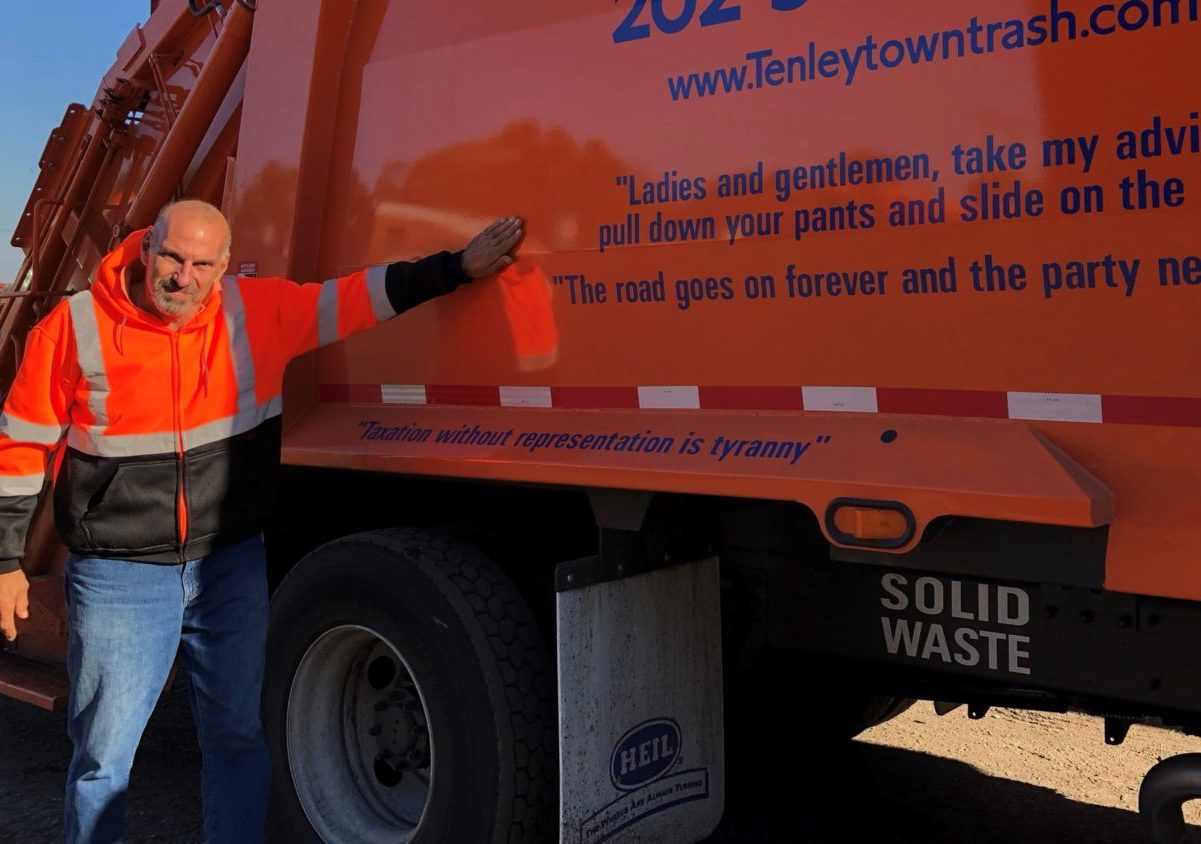
Barney Shapiro, the owner of Tenleytown Trash in D.C., takes daily walks to help clear his head. He says he often sees signs that read, “Thank the nurses,” and “Thank the doctors.”
“Last week, I saw—in chalk on a sidewalk—‘Thank you trash men.’ And [it] put a little tear in my eye,” Shapiro says.
People often overlook the sanitation workers and forget that they, too, are on the front lines in the fight against the spread of coronavirus.
Public life has been shut down around the region for over a month now. Entire families are staying home to help flatten the curve. Spending more time at home has led to an increase in residential trash.
Patriot Disposal Services in Northern Virginia reports a 30 to 40-percent increase in the amount of residential trash collected over the last month. Tenleytown Trash, which serves parts of D.C. and Maryland, doesn’t have official numbers yet, but Shapiro says the increase is noticeable. Chris Geldart, director of D.C.’s Department of Public Works (DPW), says the department has seen a roughly 8-percent increase in residential trash.
“On the other side, we’ve seen an 18-percent decrease in our night litter can operations because we pick up 7,000 litter cans in the city every night. And our daily litter can collection is down 39 percent,” Geldart says.
The decrease is due almost entirely to the shutdown of public life in the District.
Trash Is Hard Work
Sanitation work is brutal, back-breaking work.
“The average trash collector on a residential route runs three to five miles a day and picks up approximately 10 to 14 tons each person a day, five days a week,” says John Poague, president of Patriot Disposal Services.
Now imagine how much sanitation workers are running and lifting these days with the spike in residential trash collection.
Poague says the increase in residential trash is offset by a significant decrease in commercial trash since many businesses are shut down. But he can’t just ask his commercial trash guys to jump into residential work because it’s a completely different beast.
“In a commercial route, the only time you may ever get out of a truck is to open a gate where a dumpster is because it’s all automated. On residential routes, that’s where you see guys hanging off the back of a truck and he jumps out and physically empties toters or garbage cans. So, the average commercial trash collector wouldn’t have the conditioning to do it,” says Poague.
A decrease in commercial bread-and-butter service also means a loss of business. A trash company that was emptying a business’s dumpster fives days a week before the shutdown now may only be servicing that business two days a week, or not at all. This slow down has hit Tenleytown Trash hard financially.
“We have been lucky enough that we have gotten a Paycheck Protection loan and that will help us get through the next few months,” says Shapiro, referring to the federal government’s Paycheck Protection Program aimed at helping small businesses weather the shutdown.
Safety Requirements Differ
Tenleytown Trash employs about 90 people. To help protect his employees who are working harder than ever, Shapiro requires them to wear masks when they’re out in the field.
“I think it makes our guys a little more comfortable,” he says.
Some Tenleytown trash collectors have been wearing masks in the field for years to keep debris, dust and other particles out of their mouth and facial hair. Shapiro made masks a requirement after three employees tested positive for coronavirus last month.
“Actually two of them are back. One came back yesterday. He had been away for four-plus weeks. Another came back today, and she had been away for five weeks,” Shapiro says.
John Poague says thankfully none of his roughly 100 employees have tested positive. He says that while he encourages his employees to wear masks in the field, they’re not required to.
“It’s quite difficult for a lot of the guys to even wear the masks because they’re sweating profusely and they’re running and breathing so much,” Poague says.
To put this into perspective, Poague says try running a marathon while wearing a mask.
Chris Geldart of DPW says they’ve had 10 people across the department test positive for coronavirus. They’ve quarantined up to 36 people at a time — mainly other employees who came in contact with someone who tested positive. Geldart says DPW requires all employees to wear face coverings, use gloves and social distance.
Are We Really Creating More Garbage?
Maryland resident Rachel Johnston, 29, is passionate about recycling. But since the stay-at-home order went into effect and she and her husband moved from Anne Arundel County to a family farm in the Eastern Shore, Johnston says recycling has gotten … cumbersome.
Johnston says when they lived in Anne Arundel County, recycling was easy. It was single-stream. Paper, plastic and the like all went in the same can. Now, Johnston says, she’s the only person in her seven-person household that really seems to care about recycling.
“When I’m successful at it, there’s probably at least five to six to seven full trash bags worth of recycling,” she says with a laugh. “And it’s about 15 minutes into town. The [place] where you take the recycling requires you to separate it out. It’s easier if you separate it as you create it. It’s harder trying to separate it when it’s all dirty and wet and sticky.”
And, Johnston says, the new recycling process requires her to leave the house. So, she’s only doing it about once a week. Seven people in one farmhouse make a lot of extra garbage. But is it really more garbage, or is it the same amount of garbage just being disposed of in one place?
“We’re used to being out and about in different places. We’re used to being on the road. I was in the office at least five days a week. And, I think all of that [garbage] got spread out,” Johnston says. “So, I think three meals a day, seven days a week without offices, without being on the road, without being here or there then all of that [trash] is just centralized into where you are now.”
This story originally appeared on WAMU.