 Eliza Tebo
“You unlock that revolving door, and the world comes through,” David Moran says.
The one-time general manager of Old Ebbitt Grill has hosted his share of power brokers, entertainers and tourists (he remembers the time Bono popped in for oysters and a Guinness). But the revolving door is locked now.
With sales limited to to-go orders during the coronavirus pandemic, revenue at Old Ebbitt Grill has fallen about 95%. Some 270 employees, or 90% of its staff, are out of work. The dent in the restaurant’s financial situation is “massive,” Moran says.
“It’s not sustainable,” he says. “The Old Ebbitt Grill is not going to continue to be a takeout and delivery-only business.”
Like it is with many restaurants across the city, the bleak reality now facing Old Ebbitt is unprecedented—even for a restaurant that predates the telephone. In the last century-and-a-half, Old Ebbitt has grown from a boarding house to a destination for tourists and politicians alike. Everyone from Ulysses S. Grant and Teddy Roosevelt to Paula Abdul and Stevie Wonder have stopped by what’s considered the oldest restaurant in Washington. The business has changed locations. It’s been bought and sold by various individuals and companies. And in the last month, it’s gone from being one of the most profitable independent restaurants in the country to its current state — barely hanging on.
As newcomers of the industry are showing their fragility during the pandemic, so too are the stalwarts.
“It’s important because it has that continuity — very few restaurants do. A lot of restaurants come and go very easily,” says John DeFerrari, author of Historic Restaurants of Washington D.C.: Capital Eats. “It’s now a symbol of the connection I think between the old Washington and its ways and the new Washington that we have now.”

From Boarding House To Nightlife Spot
If you count its early years as the Ebbitt House, then Old Ebbitt Grill is the oldest operating restaurant in the city, according to DeFerrari.
“People often think that Washington never had any good restaurants in the past, and they think it’s all happened in the last 10 years,” he says. “And places like the Old Ebbitt, and the Old Ebbitt in particular, are really nice because they show the continuity. They show we’ve had good restaurants going back a long time.”
The Ebbitt House opened in 1856 when William E. Ebbitt took over a four-story boarding house at 14th and F streets. It changed hands a couple times in the following years, eventually becoming a hotel operated by Caleb C. Willard, brother of Willard Hotel proprietors Joseph and Henry. The new hotel featured a restaurant that poured Veuve Clicquot and dished out leg of mutton with caper sauce. In the decades after a major renovation in 1872, it welcomed many military veterans and politicians, including William McKinley as he prepared for his inauguration.
Facing tough competition, the hotel closed in 1925 and was torn down, eventually replaced by the National Press Club building. (A New Ebbitt Hotel was underway on H Street at the time, too.) Before the demolition, a restaurateur named Anders Lofstrand bought many of the hotel’s furnishings and incorporated them into his new restaurant a block away, DeFerrari says, which was eventually named Old Ebbitt Grill.

Clyde’s Restaurant Group bought the Ebbitt, seen along F Street, and reopened it in 1972.
In 1970, the Internal Revenue Service closed the restaurant after tax trouble. John Laytham and Stuart Davidson, who owned Clyde’s of Georgetown, attended the auction of Old Ebbitt’s memorabilia, hoping to snag the restaurant’s beer-stein collection. They ended up buying the restaurant instead. It reopened in 1972 and moved to its current location on 15th Street in 1983, the site of an old Vaudeville theater and movie house.
“They were buying the Old Ebbitt Grill for $10,400,” says Moran, now the area director of operations for Clyde’s Restaurant Group. “Good R.O.I. on that one.”
This wasn’t the Old Ebbitt Grill that White House staffers and school-trip chaperones know today. In a 1972 Washington Star article, the renovated Ebbitt is painted as a bit of a rough-and-tumble downtown spot for cheap eats (corned beef hash and eggs, $2.25) that caters to daytime diners and late-night drinkers. Davidson is said to have modified the mahogany bar to make seating more comfortable for female guests.
“Now, if the tables at the Ebbitt are full, as they often are at lunch, shoppers from Garfinckel’s down the street and secretaries from nearby federal beehives can join the male chauvinists who like to eat facing long rows of antique steins, stuffed game heads and a little embalmed bear that once reputedly graced the bar of Alexander Hamilton,” the article reads.
‘It’s Beyond Iconic’
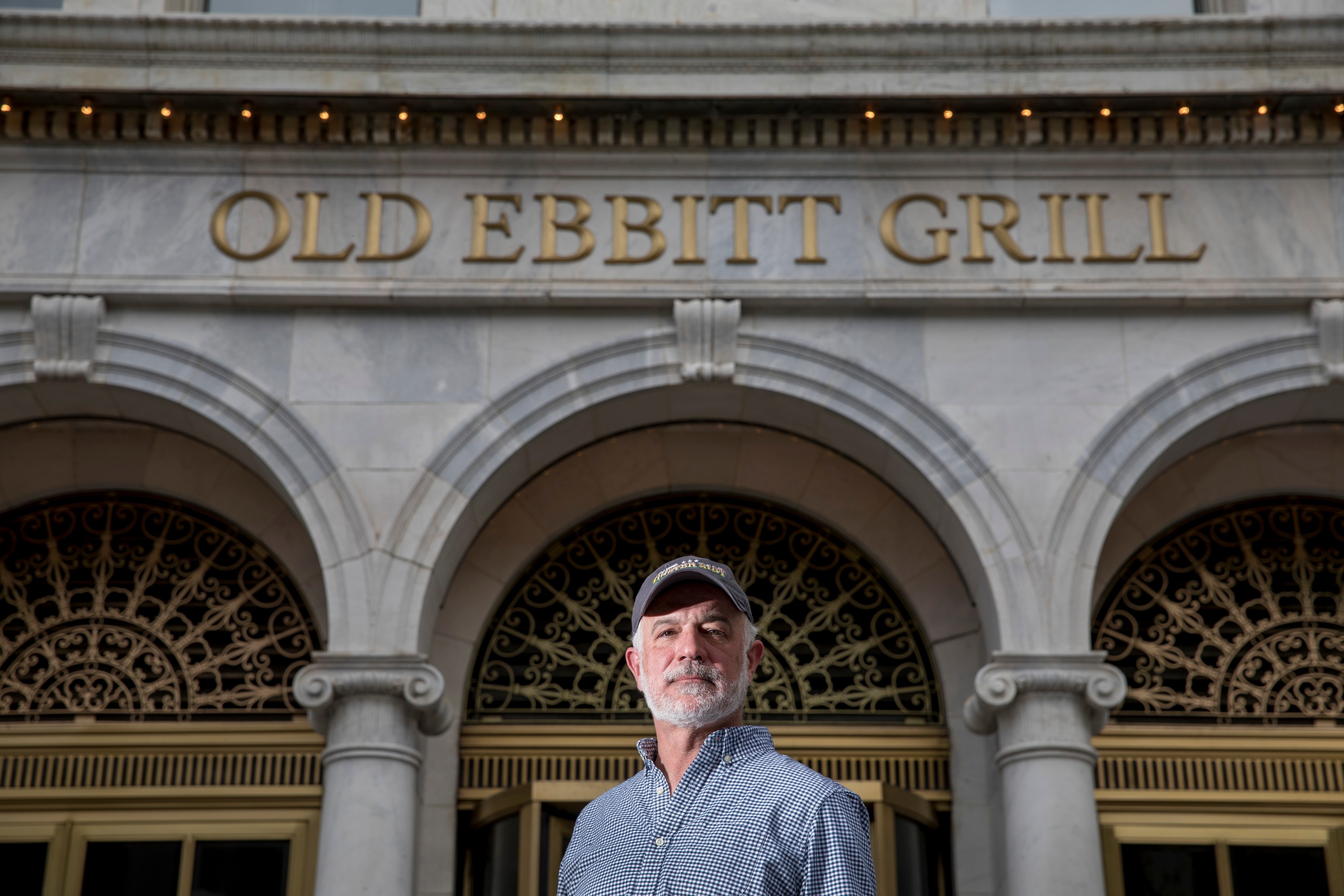
Jason Lukacs, known as “J Luke,” has tended bar for 25 years, nearly four of them at Old Ebbitt. On his last day before the lockdown, he says his experience with a few regulars was “surreal.”
“We’re talking and working and doing our thing, and every two seconds you looked up and Final Four was canceled, Major League Baseball is canceled, NHL season’s canceled,” Lukacs says. “It was almost like a joke. It’s like, I think the guy said to me, ‘What’s next? They going to shut the Old Ebbitt down?’”
Lukacs remembers visiting Old Ebbitt on the Fourth of July several times as a child. He was ecstatic when he got a job there. So was his dad.
“It’s beyond iconic, man. When I got hired there, I swear to God, it was like telling my father that I got signed by the Yankees, because he would walk around the restaurant like, “Hey, how you doing? I’m J Luke’s dad,’” Lukacs says. “He was more proud that day than the day I was born.”
Lukacs has received some disaster pay from Clyde’s and has taken advantage of free meals the restaurant group is offering staff during the pandemic. When we spoke, his bank account had $21 and he was heading to a Coinstar machine to trade in loose change for grocery cash. If he weren’t living in his girlfriend’s place, Lukacs, 46, says he’d have to move back in with his parents.
Beyond mulling his own financial future, Lukacs says he’s concerned about the restaurant’s.
“When we do go back to work, I have no idea what we’re going back to,” Lukacs says. “You walk up and down any street in D.C., I’d say more than half of these restaurants and bars that are there won’t even be there when this is over.”
Company-wide sales for Clyde’s Restaurant Group, which operates 12 restaurants in the D.C. area, are down 95%, about what Old Ebbitt is seeing. The company is continuing health insurance for any employees who had it prior, and footing the full bill. It’s also collecting public donations for an employee assistance fund and is partnering with Martha’s Table and another restaurant group to provide meals to local families.
The restaurant group initially applied for a Paycheck Protection Program loan but later told WAMU via email that it had withdrawn the application.
“The PPP originally seemed like the best way to take care of our employees,” the email states. “As we learned more about the program, though, we decided that smaller businesses with less resources needed it more. We are finalizing details on our own program we are creating as an additional way to take care of our employees.”

‘I Don’t Have The Roadmap Yet’
Moran says he hopes the restaurant will recover within the next six months, and is putting his faith in science and “smart people.” He was the restaurant’s general manager on 9/11 and says it took until early 2002 for the restaurant to get back on its feet.
“You don’t need to be an economist to figure not everyone is going to survive this. So it’s going to be a different landscape on the other side,” Moran says. “I’d love to believe that the Clyde’s group and how we’re operating and the steps we’re taking with our employees and keeping our businesses going will be well positioned on the other side. … But how we get from today to there? I don’t have the roadmap yet.”
Manager Erin Claire has concerns about what reopening might look like, given social-distancing restrictions that may stay in place.
“We have four different bars. And so how you open those and try to enforce any sort of 6-foot rule; I don’t really know how you would do that,” Claire says, who adds that the bars bring in about a third of the restaurant’s sales.
Clyde’s has shut down two of its 12 properties, 1789 and The Tombs (which share a roof) near Georgetown University. Claire remains hopeful that Old Ebbitt can remain open and benefit from a long relationship with its landlord. Yet she says recovery will be slow.
“I don’t want to be pessimistic, but I just really don’t think we could be anywhere back to business-as-normal in this calendar year,” Claire says. “I just really don’t foresee it happening to being like, to the old normal.”
This story originally appeared on WAMU.