Jacob Fenston
 Tyrone Turner
I have a pretty distinct memory of the last time I saw Andrea Molina before the pandemic. It was in the doorway of her kindergarten classroom, during morning drop-off on the last day before schools shut down. My daughter June gave me a perfunctory hug and trotted off into the room filled with art, plants and other kids eating breakfast. I don’t remember if Andrea and I exchanged words — or just shared a glance — as the world around us was about to come screeching to a halt.
Andrea is my daughter’s kindergarten teacher, and the first person I know personally to test positive for the coronavirus.
On that last day of school, Friday, March 13, Andrea ended up leaving work early. She found out a housemate had a fever, so she decided to play it safe.
“I went home and, I was like, ‘Oh, it’s okay. I think I’m okay. I think I’m fine.’” She spent the weekend trying to stay healthy — drinking lots of water and taking Vitamin C. On Sunday night she developed a fever.
“And then it started,” Andrea says.
Andrea’s story is not unique. As of May 5, more than 5,100 people have tested positive for the coronavirus in D.C., many living through the illness in isolation, far from loved ones.

Notes from a pandemic: On the left, Andrea’s journal recording her temperature and symptoms during her illness. On the right, a text message to her housemates while she was self-isolating in her bedroom.
Andrea lives with five housemates in Mt. Pleasant. They came up with a plan: If anyone got sick, that person would isolate in their bedroom. One bathroom would be designated for their use only. The healthy roommates would be on a rotating meal duty.
“There were captains for every meal,” says Andrea. “So there was someone who would bring me breakfast and I had to text them the instructions, ‘My bread is in the shelf, please toast it and put some butter on it.’”
Meals, water, tea — all were delivered with a knock, left outside the door. Sometimes there’d be a note or flowers. When I asked Andrea how she felt physically, she said it was like every sickness she’d ever had, wrapped into one.
“I couldn’t really move some days, I was in pain. I lost my sense of smell and taste.”
On days when she felt a bit better, she would do little laps in her room — about eight steps from the door to the window, then to the bed. Door, window, bed; door, window, bed.
She would watch a narrow slice of the world go by through her window. Kids playing in the alley. Her neighbor working from home on his back porch.
“He has set up a whole office outside. He has a big screen, his laptop, a phone and he makes a lot of calls. It was pretty funny,” she says. “And entertaining.”

The room Andrea confined herself in, while sick with coronavirus, and the window through which she watched a narrow slice of the world.
On one of her worst days, she picked up her jarana — a small eight-stringed instrument from Mexico. She recorded herself while strumming and crying.
“I was feeling really sad when I picked up the jarana — first, because it’s a little bit out of tune, and I didn’t have my tuner with me. I think it was somewhere downstairs, but I didn’t know where it was and I couldn’t really look for it. I think I was really alone on that day, just like not connected to people, feeling really isolated.”
‘Exactly Those Fears Came Back To Me’
For 10 days, Andrea didn’t go outside or leave her room, except to use the bathroom. She didn’t see her partner Jake, who lives a few blocks away. And, she didn’t tell her mom, who now lives in Panama.
“I knew that she was gonna get really stressed and very worried,” Andrea explains. “So, at some point she knew and she called me and she was crying on the phone. It was hard to be in a position where I needed support, but I needed to support her as well.”
Andrea grew up in El Salvador, born right around the end of the country’s bloody civil war. Her mom raised her and her sister on her own.
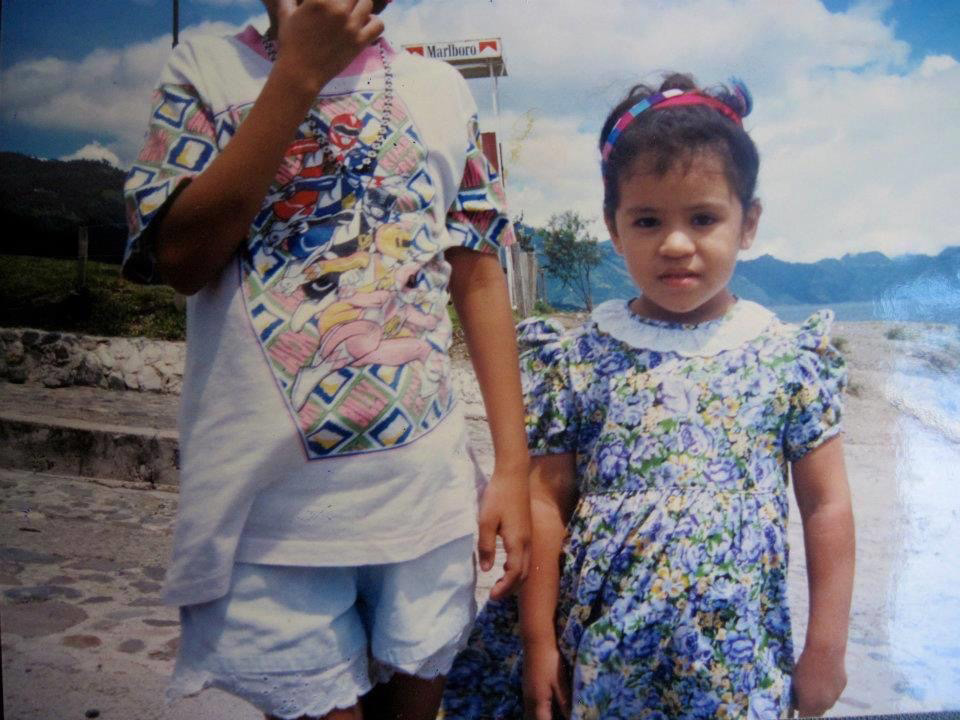
Four-year-old Andrea at the beach at Los Cobanos, El Salvador, with her older sister.
“She was part of the struggle — she got really involved in the guerrilla movements,” says Andrea. “My mom went through a lot — she did not have a partner with her to raise two kids, right after the war. She was really poor, we were really poor.”
Andrea remembers feeling anxious, as a kid — if she was sick, would she be able to get to a doctor?
“Exactly those fears came back to me when I was sick from coronavirus,” says Andrea. “It was good to realize that I had more control over the situation than when I was a kid. And by that, I mean, if I’m feeling hungry, people can bring me food and I can order food. Like, it’s fine, I can do that. But I remember growing up, for some time when I was little, we didn’t always have a meal. That’s something that stays with you in your body.”
Emerging From Isolation, Into An Isolated World
Near the end of March, Andrea texted her housemates, “Y’all have kept me alive this past week. Today is my third fever-free day!”
The next day, she emerged from her room — wearing a mask — and began spending time in shared space again. But it certainly wasn’t a return to normal.

In a still from a video, Andrea teaches her students reading, from afar.
Andrea teaches at a dual-language public charter school in D.C. During a normal workday, she is on her feet, interacting with kids all day — maybe 45 minutes, max, on the computer. Now, she spends much of the day in front of her laptop, recording videos for students, holding classes over Zoom and checking in with kids on FaceTime.
“It’s been a mix of like, connecting with them and just telling them, ‘I miss you, I love you, I’m thinking about you, I miss the class’ — and also trying to teach content.”
Andrea says teaching from afar is frustrating, and she questions whether kids really need academics right now, or just emotional support. “I’m like, ‘Do they really need to know how to write the word ‘gato?’ I don’t know.”
Like a lot of people, Andrea had plans that have been turned upside down. Her plan was to leave her job at the end of the school year, and to leave the country. Her work visa is up in July, and she’s ready for the next adventure.
She and Jake were going to get married, have a big party with friends in Mexico City, then spend a year riding their bikes to the tip of South America. That’s all off the table now.

Andrea’s and Jake’s bikes during a recent ride through Rock Creek Park.
“In terms of future planning, we have no idea,” she says.
They’ve been saving money — originally for the trip to Patagonia. There are all sorts of possibilities now. Maybe they’ll do a shorter bike trip, somewhere in Mexico. Maybe they’ll buy land in El Salvador and start a farm.
“There are just so many ideas, and I keep reminding myself that it’s great. It’s awesome.”
For now, Andrea says she’s OK with all the uncertainty, happy to be healthy and able to get outside for a bike ride through Rock Creek Park on the weekend.
This story originally appeared on WAMU.